28 Years Later: The Bone Temple
"How's that?"

Director Nia DaCosta wastes no time telegraphing her intent to make the latest entry in the 28 Days Later series her own. Despite being penned by Alex Garland, who also wrote the original film and last year's 28 Years Later, The Bone Temple immediately breaks with tradition by opening on contemporary events, rather than an Infected attack at the outset of the outbreak followed by a title card reading "28 years later . . ." To be fair, last summer's entry contained the cold open that would produce Jimmy (Jack O'Connell), and this is a direct sequel, so presumably it was excised to avoid repetition. A good enough idea, sure, but it means the opening title card isn't anchored to anything, and thus reads as an obligation rather than information. Twenty-eight years later from what, exactly? It's not a big flaw, but its incomplete consideration was a harbinger of things to come.
While the timeline picks up right where 28 Years Later left off, the narrative is split into two main focuses across a few characters. On the one hand, you've got the return of Dr. Ian Kelson (Ralph Finnes), who's continuing to work on his ossuary, as well as furthering his relationship with an Infected alpha he's named Samson (Chi Lewis-Parry). Repeated sedation results in the former human developing a chemical dependence on the concoction, which appears to be putting him into a trance with signs of life behind his eyes. Kelson's giddy at the suggestion that the sedative may be inhibiting the infection enough to allow Samson to regain some of his humanity. The implication that the virus may be treatable is as intriguing to the viewers as it is to Kelson. As such, it's a bit disappointing that we spend more time following the sadistic, Satanic Jimmy and his unhinged band of seven Fingers, now that Spike (Alfie Williams) has been inducted into their ranks.
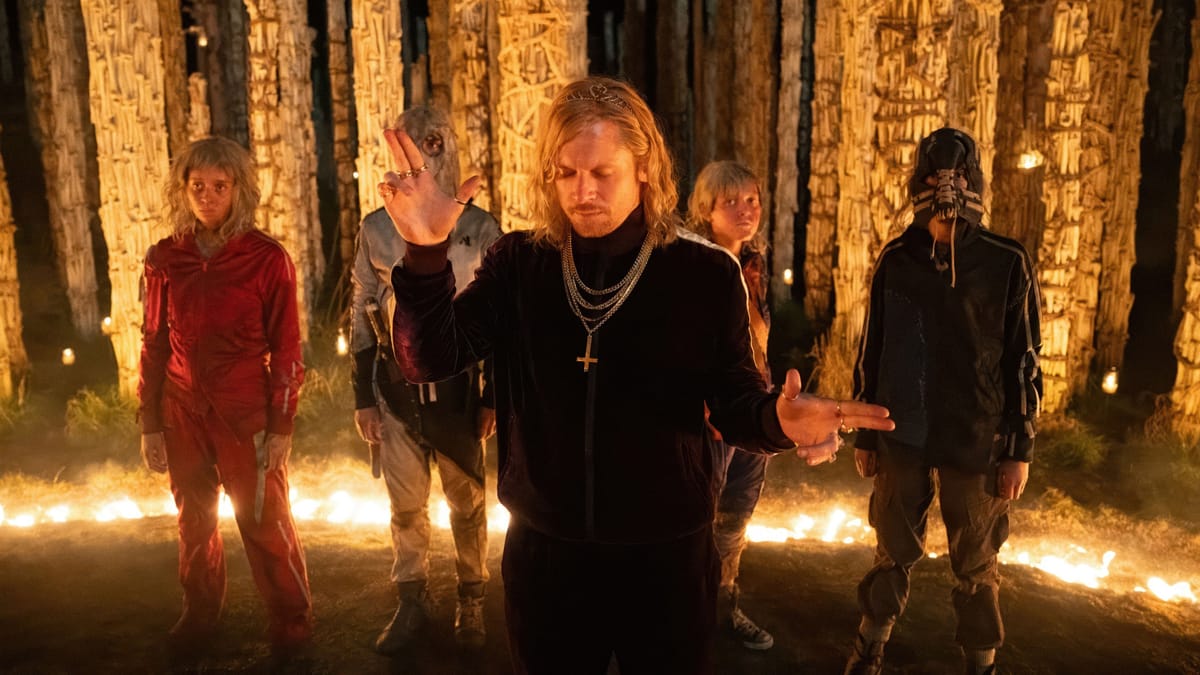
First introduced in the closing moments of 28 Years Later in an immersion breaking scene, Jimmy and the Fingers (who are all also named Jimmy (save for Jemmima (Emma Laird))) are the only new piece of worldbuilding. Intriguingly, it's the first time across the series we see people brutalizing other non-Infected people. Sure, the military massacring innocents in the chaos of 28 Weeks Later is upsetting, but it's not personal. The gang breaking into a small community to avail themselves of their hospitality and supplies, then trussing them up, and subjecting them to a horribly sadistic practice called "Charity", all while laughing as if it's a game, is stomach-turning in a way that the gore and wound covered Infected never were.
It's pretty straightforward what DaCosta is playing at here. While some human populations are descending deeper into the depths of depravity and cruelty, the so-called "monsters" are slowly showing signs of a desire for harmony. It's a demonstration of the ways certain broken people will use disaster as a leverage to accrue power at the expense of everyone and everything around them. Not to mention what skepticism looks like when such a twisted worldview is all you've known: Jimmy Ink (Erin Kellyman) isn't bothered by their actions (indeed, she's one of their most vicious and effective members), but has come to view Jimmy's claims of being the Only Begotten Son of Old Nick as massively suspect. And ultimately, what happens in a place steeped in survivalism when ruthlessness comes up against empathy. While not as satisfying or impactful as the nuanced emotional complexity from Danny Boyle's entry, it's nonetheless a solid throughline over which to play out the narrative.
However, DaCosta undercuts the potential power of her story at every turn with levity. It's not that humor has no place in this world; the very existence and demeanor of the Fingers is a study in how silly does not imply non-threatening. Their strange, childlike demeanor belies their tendency to giggle while dispatching the Infected with ease. Jimmy regales his followers with stories of the "Tele-tummies", to which they listen on tenterhooks, even having heard them many times before. That's all well and good, as it makes for a fascinating and impactful juxtaposition. But too often, jokes are uttered just for the audience to hear. Even more frequently, Jimmy's tendency to bullshit is infused with comedic timing, signalling the audacity and ridiculousness of his lie to us despite his crew not noticing.
More egregious is how Kelson is often a tottering goofball full of quips and stereotypical British humor, undermining the weight previously afforded his character. He spins 80s songs on his hand-cranked record player, and dances with Samson as if they're schoolchildren mocking adults. There is a single scene, a conversation between him and Jimmy, in which enough of their posturing and resignation is peeled back to get at something deeper in their respective souls. But once the two sides of the story fully converge, Kelson's presence is so dressed up in cartoonish theatrics as to preclude emotion, even once the plot quiets down to observe what hath been wrought. That moment of impact is a perfect case study: it's an admittedly kick ass music video for "The Number of the Beast", but the presentation is nonsensical in-universe, it's played for laughs due to its grand spectacle, and it's the most obvious and therefore boring choice of song. Thus, the much more grounded scene that follows tingles with the residue of the prior silliness. DaCosta just cannot figure out how to balance the tones, as her reliance on comedy makes the whole story feel slight, despite the heavier ideas she gestures at.
Most surprisingly, the cinematography is nothing to write home about. The series' identity is tied up in innovative and daring camerawork across a number of dimensions, starting out on a consumer-grade video camera, and reinventing itself less than a year ago on elaborate iPhone rigs. Even within that, Boyle and his cinematographer would find interesting ways to frame shots, utilize unique angles, or make scenes feel otherworldly. None of that ambition or creativity is on display here. Sure, there are some excellently framed shots, a few shots of the Moon over the world that stick in my mind, but that's about it. It's not that it looks bad; the gore looks as good as ever, and the extensive effects work never stands out (save for the CGI fire, which almost no films nail). But it lacks for ambition and creativity, which is a disappointment.
What made 28 Years Later the rare successful legacyquel was its use of the world created by prior entries without much care for the details of their stories. Instead, it focused on making its mark, building out the setting and characters and situation, and separating itself from those earlier efforts while feeling of a lineage with them. The Bone Temple is less content to stand alone, as even its most notable characters seem completely arbitrary if you don't know who Jimmy Savile was, and Spike's presence is as unimportant as it was unavoidable. At the same time, it goes about its business ignoring large swaths of the series' conceit: it's shocking how irrelevant the Infected are (outside Samson, of course). And its one contribution larger than itself is swallowed up by the whirlwind surrounding it.
After all that, the final scene mirrors the approach taken last summer. It's disconnected from the story, because its sole purpose is to tee up the next film. But instead of introducing a bizarre (and questionable) new element, it reaches into the past, counting on nostalgia to pique your interest. It's even accompanied by the iconic theme from the first movie, which was beaten to death in 28 Weeks Later before being deliberately omitted by Boyle. It seems fitting that the first movie to causally refer to the Infected as "zombies" cannot allow its past to die.