Avatar: Fire and Ash
For the first time since the 90s, James Cameron has released two movies in the same decade.

After just one or two production logos, we're hurled into reminders of why the prior two installments in the Avatar series remain the first and third highest grossing films of all time. Brothers Lo'ak (Britain Dalton) and Neteyam (Jamie Flatters) soar high above the world of Pandora on their banshees, hooting and hollering, playfully turning their pleasure ride into a competition. The joy and love between the two boys is palpable, and the reintroduction to the stunning landscape of Pandora, beautiful both in its construction and its rendering, is a reminder that the heavy use of CGI doesn't have to be a bad thing.
Additionally, if you're fortunate enough to catch the movie in 3D (which I highly recommend), this whole section uses a high-frame rate (HFR), rendering the image ultra clear and incredibly smooth. In fact, director James Cameron has said about 40% of the film is presented in 48 fps, which may even be an understatement. Historically, this has been a bad thing: it evokes the feeling of cheap, video-based filmmaking, like a home movie or soap opera. So I was stunned to find that Cameron seems to have cracked the code on making the technology work. Yes, he used it in the prior installment, Avatar: The Way of Water, but only for underwater scenes, so it was less noticeable. This time, there was no hiding it. I'm not going to claim my brain completely accepted it, and it's a little jarring when a single scene shifts between 48 fps and the traditional 24 fps. But when the scene commits fully to the HFR, it looks impeccable, and adds to the feeling that Pandora is a real place, which is even more impressive given that none of it is real.
That opening scene is the perfect microcosm of the newest film, courtesy of how it ends. The boys land, and shortly after, Lo'ak expresses how wonderful it's been to spend time with his brother. It's bittersweet, because assuming you didn't jump into the series with the third movie, you already know Neteyam is dead, so we've watching Lo'ak visit his spirit. The action grinds to a halt, some middling dialog is uttered that rehashes part of what was previously established, and emotional stakes are stated more or less explicitly. The magic is broken, and the concern Cameron has that you don't remember much of what came before shines through. It still looks great; no matter the environment, there's a lush richness to the colors, and a careful consideration to the image composition and settings that transports you across space and time. That's what a budget reported as about $400 million will get you. But the visuals only count for so much in a film that continues the story from the previous, one-hundred and ninety-two minute entry, itself six minutes longer. There are a bunch of threads to pick up, and a handful more new ones to maintain, which precludes any of them from being fleshed out as much as you'd like.
Spider (Jack Champion) is an important part of most events that drive the plot forward, but to call him the protagonist is a stretch, given that he's but a pawn in most of them, and his arc is largely external. The avatar clone of Colonol Miles Quaritch (Stephen Lang) is still the Big Bad, whose primarily objective of capturing ex-Marine and species traitor Jake Sully (Same Worthington) is threatened numerous times by his confusing affection for Spider, the son of the man whose memories he possesses. In the wake of Quaritch's previous assault killing Neteyam and threatening the rest of the Sully clan, Jake and his wife Neytiri (Zoe Saldaña) bicker over pushing Spider out of their family to protect their blood relations. The fraught relationship between Kiri (Sigourney Weaver) and Eywa is brought into sharp relief when Spider's air-tank fails, and the deity's lack of aid forces her to act on intuition, changing his body to both breathe on its own and connect to the natural world through his braid (his kuru). This only frays his relationship with Jake and Neytiri further, as the specter of the Sky People developing the ability to breath Pandoran air is an existential threat to all the Na'vi.
Collectively, they speak to the extreme difficulty humans face retaining their own identity while surviving on this alien world. No matter how much they try to adapt, they will never quite be part of it, nor will their children. It's why the humans who have returned all these years later are even more focused on bending the moon's varied ecosystems to their will. Not to mention the more obvious idea that humanity is incapable of achieving a healthy balance with the natural world, and so must destroy it, even as they are aware of all the beauty they're wrecking, and how unsustainable their actions are. Even Jake struggles with this: for all his accomplishments and dedication, he doesn't quite fit in. His kids have four fingers, he carries around a gun, and he cannot put his trust in Eywa, not fully.
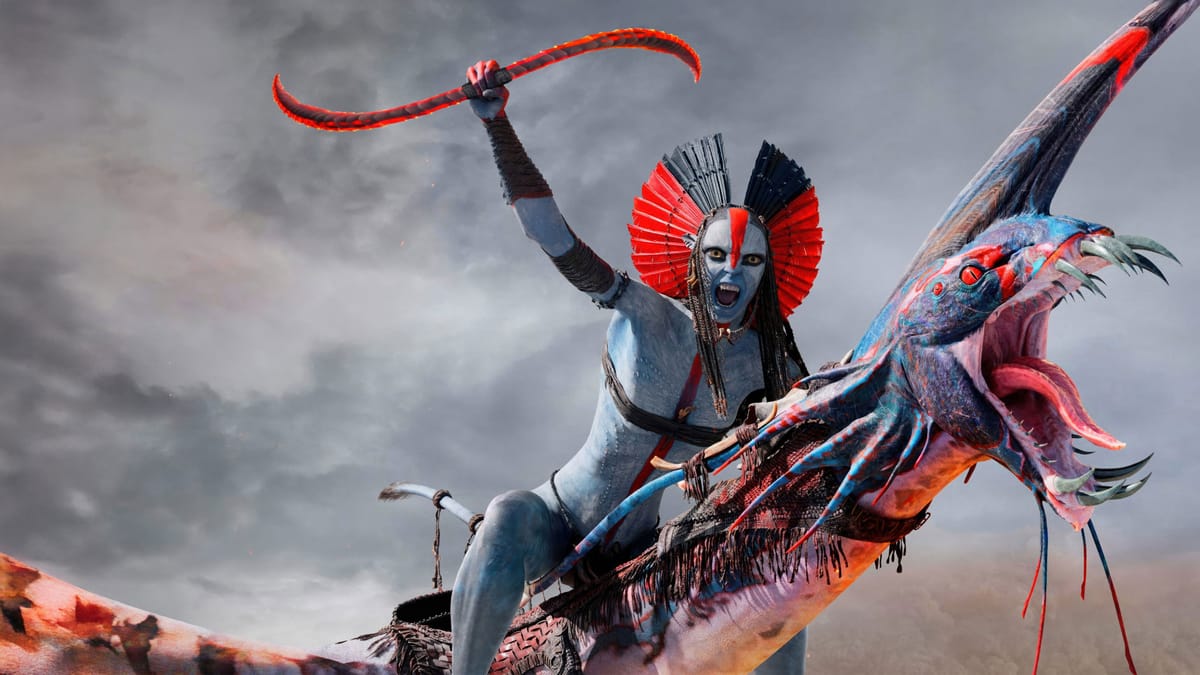
But by far the most interesting new element is the Mangkwan tribe, better known as the Ash people. In stark contrast to the first film's Omatikaya and the second's Metkayina, the Ash people are war-like raiders who pay no mind to Eywa and delight in destruction. We first encounter them attacking a trading vessel containing the Sully clan, which is ultimately how Quaritch hooks up with them. That's also where we meet their ruthless leader Varang (Oona Chaplin), whose fierce desire to protect and provide for her people results in their proactive violence, and lead to an alliance with Quaritch. Even more fascinating are the ways Varang perverts what we've come to see as the natural order of things in this place. Whereas every previous connection of braids has been depicted as an intimate, unifying experience, Varang forcibly connects to her enemies in an uncomfortable act of domination. And although every other clan rejects the use of guns, her and her people eagerly jump at Quaritch's offer to train them. While their founding lore is solid, how their actions support their goals, or even a clear view of what those goals are, is a bit murky. But they're awesome enough that you're unlikely to think too hard about it until reflecting after the film.
Oh, and woven throughout much of this is Lo'ak's distress over the Ancient Ones exiling Pyaykan, and his passionate plea for them to not only let him back into the fold, but to join the defense of their home when Quaritch and the Ash people inevitably lay siege to it.
The number of plot threads and character arcs the audience is being asked to hold on to is a fundamental flaw in the storytelling. Unavoidably, without exception, they are given short shrift. Their volume requires each to endure long stretches without any attention. Some of the new ones feel fairly pointless as a result, and even those that are more central don't so much develop as continue at the same level until a sharp change suddenly occurs. It's most palpable in those that spanned The Way of Water, as by the end of Ash and Fire, we've lived with it in some form for six and a half hours, and yet they contain so few meaningful beats. You're supposed to be moved by the evolution of the relationship between Lo'ak and Jake, and by how much it's informed by the family's grieving, but their contention comes up so rarely it gets lost in the weeds, despite each altercation being quite dramatic and well performed. Same with the complicated bond between Quaritch's clone and Spider. They include some solid (if old) ideas, but the space between them severely waters down their impact. To say nothing of those fall completely flat by the end.
What's maybe more frustrating, however, is how repetitive the plot beats are. So much of what happens directly echoes Avatar and The Way of Water. This time, it's squid lanterns who chase Lo'ak through a reef, nearly causing him to drown before being fished out of the water by a friend. Key child characters are held at knife point, the bonds between parent and child are tested, and Lo'ak continues to be the primary defender of Payakan (although he at least gets the support of some of the other Metkayinan teenagers), complete with re-litigating the socially enforced pacifism of the tulkun. The final hour of the film is another huge battle that largely takes place on the water, including the exact same image of a tulkun breaching on top of a huge Sky Person boat. Admittedly, the fight does evolve in a fresh direction eventually, helping it to end on a high note. But that's one of the shockingly few variations that feel substantial in any way. Most are so slight that they fail to develop any idea, and just mark the forward march of time: Quaritch pushing back on General Ardmore (Edie Falco), Lo'ak having won over the tulkun, Jake's resistance to becoming Toruk Makto again. There are some neat bits, but they only effect the plot in superficial ways. The Windtraders are a great example, as they're involved so briefly as to feel like a contrivance, even as their existence tells us a lot about the world Cameron has built.
Speaking of the worldbuilding, its's as excellent as ever. Some of the new pieces are goofy (we sort of see Eywa?), but the richness of Pandora has always been one of the series' main draws. All the creatures and their relationships get deeper, we see civilians on the human base for the first time (whipping out their futuristic "cell phones" to record a shocking sight), and we learn that they have hallucinogenics, which are utilized by Varang in some sort of spiritual/mating ceremony, resulting in the best looking sequence of the film as as Quaritch trips out of his mind.
Fire and Ash is the perfect demonstration that time is one of the most crucial ingredients for a successful Avatar film. The technology needs to develop such that it can show us something we've never seen before, and we need to forget what it's like for big budget spectacle to push the limits of what's possible. Because as is, it suffers from the same problem as any pair of movies that began as one but was split due to bloat. Much of the first chunk (an hour, in this case) driven by reminding you what happened last time. Many scenes and sequences feeling incredibly drawn out. And the narrative feels limited by the rules of the prior films.
Cameron clearly isn't out of ideas. Having only scratched the surface of some ideas, there's plenty of room for him to explore more deeply. Indeed, there are supposedly two more Avatars on the way in 2029 and 2031 (although who knows if they'll happen). However, given the overall weaknesses of the screenplay in all three, I think we'd all be better served by him waiting until he and his team are able to develop some new, impressive tech that compliments the story before he next revisits his playground. If that means waiting another ten years for the next installment, then so be it.