Blue Heron

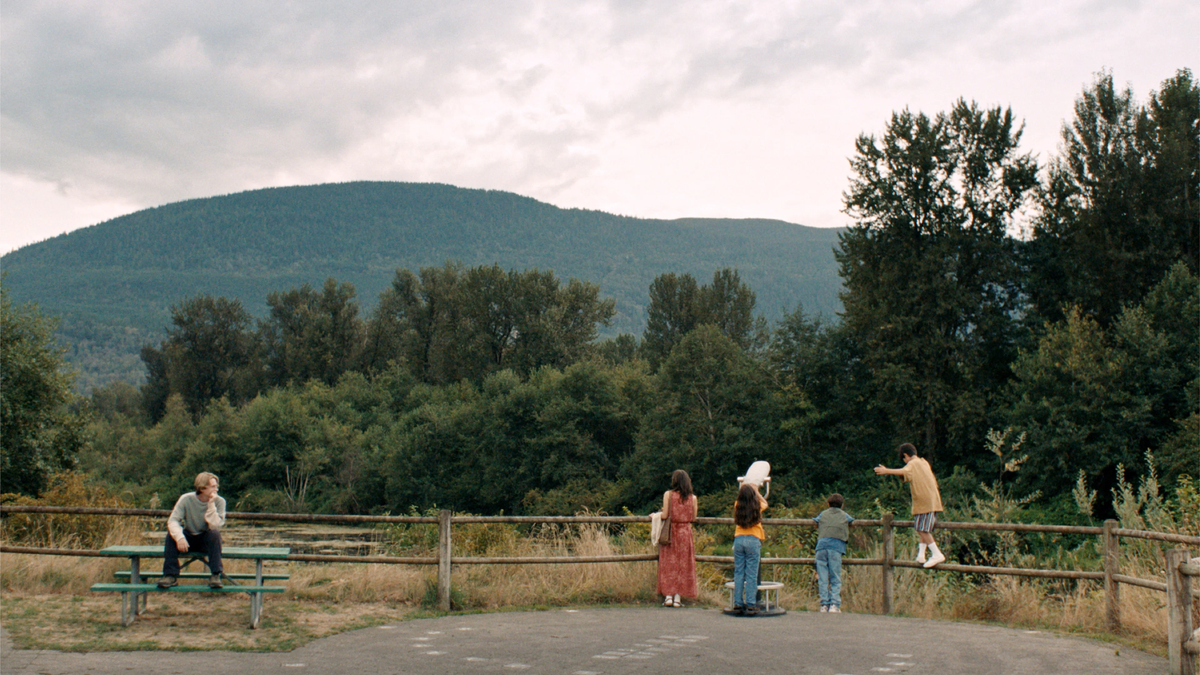
For the first chunk of Sophy Romvari's semi-autobiographical debut feature, it's not entirely clear what shape the story will take. It's introduced by a woman filming a cute seaside town, with a line or two of voice-over (presumably spoken by her) indicating that in the twenty years since, the thing she most remembers about him are the maps he drew. Who "he" is, we're not privy to right away. Instead, we jump into the life of a Hungarian family recently relocated to Canada, with the understanding this is her family. Our perspective is that of eight-year-old Sasha (Eylul Guven) as we spend time with them, taking in what it's like being a child in this environment, and hunt for what specifically the opening line was alluding to. All the while, we're getting to know her rambunctious brothers Henry and Felix (Liam Serg and Preston Drabble), her detached but sweet father (Ádám Tompa), and her loving but exhausted mother (Iringó Réti).
Then, there's Jeremy (Edik Beddoes), the oldest brother by far, although still a teenager who laments being too young to drive. He seems to be a stereotypical teenage boy, relatably aloof, lazing about and uninterested in spending time with his family, although he seems to be great with his brothers when he cares to take an interest. But slowly, this starts to shift. We start to detect concern from his parents about his behavior. There are allusions to him "acting out". But the first concrete sign we actually see that there's something more going on than normal teenage malaise is when he's returned home by some of the boys in blue in handcuffs for shoplifting.
That may sound like a miserabilist portrait of a boy in crisis, but Romvari's insistence on centering the family means there are many moments of joy and warmth, even involving Jeremy. He's not a constant problem, nor a constant threat. Rather, his erratic behavior more often manifests as isolating himself from the family, occasionally engaging in risky behavior that freaks everyone out when it's discovered. The juxtaposition renders him a full person from the outside, keeping him at a distance while allowing our heart to reach out to him, despite the impossibility of ever crossing that gulf.
The family's perspective is centered from start to finish, with a special focus on Sasha's perception, making it all the more compelling. The slow build in his behavior mostly happens away from home, so we don't see it at first, just hear occasional mentions of it. When the bubble is broken at home, this focus becomes more concrete: we never see the officers' faces, just that of their father talking to them, and Jeremy's stoic face through the porch trellis, as if we're watching through Sasha's eyes. It's a powerful moment that portends a shift, both in Sasha's understanding of her brother, and in our own.
Thus, we experience a family member in quiet crisis from the (limited) perspective of their youngest sibling, ever-worsening while staunchly resisting any attempts at connection, not that his parents know what to do. He's tight-lipped throughout, ensuring we have no insight into what he's going through. That's just how he'd like it, as one of the few times his father tries to ask him what's going on, he starts shoving and throwing things, before succumbing to a bear hug. The only arc to his behavior is its exacerbation, and its rationale will be forever unknown to all.
As viscerally and intensely realized as all of that is, pointing towards excellent performances from all involved (especially Beddoes and Réti), what makes Blue Heron a special film is how it morphs in the final section into a piece about memory and reckoning with the past on multiple levels. How that's a task for organizations as well as for individuals, and the ways those two can bleed together. The complication of trying to reach someone determined to not be reached, and how failure to do so is not personal, even as it unavoidably feels like it is. There's a lyrical and heartbreaking beauty to Romvari's visitations of the past as a place where we preserve our loved ones as we choose to see them, with the reality of their modern-day pain present only in a basic form before it had chance to grow, evoking the wondrous magical realism of All of Us Strangers while keeping her confrontation much quieter and more internal.
The combined effect puts us back in our own lives, reconsidering the fundamental trouble of knowing anyone, even those we supposedly know best. That reaching out for help may prove frustrating and ineffective, but that in concert with trying your damndest to not give up, it remains an important part of expressing your love. That admitting defeat is an important part of self-awareness, and is not the same as giving up. That facing failure is as important as processing grief, as either can turn you inward and destroy you. That we all deal with our past in our own way, sometimes directly, sometimes by fumbling around for meaning and deeper insight that may not ever come. And through it all, those complicated memories remain, the impact left by all those who've touched us remains, and we can visit them any time, even if doing so is painful.