Buddy
"Of course I'm scared. You have to be scared to be brave."

Casper Kelly has long explored what happens when people find themselves trapped in prisons constructed from pop culture tropes taken to the extreme and the absurd. After a bunch of television writing and creating a couple of TV shows (some more successful than others, despite my fond memories), it was that formula that catapulted him into internet immortality. Too Many Cooks was part of Adult Swim's Infomercials block before going viral online, and portrays a sitcom intro of the 90s' favorite style: bouncy music with repetitious lyrics and torturing the "metaphor" of the show's title, where each actor is introduced doing something that defines their character before smiling and looking straight to camera as their name appears. But what if it was endless (i.e. eleven minutes long), and what if some undesirable element got in and used their freedom from the rules to terrorize the characters? It was clever and knowing and pretty funny, even as it hinted at Kelly's tendency to stray from his own premise. In making his first feature film, 2022's the direct-to-television Adult Swim Yule Log, he gave over fully to that anxiety, and the film was worse for it. His follow-up sequel (Branchin' Out) also failed to find the balance, raising questions about how well-suited his style is to feature-length storytelling.
Fortunately, in his first theatrical release, those concerns didn't quite come to pass. Yes, there's a distinctly out of place middle chunk of Buddy that weakly attempts explain what's going on, failing in its attempt to deepen the horror, and landing as a distraction instead. It's easily the least interesting part of the film, despite including a low-key but amusing performance from Topher Grace as a suburban dad. It was also the most didactic, nearly screaming at you about the problems with letting the TV raise your kids, and how devices are an easy escape from reality. Presumably, it was the only way Kelly and casting directors Chelsea Ellis Bloch & Marisol Roncali could convince Cristin Milioti to join, since she plays an important but minor role in the rest of the film as Nurse Grace. But it's a break in format that dilutes the terror by giving a window into what's going on outside.
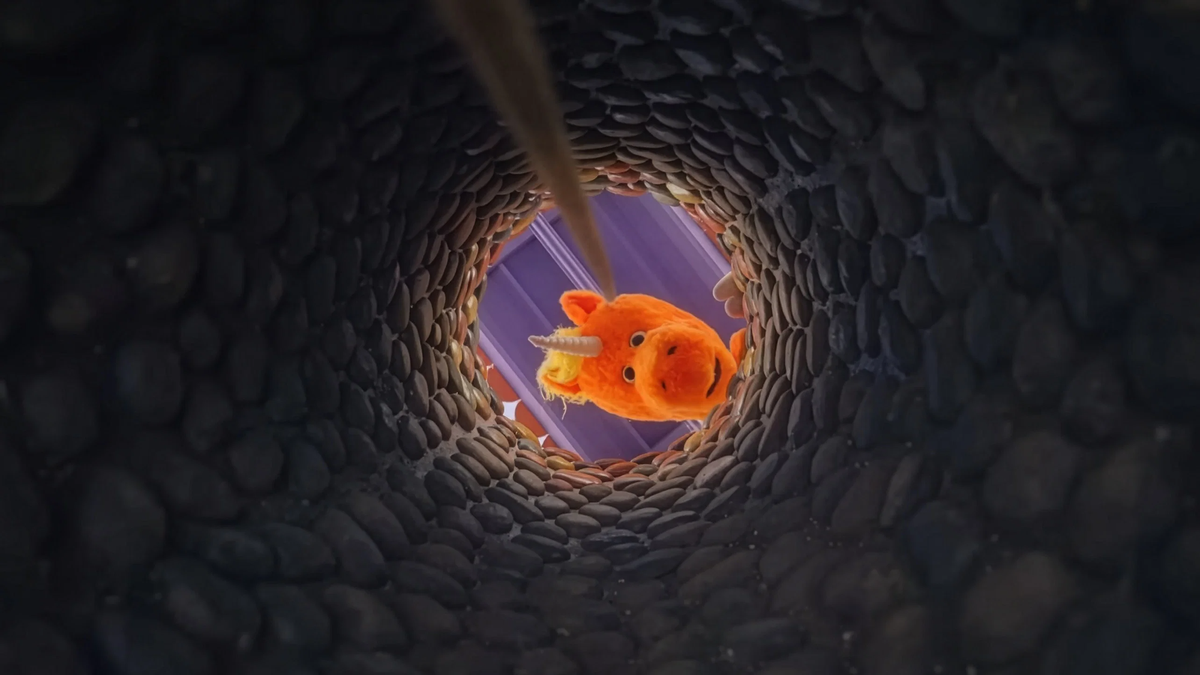
Most of its runtime is spent inside the fictional TV show It's Buddy, a combination of Barney & Friends and Pee Wee's Playhouse, with Eric Bauza voicing many of the inanimate objects, and an oversized, bright orange, bipedal unicorn as Buddy (voiced by Keegan-Michael Key, with Sergey Zhuravsky in the suit). We sit in that familiar milieu for just a bit, the humor coming from just how earnestly it's played, before cracks begin to show, and the register shifts into the surreal dread of Don't Hug Me I'm Scared. Whereas Wade (Caleb Williams) is excited about the dance party to be held later, and Freddy (Delaney Quinn) is insecure about her moves, Josh (Luke Speakman) simply wants to be left alone to read Wrinkles in Reality. Unable to cope with disinterest, Buddy gets more and more insistent, until by the end of the episode, Josh is conspicuously absent. The next episode starts immediately (albeit after a glitch shows us a patch of blue sky), and he's been replaced by the far more cooperative Hannah (Madison Polan). Buddy's disturbing behavior continues, becoming more and more visible and violent until the kids break out of their micro-world and go on a Wizard of Oz inspired journey.
As in Kelly's prior works, the horror is never really scary, nor is it designed to be. Instead, the sheer brutality and shocking contrast of the benign surroundings and supporting cast is meant to unsettle you, to dig under your skin as you contemplate the darkness underlying the mundane. As such, its effectiveness is questionable, as thinking something would be upsetting is far less powerful than actually inducing that feeling. A few moments of violence extruded an exclamation from me, as they came strongly juxtaposed with iconography of candy-coated children's shows. Memorable as they are, given that the movie more-or-less began with the implication that Buddy murdered a child off-screen during an episode, it's hard to say they raised the stakes.
That same use of clashing tones proved quite valuable for the comedy, however. Instead of deploying obvious jokes in the dialog, it emerges more naturally from the bizarre scenarios and regurgitating the style of children's shows of the 90s, embraced so purely as to make its real-life counterparts look nuanced. As it shifts into horror, the movie sometimes forgets to be funny for stretches, but it always recovers with a jolt, such as when they encounter fellow wanderers Willie and George (Michael Shannon and Clint Howard), a talkative and independent marionette and his human (lover?). Fortunately, Freddy is always accompanied by her trusty backpack Strappy (Patton Oswalt), providing small injections of humor by remaining a true children's show character throughout (well, save for one key moment where he plays the hero).
The story is primarily about the loss of innocence as the children venture outside the comfortable walls of their home and their upbringing, confronted with the terror and disappointment of the real world where they must band together to fend for themselves. While not particularly original in conception, its depiction is quite unique. To wit, I did not expect the finale to owe so much to Shin Godzilla, despite the film's frequent signals of a deeper evil at work in Buddy. The stakes are kept high and thrilling throughout as actions have consequences (good and bad), and you're given ample time to stop and consider the extra levels of messed up it is that it's all happening to kids who can't be older than ten.
As with all of Kelly's projects, that framework eventually decays into hopelessness and ends with a bleak rug-pull, but it feels even more at odds with all that came before due to its sharp aim at kids shows of the recent past. Kelly enjoys punishing his characters, deserving or not, forcing you to reckon with the boundaries of your own enjoyment. But given the element of magic, and the obvious build-up that gives you plenty of time to root for the opposite, its conclusion reflects more strongly on the screenwriters than it does the audience.