Carolina Caroline
"How do you tell if you're good people pretending to be bad, or just bad people pretending to be good?"

It didn't used to be that so many movies began with their ending.
Not that it's a new phenomenon. Citizen Kane and Sunset Boulevard are two of the most famous and effective examples. Fight Club used it to quickly establish the characters before spending two hours tearing apart their relationship. The opening scene of Eternal Sunshine of the Spotless Mind means something completely different on its second occurrence. When wielded deliberately, it's an incredibly effective tool for directing the audience's attention. But too often in modern films, they're the equivalent of a pre-roll ad, something that tells you exactly where the story is going long before we get there. It becomes a device that greatly reduces the stakes. Have a scene where the protagonist's life is in danger? It will fall flat on its face if you began the movie by telling us they'll pull through.
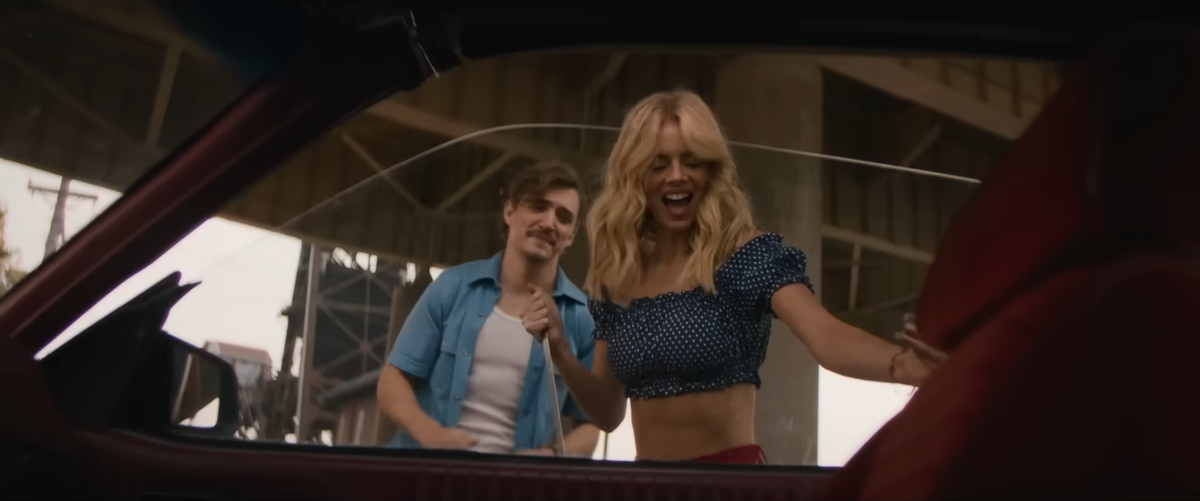
So even as Caroline (Samara Weaving) gets more and more wrapped up in escalating cons with drifter Oliver (Kyle Gallner), as the house of cards inevitably falls down around them and the cops close in, we're never for a moment worried about her safety. We're not even thinking too much about how she'll eventually be caught; three months after our story begins, she's walking free. In disguise, indicating she's on the lam, so at most she was caught and then escaped. If anything, we're meant to wonder what happened to Oliver, as he remains unseen while she hijacks a dude's pickup at gunpoint and runs a series of quick short change scams.
They initially hook up when he rolls through her Texas town in the early 90s1 and successfully runs that same scam on her daddy's gas station. But she's the only person in the entire southern US who notices, and when she runs out to confront him, she's far more intrigued by this man who just (gasp!) lied than she is mad. They begin spending time together, and before you know it, director Adam Carter Rehmeier wants to make sure you know he's seen Thelma and Louise and Badlands and Bonnie and Clyde. But given his star is a bombshell, her seeming naivete is paired with a girl next door meets southern belle aesthetic, and a eager forwardness regarding sex. She rarely misses an opportunity to celebrate a successful grift by throwing herself at Oliver and taking her clothes off, starting with their first date where she suddenly, wordlessly strips in the middle of the road before jumping off a cliff into the lake below.
Given Oliver's monologue about conning being all about directing people's behavior through distraction, it's absolutely baffling that her sex appeal is never once turned on their marks. The implication is that it's Rehmeier who's getting one over on us, hoping that if you're taken by her appearance, you'll overlook the thin plot and the protagonists' lack of motivation or goals. At least she has a passing interest in meeting her mother (Kyra Sedgwick), directing their meandering travels in the general direction of South Carolina. He's just a manic pixie dream dude, a criminal who seems to have no motivating factor, not even pulling off the next con. He talks about how what he does doesn't hurt nobody, so he don't feel bad, implying he's just conning to get by despite also calling it his job. he expressed no ambitions to do anything with the scratch he accrues, fun or otherwise. In fact, the only reason they go after bigger and bigger fish is her near-sexual excitement over the prospect, demanded while she's essentially mid-orgasm.
As a result, the narrative feels surprisingly light and airy, even as the screws begin to tighten and consequences rear their heads. The beats you're familiar with come in more-or-less the way you'd expect, with no punk rock edge or primal scream or bigger purpose of any kind. Gallner and Weaving have chemistry, and the editing injects a certain amount of energy into the plot, but there's only a limited amount of fun to be had, especially once she starts showing signs of compunction. Gallner continues to limit himself to roles where his faux-hawk-meets-mullet makes any sense, and although Weaving isn't playing against type either, she displays a bit more dynamism in a part which doesn't ask much of her.
The most fascinating piece of all of this is Rehmeier himself, whose career has often felt like searching for how to commercialize his less mainstream sensibilities. His debut was infamous torture porn flick The Bunny Game, one of just a few films banned in the UK since 2010. Though Carolina Caroline has nothing in common with that experiment, you can feel his attempt to figure out how to tell a story while continuing to reject society, a project he began (with far less polish) in 2020's Dinner in America. Although it should be noted that this is the first of his films on which he doesn't have a writing credit, so while he certainly had a hand in further grounding his characters and sanding down their politics, it's hard to know how much was on the page. What is for sure is that this film is far less angry, maybe moderated by his intervening experience making Snack Shack, a sweet but rude coming of age tale that's about as far away from his other output as possible.
When Carolina Caroline finally circles back around to the beginning, little has changed. We've learned this woman's backstory, but we've no reason to feel any differently about her or what she does, as it all stems from self-inflicted desperation. The screenplay desperately wants us to feel sympathy for her, as seen in the sole recontextualized detail. But it's a cheap trick easily seen through on the way to a drawn out, listless ending with one of the most frustratingly hollow final lines I've ever seen. There's something to be gained from modern buddy crime flicks, to be sure. But not all that much of it can be found here.
The exact time period isn't clear. There are pay phones everywhere, gas costs less than $1.50/gallon, and there are no "modern" cars. So it could be earlier, but one (untrustrworthy) character who visits a bar claims to have been born in 1970. The key point, though, is that there's not a single security camera in sight.↩