Coyote vs. Acme
"That's what we do. We settle."

Following its debt-laden merger with Discovery, the first major flash point in the industry's relationship with Warner Bros. and its then-new CEO David Zaslav came in 2023, when they cancelled three movies simply to save some cash. It's cold comfort that Batgirl and Scoob! Holiday Haunt were "only" ninety percent done (they still needed some post-production work), but most egregious was the announcement that Coyote vs. Acme, a fully finished film that received positive response in test screenings, was being shelved as a tax write-off. Outrage from all parts of Hollywood and the internet (and the film's blindsided cast) ensued, and through much pulling of teeth and false-starts and a couple years, Ketchup Entertainment took a hair dryer to Zaslav's heart; by early 2025, they'd done the improbable, and liberated Coyote vs. Acme.
Which makes it frustrating that WB's branding remains front and center, on a labor of love that the current regime cares so little about and for which they deserve no credit. The only signs of the struggle are Ketchup's logo at the end of the end credits, and a message just before it: “Dedicated to everyone who posted, shared, held up signs and spoke out when it counted. This film made it to the big screen because of you.”
We live in an era during which companies routinely bury movies and TV shows, and even rip them away from "buyers". Streamers lock them into an ephemeral existence exclusive to their walled gardens: Netflix is famous for it, and Apple's even more aggressive approach means 2021 Best Picture winner CODA just broke free last year. These companies have little interest in stewardship, viewing the resulting art as collateral on the way to acquiring the public's money. Thus, any restoration of the public's ability to view a previously inaccessible piece of art should be celebrated, no matter the quality.
Fortunately, this instance is pretty good.
There's nothing particularly novel about the premise, as entertaining as it is. After decades of futile efforts to capture the Road Runner using comedically malfunctioning products from ACME Inc., the hapless Wile E. Coyote happens to spy an ad from local (human) attorney Kevin Avery (Will Forte) in the familiar format of a personal injury lawyer: your (cartoon) injury is not your fault, and he can get you a settlement. Avery has long since become disillusioned and disinterested, keeping his office small and disorganized as he fires off tort claims. He's resigned to living in the shadow of his former classmate and ACME's head counsel, Buddy Crane (John Cena), an inverted triangle of a man with the smile to match. Despite trying to brush off Mr. Coyote's insistence on holding ACME to account for the mountain of pain they've caused, some cartoon trickery lands it on Avery's desk anyways. Mr. Coyote's relentless trickery forces it to trial, despite the offer of the biggest payout Avery has ever seen by a country mile, when Crane clarifies that the settlement is in no way an admission of wrongdoing.
What follows from there is the broad strokes of any such David and Goliath legal story. Shady attempts to "inconvenience" witnesses and the prosecution, from people clearly associated with the defendant. Meetings in the middle of the desert. A sudden phone call from an anonymous figure who inexplicably has a bunch of insider information, leading to a clandestine meeting in an off-beat location, where their visage means a lot more to the audience than it does the protagonists. One of the key dynamics is slightly tweaked in a late reveal that remains unsurprising, and manages to draw comparisons to The Dark Knight, sure. But there isn't all that much here that will catch you off guard.
However, an insistence on novel "story" would be a bizarre demand of Looney Toons. A bunch of bombastically slapstick shorts featuring recurring characters often breaking the fourth wall and always breaking reality, sometimes crashing through the screen into "our world", doesn't exactly set the tone for deep introspection. I'm doubtful it would work if they tried. No, for the plot, it just needs hit those beats well-enough to keep us engaged, which it absolutely does. Few flourishes, but few mistakes.
As such, its success hinges on the comedy, which is excellent. Its extensions of certain Looney Toons tropes is delightful, from Buddy unconsciously parroting Tweetie's (Eric Bauza) speech patterns, to Wile E. Coyote's limited number of signs, to his employment of ever-increasing Rube Goldberg-inspired traps, including possibly his grandest and most clever one (which, of course, misfires). While the assistance Avery receives from the firm's other partners has zero impact on the plot, to lose the perfectly deadpan monotone of Dottie Jones (Martha Kelly) would be tragic, as her every delivery is gold. That's not to denigrate the performance of Tone Bell as Sal Maltese, or Lana Condor as Avery's niece and intern Paige, an endlessly optimistic and unjaded force pushing back against Avery's cynical worldview. It's just that neither is able to elevate their characters past their weak and largely inconsequential writing.
But the chief human actors hurl themselves into their roles with aplomb, playing to their exaggerated co-stars quite capably. None is quite so successful as Cena, whose history as a professional wrestler allows him to play to the cheap seats without breaking a sweat. Forte has an actual (albeit small) arc, so he's a bit more muted, but he manages to play the sad sack bigger than expected, which fits in pretty well. And P. J. Byrne does an excellent job slithering around by Buddy's side as his toady, somewhat seeming to be from another movie, but it's a good one, so it works out.
Whereas The Day the Earth Blew Up contained barely any of the classic Looney Toons apart from its two leads, Coyote vs. Acme goes out of its way to pull in as many as possible (most impressively and impeccably voiced by Bauza). Of course, the courtroom setting provides ample opportunity to fill the frame with faces between the spectators and the jury. They use their opportunities well, although you could see them pushing the witness stand a bit harder to squeeze in a few more speaking roles. Still, it's hard to complain when they find an excuse to have the Tazmanian Devil (Jim Cummings) tear apart the courtroom. And there are a few inspired choices, my favorite being Foghorn Leghorn as ACME CEO, a Steve Jobs/Jeff Bezos type, introduced at an event styled after an Apple product launch.
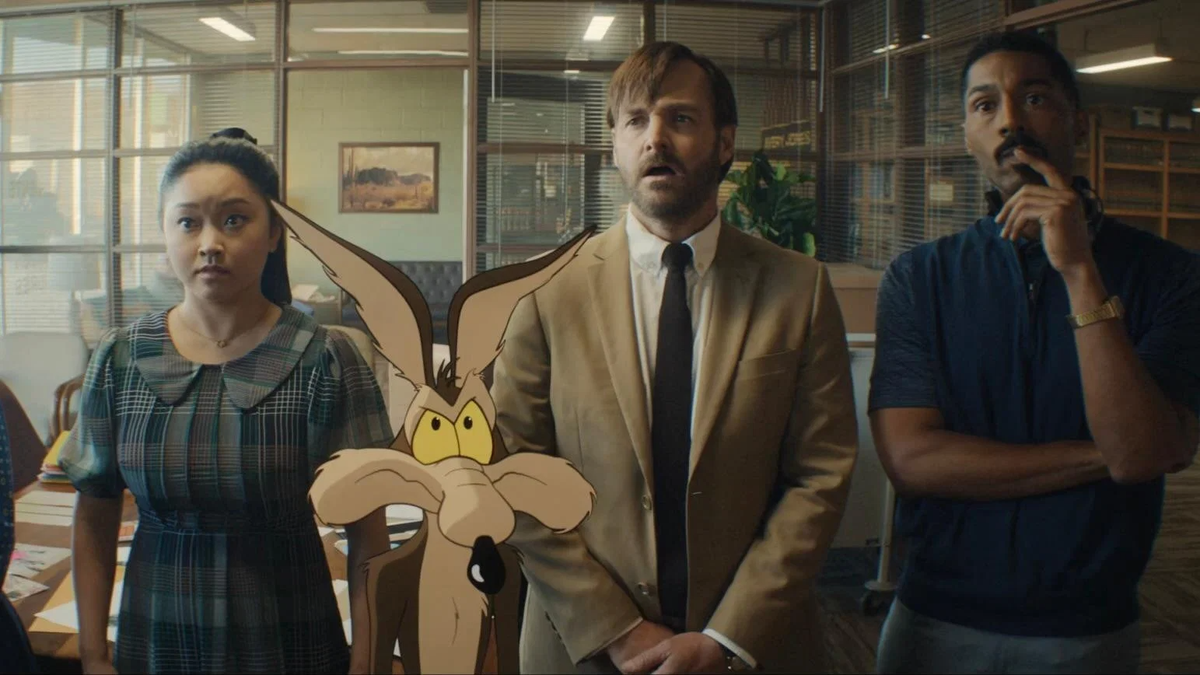
It does carry forward the slick, modern, digital animation from that earlier film, which stands out even more when put against a live-action backdrop. The mere fact of mixing live-action and animation is no longer impressive, and while it's certainly well done, their crispness clashes hard with the real world. At least Who Framed Roger Rabbit? could lean on the 'Toons being from another realm to smooth over any unevenness (not that they needed to). Here, they're just a regular part of the world, so their resting in front of it is even more jarring.
In any case, if you'd told me just a few years ago that the Looney Toons would be having a moment right now, I'd never have believed you. Sure, even as the original show fell out of rotation and kids stopped watching it, the characters and iconography have remained as popular as ever. But Warner Bros. has proven unable to properly revive them, throwing show after show at the wall, with none of them attaining any level of cultural cachet. While the jury remains out on what two reasonably successful movies in as many years means for the future of the characters, at least for now, it's thrust them back into the limelight in a way they haven't been since the original Space Jam. It's a testament to the power of the movie theater to make the experience something special, as further demonstrated by just how many families made the trip for an early screening on a stormy Sunday afternoon. It was a beautiful opportunity for multiple generations to share in the entertainment of their childhoods, without distraction. Given how rarely I heard the sounds of restless children, it would seem the youngest generation was as taken with it I was.