Digger
"Be truthful. Be free. Be happy."

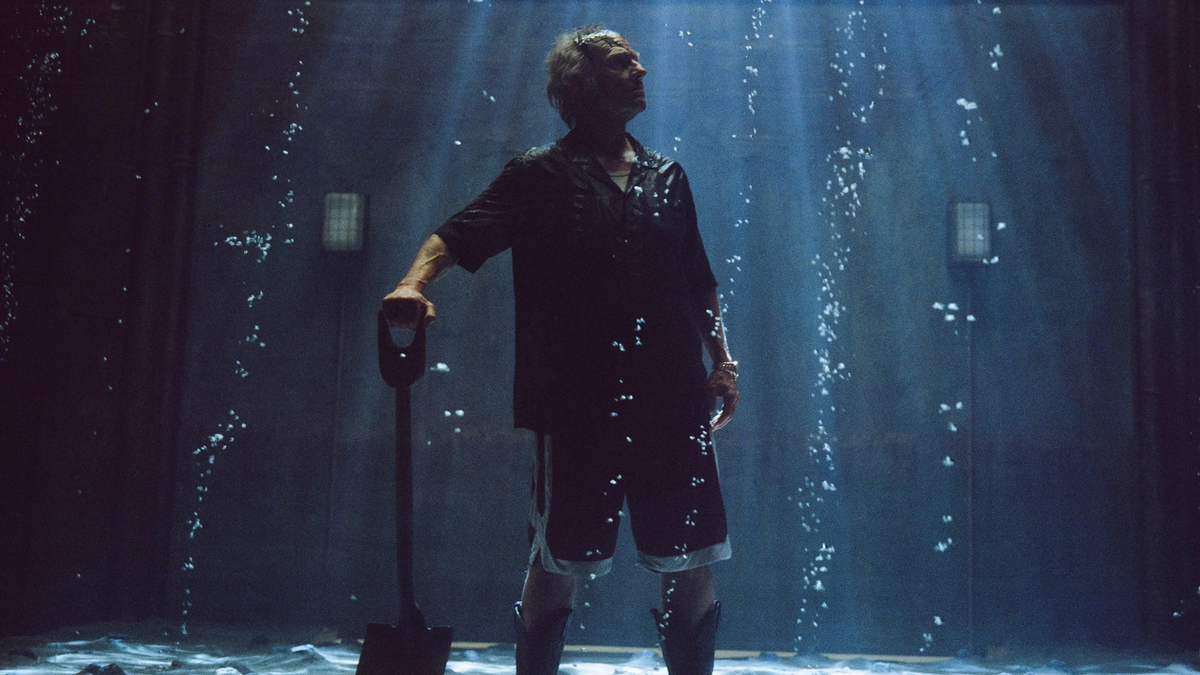
The first trailer for Digger made its public debut in front of the May re-release of Top Gun. Remarkably, there was zero indication of what we were looking at for the first two and a half minutes. Instead, it was simply a highlight reel from the storied career of Tom Cruise, focused on iconic lines and a spate of spectacle and his charming, toothy smile. Only then did it drop into a couple short clips of the film, not enough to tell us much about it (this was a teaser, despite its length), but enough to learn that Cruise would be playing a older oilman under a bunch of makeup and prosthetics, boisterous and brash and with a thick Texas drawl. That was all we'd see for a few months, sparking speculation that distributor Warner Bros. had concerns with the new film from Mexican auteur and two time Best Director winner, Alejandro G. Iñárritu. The eventual full trailer told us similarly little about the plot, but at least we got a broader sense of what to expect.
What's surprising is that the teaser was the more accurate and revealing one, at least structurally. It was a welcome shift, for as the rhythms of the plot settled in, all I could think was "...is this it?". Thankfully, the answer was no. About thirty minutes into its one-hundred and twenty-ish minute runtime, the Earth is ripped out from under us and our sense of what we're watching flips on its head. It takes a moment for your eyes to adjust to the light, but when the dust settles, there has been a profound impact on our understanding of the events thus far. Maybe more fascinating, however, is how quickly we return to what came before, our revised understand hovering in the back of our mind. It doesn't come up again for another twenty minutes or so, by which point you're desperately curious about what's going on, and what it all means. So goes the rest of the film, although once we enter the late-breaking third act, the initially established order is never allowed to continue unblemished for long. As we jerkily step towards the end, Iñárritu finally reveals his hand in full, gracing us with its best scene, in which the sparsely used Jesse Plemons is steps out of the shadows and wonderfully reorients the room yet again.
A movie as deeply predicated on the unknown as this, that asks us to blindly give ourselves over to the director's vision, requires such oblique allusions to preserve its magic trick. That's not to say its effect will dissipate once you know what it's doing. Rather, by viewing it once without fully understanding what you're getting yourself into, you'll be better equipped to evaluate how much it amplifies (or detracts from) the ultimate story the second time through.
Digger Rockwell (Cruise) is an aging oil tycoon whose family business has spent decades plundering the Earth's resources and becoming obscenely wealthy. His reckless disregard for the planet has finally caught up to him, in the shape of "Judy", a huge piece of Greenland that's broken off and is heading towards the European coast, endangering the lives of millions. His head of environmental safety, Dr. Ganesh (Riz Ahmed), desperately tries to impress upon him and the administration of President Compson (John Goodman), whose deference to the arch capitalist is screamed at us by their assembly in Digger's home, the seriousness of the situation. Of course, all Digger is concerned with is how to paint America (and his oil platforms) as the good guys, how to control the narrative, despite requiring denying they knew anything and neglecting to aletr Europe. And as we see in Cruise's later bravura acting centerpiece, a meeting of international powers that sits at the midpoint of Roy Andersson and Ruben Östlund, he is the king of bluster, slamming in their faces how much they all need him mere hours after his negligence killed so many of their citizens.
What adds to the surreal experience of Digger is how flat most of its attempts at humor fall. The jokes keep coming, from a creepy animatronic cat on death's door to the President's every absurdly strained and shouted word to naming an ice shelf "Judy" (and later "Kimberly"), but the laughs are few and far between. About the time of an incredibly forced and poorly executed joke about the lack of women in Compson's government, followed by so much obnoxious laughter that even Austin Powers would roll his eyes, it becomes clear that's at least partially intentional. On the one hand, it's an annoying cop out, an insecure escape hatch with which to deflect critique. On the other, it certainly ensures we hate everybody there, Digger included. Its deliberate clunkiness makes you think more deeply about what's going on, a risky proposition when what you'll find isn't all that profound, all while sacrificing the more immediate experience. While there's certainly some effective humor, it never earns its tagline: "A comedy of catastrophic proportions."
However, the performances partially compensate. Chief among them, Cruise, emerging from a twenty year run of only playing "charming action guy who runs a lot" to embody the most exhausting man alive. He hurls himself into this outsized, goofy villain, even managing to capture some pathos when the plot allows him to shift gears. He's most often playing off Ahmed, who wonderfully captures how no fiber of Ganesh's being belongs amongst these indifferent sharks. Ganesh is jumpy and frequently in a daze, stunned by the actions the super powerful consider normal. Cruise's other consistent screen partner is Goodman, playing the most cartoonishly realized character in a movie full of cartoon characters. His every line delivery is fantastic, the muscles of his gaunt neck bulging, the camera always peering up at him from below, the domineering position in which it places him clashing with his sickly physical appearance. With the exception of Plemons's sporadic, brief appearances, Goodman gets the most consistent laughs throughout.
Additionally, the film looks fantastic. The previous comparison to Andersson is born as much from its faded diorama aesthetic as from its contents. Digger's maroon suit pops off the screen as he castigates government officials for their lack of faith, weaving between their dull pastels that blend into the drab, gray walls. Legendary cinematographer and frequent Iñárritu collaborator Emmanuel Lubezki shoots the hell out of every moment. All of the best parts of Birdman's aggressive camerawork have long since been tamed into an impressive array of techniques. Longer takes to enhance the tension, looking up at these buffoons to emphasize their the oppressive power they wield (or to undermine it via contrast with the jaunty, quirky score), the camera often moving on a swivel to take in the whole scene before moving to follow the action. And as is Iñárritu's trademark at this point, it's mostly shot on a gently wide angle lens, whose presence becomes unmistakable in the many close ups, its warping of reality an obvious but effective mirror of how every character sees the world.
The narrative is pulling us in multiple directions, calling into question just how much Iñárritu actually has to say about our current climate situation, and even how committed to the satire he is. Each one feels like filler, a bridge until he can talk a little more about faith. Not necessarily religious faith, although the presence of Reverend Moore (Stephen Wight) in Compson's government points a finger at the modern disregard for the separation of church and state. Rather, trusting others to have our best interest at heart, or at least to not be lying to us. Digger's problems are exacerbated by his disregard of what his scientists are telling him. His daughter's (Sandra Hüller) company is in trouble because she never believed her father would sell them out. Dr. Ganesh thought presenting the facts to the world's leaders would prepare them to act, not soften them up to applaud Digger's sociopathy. It's notable that the only people whose faith is rewarded are the wealthy, calling out the way the world is oriented to best serve their interests, and continuing the anti-capitalist streak in Iñárritu's work.
Cynicism is another defining characteristic of his films, which is part of what makes them such punishing watches. By viewing the world so transactionally, he asserts that loyalty cannot be counted upon, that people cannot be assumed to do "the right thing", and flirts with tipping over into nihilism in the face of the outsized, destructive influence the ultra-rich have on our world. The contrast, here as in his other films, is a deep reverence for family. He condemns the characters who eschew their own blood, while providing solace (no matter how small) to those who express a human level of concern for their well-being. Does it provide an actual solution for the misery inflicted by these rich assholes with more money than God risking the lives of others to obtain more? No, not at all, as the final shot is more than delighted to show us. However, in a world that is nowhere close to what we were promised, their presence through the darkest of timelines is the salve we need to make the struggle worthwhile.
Iñárritu has become such a wonderful visual magician that the actual experience of his films has suffered in the second half of his career. They dazzle and impress, but have historically masked and even complicated relatively simple, straightforward ideas. His most recent and most inward facing film, BARDO, False Chronicle of a Handful of Truths is a perfect example, employing nonlinear storytelling and magical realism for questionable effect, keeping it small and bitter. That's why there's been so much talk of the critics having their knives out for Digger; Iñárritu's track record has forced cautious engagement with his work, breeding a lack of certainty of whether the wool is being pulled over their eyes by the light show. The grand production value and more grounded narrative approach here hints at a more earnest (if sour) expression of grief for a world he sees as broken. Can his artistic output save us? Probably not, but maybe he can provide us some much needed catharsis, if only for a while.