Disclosure Day
"Don't be afraid of what you don't know."

I'm glad that despite the terrifying state of the world, director Steve Spielberg has stubbornly held on to his belief in people.
Humanity is on the brink of WWIII, the geopolitical situation a powder keg that could detonate at any moment. Into the middle of it, cybersecurity expert Daniel Kellner (Josh O'Connor) wants to toss a vast trove of video documenting not just the existence of alien life, not just that we've made contact with them, but that we've tortured them in the name of weapons research. It's explosive, but Kellner cannot be dissuaded from his conviction that this knowledge belongs to the world, and as for what comes next, well, we'll figure it out.
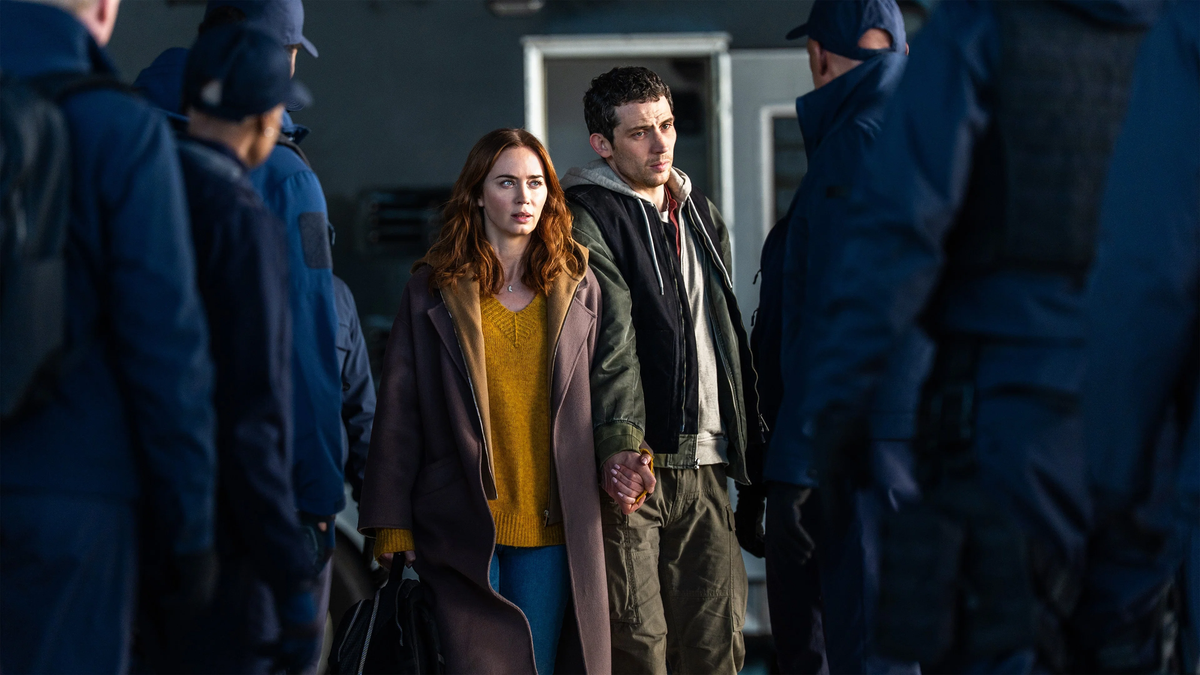
But we don't learn any of that just yet. Instead, Spielberg thrusts us into what is instantly one of the most captivating openings of any movie from the past few years. What would normally be the "all is lost" moment is instead the beginning, after the villains have already kidnapped the protagonist's girlfriend, Jane (Eve Hewson), which they leverage to recover what was stolen from them in a public hand-off, ending in our heroes meeting the bad guys' leader, Noah Scanlon (an exhausted Colin Firth), for the first time.
What makes it better is that Spielberg never cuts to black and flashes "one month earlier". Rather, Daniel has kept Jane in the dark in an attempt to protect her, and now that that's failed, she demands answers as the plot continues apace. Which is how we come to learn that Kellner stole from the people he used to work for, government contractor WARDEX, whose purpose is to protect and exploit the extraterrestrial secret. In the swirling chaos, we meet his former co-worker Hugo (Coleman Domingo) via a phone call, who seems to be coordinating a plan for maximum impact via worldwide disclosure.
It's energizing to witness them successfully flee to a safe house with the documents, and the subsequent efforts of WARDEX to hunt them down pushes this into clear conspiracy thriller territory. There are standout car chases, surveillance technology, and a few clever set pieces down the stretch that employ lovely imagery and imbue the proceedings with Spielberg-ian wonder. The camerawork is frequently superb, as Spielberg (working with cinematographer Janusz Kamiński for the twenty-first time) reminds us that while it's been a minute since he's made an action-packed blockbuster grounded in the modern world, he's very much still got it. He mixes in a few deft and effective oners with numerous scenes that are wonderfully and impactfully staged, so you've often got something on screen at which to marvel.
But the overall experience is quite bumpy. For one, since Kellner is not new to being on the run, he's become immured to it. So O'Connor is called upon for his bread and butter, the quiet, reserved sadboy, which is an awkward fit for a movie that can be so high octane. Even Hewson is a bit subdued, her reactions to the existence of aliens smaller than you may expect, although she is absolutely emoting. And she equips herself quite well in the movie's best scene and coolest/creepiest invention, in which Scanlon "dives" on her; using an alien artifact, he psychically burrows into her mind, initially to extract information and later to force her to murder her boyfriend. But both performances keep us at a remove, despite occasionally getting a bit of Domingo's impossibly lively (and alive) voice.
David Koepp's screenplay isn't helping much, either. The structure is solid. But plot threads and character details are dropped as quickly as they're raised, and convenient contrivances without attempting a justification abound. The dialog is rarely "bad", but neither is it particularly memorable. It's further hampered by the need for a fair amount of exposition, despite Spielberg and Koepp showing comfort leaving you in the dark. Early on, we're told that, "When the time is right, all will become clear". But that promise never comes to pass, necessitating monologues to fill in the gaps.
Apart from the action, what keeps the movie afloat is the parallel story of restless Kansas City-based weather reporter Margaret Fairchild (Emily Blunt). After locking eyes with a cardinal, she starts fluently speaking languages without realizing it, and exploiting her intuition of people's emotional states to keep them from obstructing her. Soon, she feels the inexplicable drive to head north (...no, east!) towards Kellner, a man she's never met but whose face has invaded her mind. That she's a conscious but unknowing passenger on this journey makes her the central focus of the comedy even when things get harrowing, which Blunt pulls off incredibly well. Her boyfriend Jackson (Wyatt Russell) is more of a trope than a character, too quick to decide his partner has gone crazy before considering there may be some merit to her (admittedly absurd) claims, a fault that lies at the feet of the actor, screenwriter, and director. So his exit from the film around the midpoint is not unwelcome.
If it wasn't for her magical mental abilities, you could almost forget aliens were involved at all until the third act or so. As Hugo's inexplicable knowledge finally spills out of him, as long-repressed memories are uncovered, and as the looming threat of a new world war reaches a fever pitch, Spielberg's statement of belief comes into focus. A small aside noted that Jane's journey as a novitiate ended due to her crumbling faith in people, part of the film's limp engagement with the impact (or lack thereof) the discovery of alien life would have on the Abrahamic religions. Using that as a springboard, Spielberg's finale emphatically espouses his deep faith in the glow of the silver screen to bring everyone together the world over, and of television news to serve the same role as it did in the 70s. Both of which are wonderful sentiments! But he never considered that the audience might need some convincing, so nothing that came before deals with modern media consumption in any way, leaving cynical viewers (such as this reviewer) more incredulous than moved. Especially given the abrupt final shot that misses profound and lands on silly.
It fails to reach the thematic depth of Close Encounters of the Third Kind or the emotional resonance of ET. But Spielberg's latest foray into the world of sci-fi blockbusters still manages to land on the positive side of most of its flaws. And ya know, given how much I hate the tenor of most modern blockbusters, it's quite refreshing to experience big-budget sincerity, even underbaked sincerity. As much as I'm skeptical that the broader public cares enough about movies for any one to alter popular perceptions, I want to believe they can. But we'll never know without filmmakers willing to try. For that, if for no other reason, I appreciate what he's done here.