Exit 8
"Do not ignore any anomalies."

The power of a brilliant sci-fi conceit is that it can be realized for a minuscule budget. The most well-known are often huge spectacles with movie stars and tremendous effects. But as demonstrated just a few months ago, if your idea is good enough, and you're creative enough with its execution, you can make a lot happen for a modest sum. Case in point: two of the best of the past few years are a couple of Japanese films that cost a fraction of a million dollars to make. Beyond the Infinite Two Minutes is a single-shot film about some cafe employees who discover their CC TV allows them to see two minutes into the future, and River is about a localized time loop that resets every two minutes. Both present lovely little twists on their somewhat familiar setups, which they proceed to explore to an incredible degree, especially given that neither takes even ninety minutes of your time.
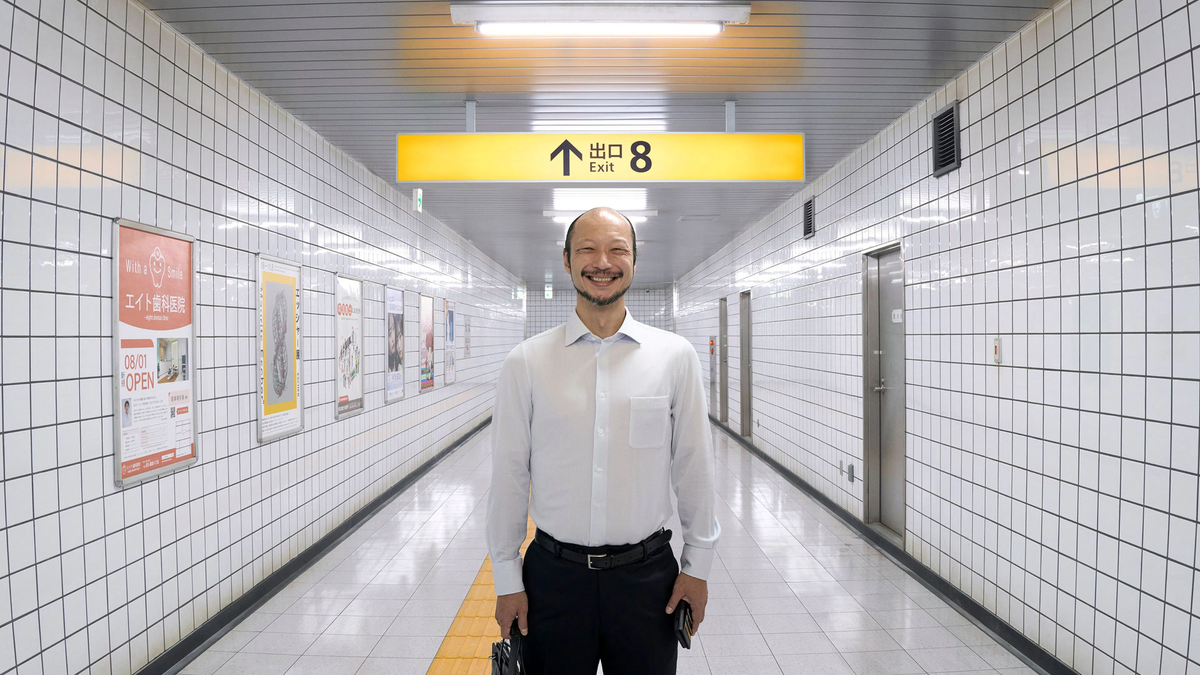
While Exit 8 has no connection to them, they're linked in my mind by this minimal setup. What if you became trapped in an endless hallway, and had to repeatedly spot things that are "wrong" in order to get out? Our protagonist, unnamed saved for a title card implying he's "The Lost Man" (Kazunari Ninomiya), is so in his own head with the shocking news that he's to be a father with his ex-girlfriend (Nana Komatsu) that he doesn't realize at first that he's been in the subway's exit tunnel for far too long. Next to the "Exit 0" sign, there's a plaque with some instructions. One, do not ignore any anomalies. Two, if you see an anomaly, turn back; if you do not see an anomaly, do not turn back. And three, only go out through exit 8. On each successful pass through the short hallway, the number increases; on each failure, it resets to 0. The latter is far more common at first, as the man's frantic panic and disbelief overwhelm him. And of course, the nature of the anomalies is ever changing, from misplaced doorknobs to auditory hallucinations to the appearance of other people/creatures, and more.
So why is so much time spent on the characters trying to figure out how this all works?
Even in Cube, where the mechanics are more esoteric, the story gets moving almost as soon as they're discovered. Here, we get multiple sequences trying to figure out what is meant by an anomaly, as well as witness numerous resets caused by neglecting to carefully observe all surfaces and items. The repetition is more forgivable when new, confusing types of anomalies begin to appear. But when the POV temporarily changes to The Walking Man (Yamato Kochi), the film reuses many of the same beats to divulge his backstory, with the only meaningful narrative advancement being the introduction of The Boy (Naru Asanuma).
The overall way director Genki Kawamura and co-writer Kentaro Hirase deploy the anomalies is frustrating. Especially once it's established that the word "anomaly" was chosen very deliberately, you naturally expect they'd get more difficult and weirder the further the man progresses. But more often, the sequencing feels haphazard, with the most obvious events coming later, and some of the subtler ones only popping up on the first few passes. On the one hand, it would be tedious as hell to repeatedly send him back to the start as he nears the end, so the threat of failure quickly loses its power. On the other, it robs the story of an innate flow, and places an increased emphasis on his struggle to come to terms with the evolution of his relationship with his ex. Even more so once he becomes temporary father figure to The Boy, the most blunt presentation of theme in a movie that opens with The Lost Man overhearing and ignoring a stranger screaming at a woman on the train who's holding a screaming baby. It's a thin plot thread, albeit serviceable enough to keep your attention.
Most confounding are the interesting anomalies is left on the table. The set is small but textured, so as soon the shape of the story reveals itself, you start thinking of how it could interact with the environment. While a few do, it's not long before outside forces begin to infringe upon the space, implying this is a place where most anything is possible. It makes for some truly memorable images, and dials up the anxiety and danger further than its opening offer suggests is possible. But it also leaves you wishing they did a better job at picking the bones clean.
Kawamura and his team manage to imbue the film with additional energy via some flashy but effective filmmaking techniques. Cinematographer Keisuke Imamura opens the film with a first-person tracking shot that's nearly ten minutes long, drawing a palpable connection between what we're about to witness and its video game source material. Although we never re-enter that visual POV, the entire film makes use of long tracking shots to increase the tension by refusing to give you the space to safely blink. And both the shot composition and sound design (under the direction of Masato Yano) encourage you to play along, allowing you to visually or aurally spot anomalies before the man does (if he does), while never highlighting them until he notices. Unfortunately, it occasionally makes him seem oblivious; we see the altered back of the hanging sign during an early failure, informing us that he should always check there, but he never adds it to his routine, causing him multiple problems.
Which is a microcosm of the experience. While an adept adaptation and leveling up of the indie game, there's so much unrealized potential that's it's hard not to feel let down. The story is simple and relatable, telling us of a man kept from the rest of his life, forcing him to figure out what he truly cares about, even as he's unable to participate in it. But too much of it is dispensed through exposition, stopping the rest of the movie while emotional beats are hit. And there just isn't enough visual invention to be captivating, although what's there is quite good. The result is a fine alternative to the game if you're uninterested in the interactive bits, but too slavish to truly escape its grasp.