Ha-Chan, Shake Your Booty!
"I'll fix you before I fix your lock!"

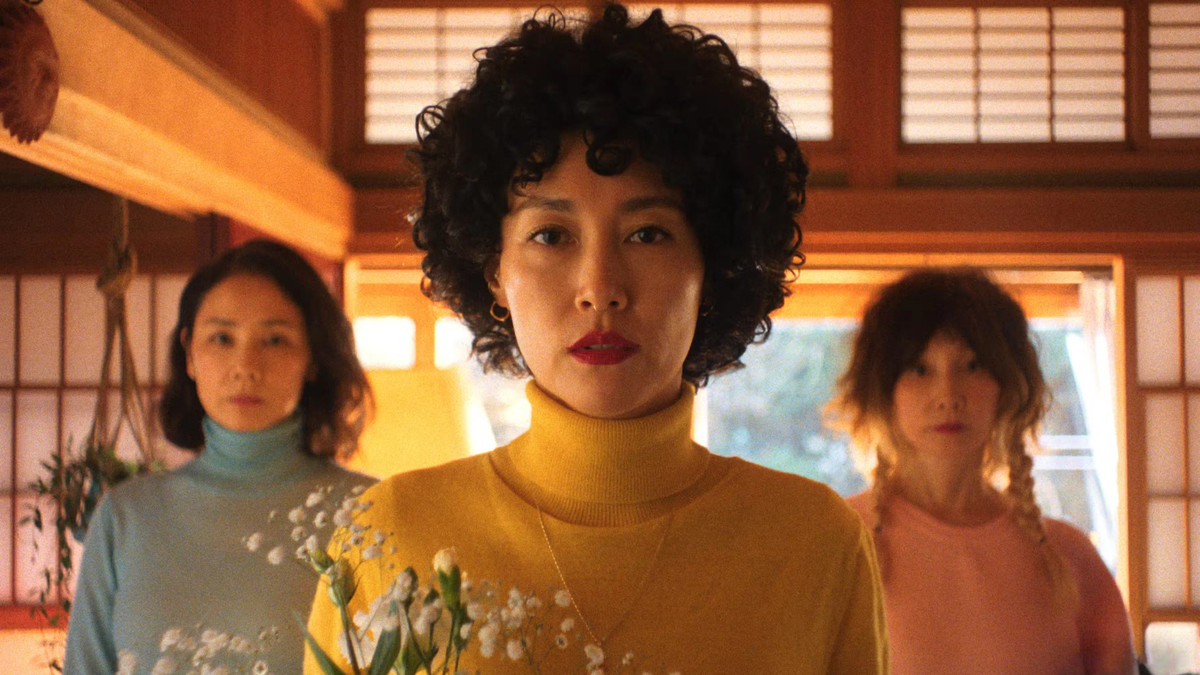
The first few scenes of Ha-Chan, Shake Your Booty! feature impeccable relationship building. The camera takes its time observing Haru (Rinko Kikuchi) and Luis (Alejandro Edda), a married couple sitting down to dinner while watching video of their ballroom dance practice. They're preparing to compete in Tokyo, so Haru's intense focus and sharp critique of her husband's technique reads as familiarity and comfort rather than judgement. There are so many loving, warm moments in the conversation and prep for their performance, their gaze at each other filled with the bonds of twenty years of history, of the work done to unify their disparate cultural backgrounds and upbringings (Haru is Japanese, while Luis is from Mexico). When they dance, it's like magic, their passion, their precision, and their energy making for undeniable sexiness, the fire setting them apart from a floor full of twirling, gorgeous bodies. Quite literally, in the first of many bits of impressionistic flare in the filmmaking: they lift off the floor, the spotlight in pursuit, hovering above everybody else, for one glorious moment...before tragedy brings it all crashing down.
The efficient, emotional way it constructs its subjects throws into sharp relief the pacing issues that riddle the rest of the story. Director Josef Kubota Wladyka attempts time and time again to imply depth and duration of experience indirectly, and while you get what he's going for, you rarely feel it. We have no idea why it takes eleven months after Luis's heart attack for Haru's sister Yuki (Yoh Yoshida) and close friend Hiromi (YOU) to become fed up with her social withdrawal. Nor does it track how little effort it takes them to convince her to leave the house for a dance class (although it does follow an entertaining sequence of trying to break into her house). Nor how easily she falls for the new dance instructor, Fedir (Alberto Guerra), especially given just how much she's not over Luis: she's been recreating their final day together over and over again, and his spirit shows up each night in an oversized black bird costume. Wladyka almost seems to get it in the case of the latter situation, as that internal conflict forms the backbone of the plot. However, that the breakneck pace only occasionally stems from Haru keeps the focus on her poor decisions instead of the speed of those decisions.
Wladyka's focus is far more often the here and now, despite never letting us forget the past. Haru's pursuit of Fedir is as hilarious as it is self-assured, even as (because?) she's constantly lying to further it. We see the restorative effects of an energetic new romance, of being around and with other people rather than drawing inward, and get plenty of the power and beauty and allure of dancing. Touches of the unreal abound, all couched as Haru's dreams or active imagination. To what end is unclear, as the first comes in the opening, and the last is nearly at the end of the film, contradicting the idea it indicates her desire to disassociate from her upsetting reality. They do function as periodic projections of her emotional state, however, and are used quite well throughout: we're left unsure if a few key plot beats even happened, but their emotional truth mean we've little cause to care. They combine with the lush, eye-popping colors throughout to render the whole film a piece of visual art. The story, however...
Not that it's bad. It's a perfectly serviceable sequence of events, quite entertaining and just weird enough to keep your attention. But it never makes a convincing case for the quirkier parts of its presentation, making them feel like arbitrary decisions that serve no real purpose. They're reduced to decorative touches that distract rather than amplify, especially since few are strong enough to stand as captivating style on their own. Why does Luis's spirit return in a costume, especially that costume? Dunno, but I spent much of the movie pondering just that. On the other hand, why does a drunk salaryman bumping into Haru turn into a musical number complete with choreography? Also unclear, but it leads to a scene fantastic in both its execution and its audacity.
Its central concern is the surprising and often arresting manner in which grief is expressed and experienced and dealt with, especially as influenced by the angel and devil on her shoulder, Yuki and Hiromi. It's well-worn territory, but effective. What makes it frustrating, however, are the narrative tributaries that are left unexplored. There's the sense that instantly chasing another Mexican ballroom dancer could be more an act of missing Luis than anything about Fedir. But that parallel remains in the background, even when the men meet in a dream sequence. Hiromi alludes to the benefits of a life lived without the burden of regret, but it's left as her encouraging her friend to go out. And Yuki isn't given all that much to do except be a foil for Hiromi.
This a great example of a "Sundance" movie, so it should come as no surprise that's where it premiered. It's an indie from a relatively green (albeit not brand new) director, featuring a few known actors, and mixes heavy thematic elements with light, off-beat humor and a saturated palette. It presents as challenging, but the edges are sanded off to make it all more palatable and fun, if a bit downbeat. Most importantly, it includes a few stylistic touches, not from any narrative necessity or even congruity with the director's previous work (Catch the Fair One is a fairly down the middle revenge flick), but just to ensure it doesn't get lost in the festival shuffle.
Fortunately, it's one of the better entries in that approach. It is earnest and funny and a little bit sexy, and those stylistic elements have stuck with me. It's emotionally honest about the push and pull of grief, even as the plot fails to capitalize on it. Yes, the ending is pat, and the events wrap up too cleanly, and we don't get the best sense of the characters' growth, apart from them periodically sniping at each other. But the experience of watching the film is enjoyable enough to distract you for two hours, until the lights come up and you start to think about why this warm movie leaves you feeling just a little bit cold.