Her Private Hell
"Say it with me: I am a wholly unique consciousness."

Writer/director Nicolas Winding Refn had already been working for fifteen years when Drive premiered at Cannes, for which he won Best Director, beating out countryman Lars von Trier. He'd slowly built acclaim, a long simmering favorite of critics for the energetic Pusher trilogy (well, at least the first two entries) and the unnerving Bronson, the latter of which saw him evolve his filmmaking style in exciting new ways. But it was Drive that announced him to a wider audience, partially for repurposing a romantic lead as the enigmatic star of an action film, but also due to the refinement of his style.
It was there he first experimented with neon-noir, although applying that label to such a grounded film seems quaint in light of what came after. Over the following fifteen years, each successive feature has further cranked the dial on his signature lighting scheme, until even the Sun emits a soft, low hum in its rare appearances. Simultaneously, his increasing employment of unmotivated slo-mo tracks with the decreasing coherence of his plots, which punish you for daring to engage. The cool remove of Gosling's cipher has become the only type of character Refn is interested in, regardless of gender. The more energy he pours into failed recreations of that alchemy, the more instructive it becomes that his most famous (and best) film is the only one penned by someone else.
That's not to say Refn's era of soap-opera-by-way-of-head-shop is without merit. Only God Forgives wields its protagonist's silence to deny us easy interiority, and its revenge flick underpinnings turn the build into effective drama (including a beautiful example of action as characterization). As if frustrated that its ambiguities allowed audiences to something to hold on to apart from the visuals, and with a much weaker lead at his disposal (2026 Oscar nominee Elle Fanning has come a long way since 2016), The Neon Demon gave us a blunter, clunkier narrative, albeit one whose heart is in the right place. Refn became convinced that by having his characters sound bored and mistreat each other, he was pointing vigorously at something True. Intentional style doesn't shield you from critique, and he spent the next decade making TV.
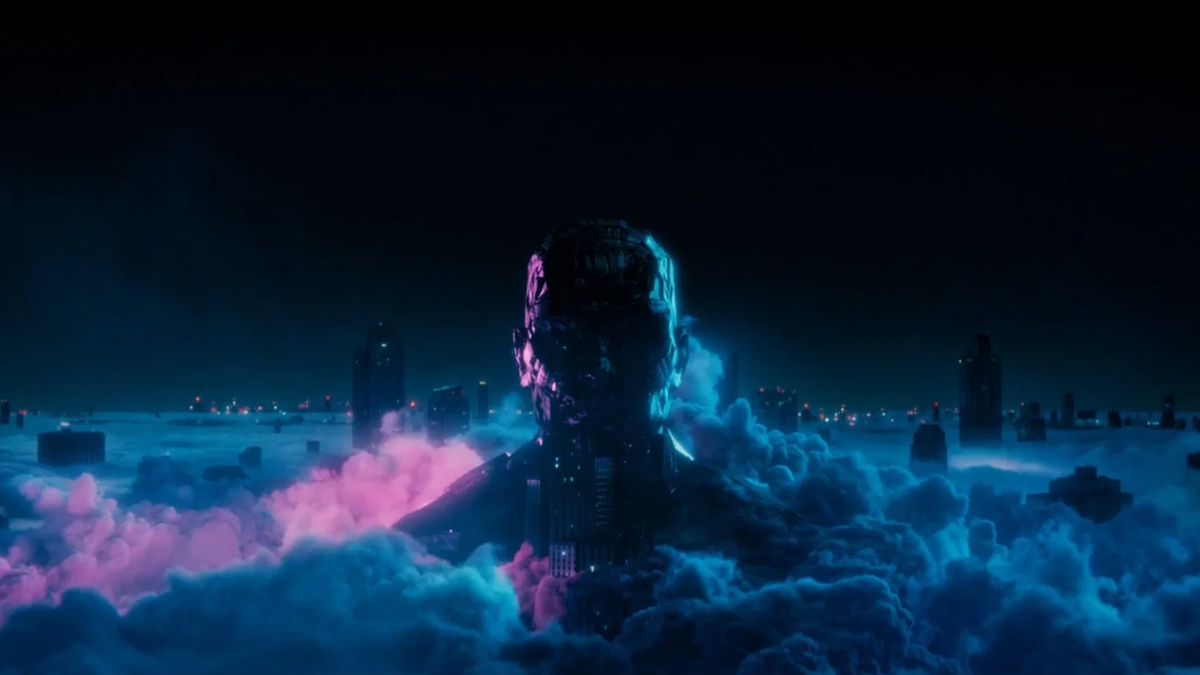
Her Private Hell feels like the next natural step, in all the eye-rolling, insufferable glory that implies. You'll frequently find yourself stunned. Its fantastical, angular, Ayn Randian cityscapes drenched in hazy bisexual lighting flicker between gorgeous sci-fi creation and cheap, chintzy facade that clashes hard (and composites poorly) with the grounded interiors of the 70s/80s-tinged luxury hotel the main cast barely leaves. There's no such unevenness in the dialog; it's all confounding, especially as all is monotone. It's a minor blessing that although most of them don impressively flat affects throughout, newcomer Hunter (Kristine Froseth) is endlessly peppy and oblivious. The constant discordance ensures you never forget that this unforgiving world has yet to leave its mark upon her, but that it never changes prevents her from becoming more than a nubile object of desire.
In turn, Elle (Sophie Thatcher) is the object of Hunter's affection, and of ours. She's an established star about to work with the younger woman on a low-rent sci-fi adaptation of a pulpy, 50s-style comic book called Candy Floss. It's a family affair, financed by her daddy Johnny Thunders (Dougray Scott), a womanizer calling to mind Night Nurse's Douglas, and his new wife Dominique (Havana Rose Liu), with whom Elle has always had a complicated relationship, even when they were best friends. But the movie within a movie is just a plot contrivance to bring everyone together, and occasionally give Thatcher David Bowie-esque facial adornments - she wears them well, even as they're largely a signifier of the film's obsessive application of style over substance.
Once everyone is in the Astro Lounge, the melodrama unfurls in awkward fits and starts. Hunter's eagerness to bask in Elle's glow becomes undeniably sexual when she sweetly parlays her lack of accommodations into sharing a bed, her innocence barely concealing her leering gaze. But the movie doesn't have anything quite so salacious in mind. Sure, there's plenty of alluring attire and a club scene and even bathroom sex against a frosted glass window, all while Refn tries again to weaponize the male gaze. But at least The Neon Demon juxtaposed its objectifying images with a fable that indicts its audience. Her Private Hell juxtaposes them with stories of Leatherman (Jason Hendil-Forssell), a killer with diamond-encrusted gloves who will arrive to violently rip open the chests of women "when the mist returns", an idea rendered meaningless by the cinematography's indebtedness to mid-century noir. Oh, and a meandering subplot lifted from that genre, in which American GI Private K (Charles Melton) searches for his daughter in the dark, dreary city streets.
The recurrence of key details from his last few films hints at self-reflection, but precious little manifests in any meaningful way. The same goes for its further focus on the exploitation of women in the visual arts, or the way society's suppression of how they're "supposed" to act results in them at each other's throats: all is lost amidst the pervasive atmosphere, never amounting to much. The effort expended by the screenplay setting up narrative threads is largely wasted, as they're often addressed (or even dismissed) with little care or fanfare. For example, the particular shades of pinks and blues that dominate every outdoor shot (and some of the indoor ones) are not an accident, and the payoff is technically relevant for the plot. But by then, we've received more relevant backstory, rendering it moot, save for the shock value, itself muted by confusion. The movie cycles through various plots and genres and unabashedly artificial constructions, all slowly converging on the masked killer, but never cohering into anything engaging or insightful.
None of the actors are at fault, and some even manage to rise above the material, at least in spurts. Thatcher and Liu deserve special attention, as both quite effectively switch gears on the rare occasion they're asked to do so, maintaining character continuity as they discover a new mode of expression for what seems like the first time. The same goes for the score, a soaring bit of orchestration from Pino Donaggio that rarely backs off. As lovely as it is in isolation, it never combines cleanly with the image. Various pieces would be perfectly at home in a ballet, a Tarantino crime flick, a quirky indie comedy, a proper horror movie, or some combination therein. None of which applies to this film, so it's yet another element keeping you at a distance.
It would be easy to look at all of this and praise Refn for crafting a film so uninterested in commercial sensibilities, and aiming instead for "vibes". But even here, he gets in his own way, imbuing it with enough plot and minutia to frustrate that possibility. You begin to wonder what it would look like for him to truly dip his toe into experimental film, or at least abandoning the trappings of mainstream cinema. He is an impeccable visual stylist, and there are once again a bunch of beautiful shots and compositions littered throughout the film. You want to turn off your brain and drink it all in, but every time you try, the camera is pulled in by some dramatic moment, the score swells, and your mood is gone.
While in theory I appreciate Refn jumping into the deep end feet first for his return to the big screen, the reality is that the product on screen leaves me wondering what the hell happened.