Hope
"Listen...have you seen...a tiger?"

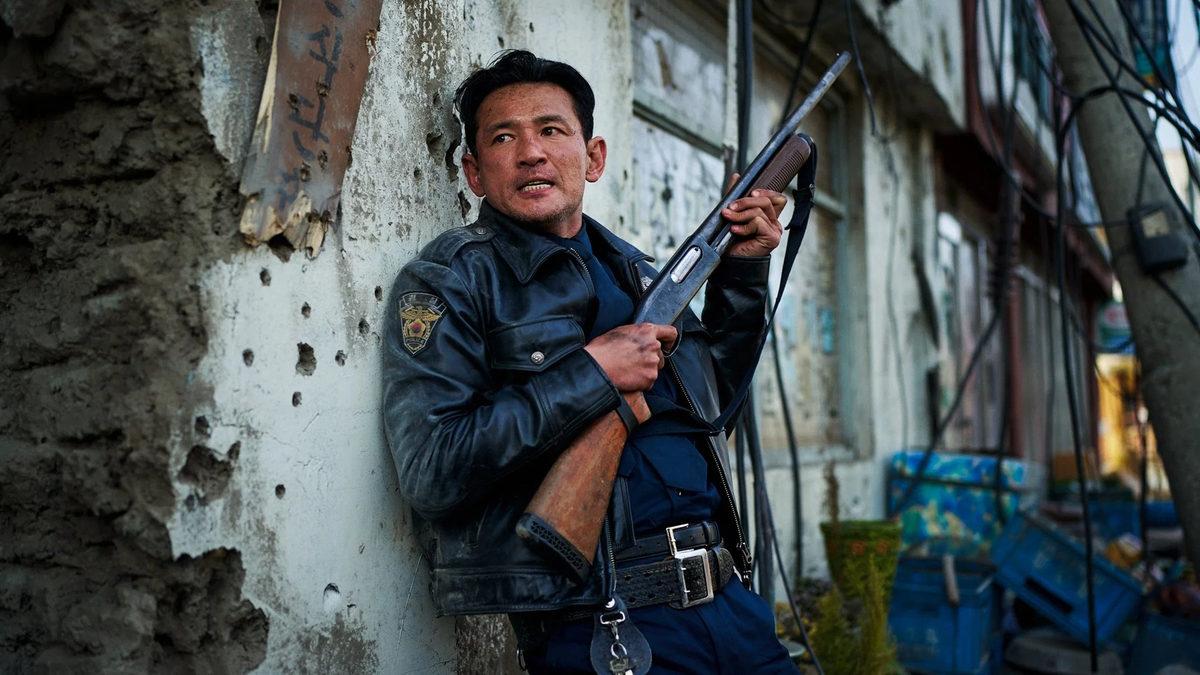
For the first sixty minutes of Hope, the ten year wait for South Korean writer/director Na Hong-Jin's follow up to The Wailing feels well worth it. That hour is amongst the best action filmmaking of the decade, never mind the year (although it's a very different kind of action from another recent contender, The Furious). Chief Officer Bum-seok (Hwang Jung-min) is called to the outskirts of the fiction town of Hope Harbor by some local hunters, led by his cousin Sung-Ki (Zo In-sung), to deal with a dead cow in the middle of the road. Their incessant screwing with the gullible, slightly goofy Bum-seok ensures your laughter despite the looming threat, communicating early that for all that is to come, fun is the order of the day. Given Na's penchant for highlighting the incompetence of the police and their tendency to make things worse, it's fitting that he's once again made his main characters cops who are in way over their heads. Even when Bum-seok is joined by his more bad ass, confident colleague, Lim Sung-ae (Hoyeon), they struggle to get a handle on the situation. Key to the comedy is that they're not evil or corrupt; they're good people doing their best, who truly wish to help, but whose desire to regain control is a disastrous mismatch for their new reality. Which makes it that much funnier that they're frequently outdone by well-armed elderly civilians.
From that point on, the tension steadily ratchets up until you realize it's been a while since you've blinked. Gently at first, as their bovine investigation reveals strange details: huge claw marks, no bites taken of the flesh, and a trail of destruction stretching away through the field and into the woods. The scale of the terror becomes horrifying as Bum-seok drives through the city. He first encounters a two-story building with a hole through it from front to back, floor to ceiling. Every street he jogs down from that point forward has been hit by an EF5 tornado, debris and rubble and garbage nearly obstructing the road, the occasional sounds of the perpetrator occasionally wafting in on the wind, the bloody corpses freshly dismembered. We periodically cut back to Sung-Ki and his crew following the original trail into the woods, their own discoveries adding to the growing dread as we wonder how anyone is going to stop this thing, despite Na having smartly concealed its actual nature from us thus far à la Jaws. We're firmly grounded in Bum-seok's experience, so even when nearby residents are squaring off against the destructor, his hesitation before each burst of bravery keeps it out of sight. This whole time, Na's balance of tones is masterful, keeping us engaged in the plot while frequently letting off bits of steam in hilarious moments and lines and set pieces, playing on the absurdity and confusion of the situation.
Where it starts to fall apart is the reveal of the monster. The design is fine enough, although a missed opportunity to say anything about paranoia and fear of the other, given the plethora of signs imploring locals of this DMZ-adjacent town to report any suspected spies. But the CGI used to realize it is shockingly bad, more suitable for a turn of the century PS2 game than the most expensive movie to ever come out of South Korea (about 46 million USD). The more elaborate its movements, the more distracting it is; once its leg is blown off, it has to relearn how to move, and its solution turns it into an early Resident Evil baddie. As it crashes through Hope Harbor, chasing Bum-seok while he and Sung-ae attempt to take it down with increasingly outlandish weaponry, I swear I could see it clipping through the ground, despite the overall reasonably well-done integration into its environment.
Bad special effects would be forgivable. They break immersion and harm the experience, sure, but there's so much more that goes into moviemaking. However, you can feel Na's exhaustion following the conclusion of that initial breakneck action sequence. There was always going to be a pause to dole out plot and backstory. Few movies can get away with sprinting through their whole runtime, and it's a chance to deepen the themes and engage in worldbuiding. However, we're given so long to catch our breath that we slip into boredom. The vignettes work well-enough alone, but fail to gel into a larger plot. We get pulled in half a dozen disparate directions, each forcing us to temporarily but completely forget the one we just watched. Plenty are amusing, as are a couple of the newly introduced characters, most of whom aren't around long enough to make an impression. But the lack of firm direction leaves us adrift, grasping at something, anything to compel us forward. Even the action's resumption doesn't do it, as the second half's set pieces quickly become repetitive and bland, the creatures' dedication to using the same strategy over and over not turning into a weakness despite its predictability. This would be painful in an average length movie, and it's excruciating in one running more than 150 minutes.
Maybe most frustrating about the lull is how much it comes to nothing. For all the characters discuss the specifics of what's going on, for all the mysteries raised and strange occurrences pondered, just about none of it is answered. And Na is still bringing up new ideas and plot threads as the movie comes to a close. Hell, the final scene or two feel like the beginning of a completely different movie, despite the lack of a clear conclusion to the first. That's because Na has always planned on a sequel that completely shifts perspectives. But instead of focusing on completing his initial tale, he got all twisted up in the combination of the two. Who is Ku'er? And why are they here? Tune in in another ten years to find out!
At least the humor never slows down. It provides a balm and a reminder of where this all began, even as Bum-seok becomes more confident and the situation more dire, and the plot breaks apart around you. Na never stops taking bold and preposterous swings, which is certainly exciting, despite few connecting. Perhaps the biggest pop in the final third is the realization of how some of the more recognizable names in the cast are used, which I'll leave for you to discover on your own. That I left equal parts delighted and confounded is a testament to just how strong of a promise that opening is, its echoes still felt despite being far in the rearview. Maybe if the film didn't carry as much prestige as both Na's name and the story's more self-serious plot points indicate, it could become the kind of wild curio people discover on streaming and tell their friends about with an excited "Can you believe this shit?". But the movie we got is destined to fade into the background (at least outside of South Korea, where it's doing great business), a bizarre corner of a well-renowned filmmaker's career.
At least, until his impression of James Cameron is complete, and he pours the rest of his professional life and all the audience's prior goodwill into completing this saga.