I Play Rocky
"If I'm not willing to live up to what I wrote, then what's the point?"

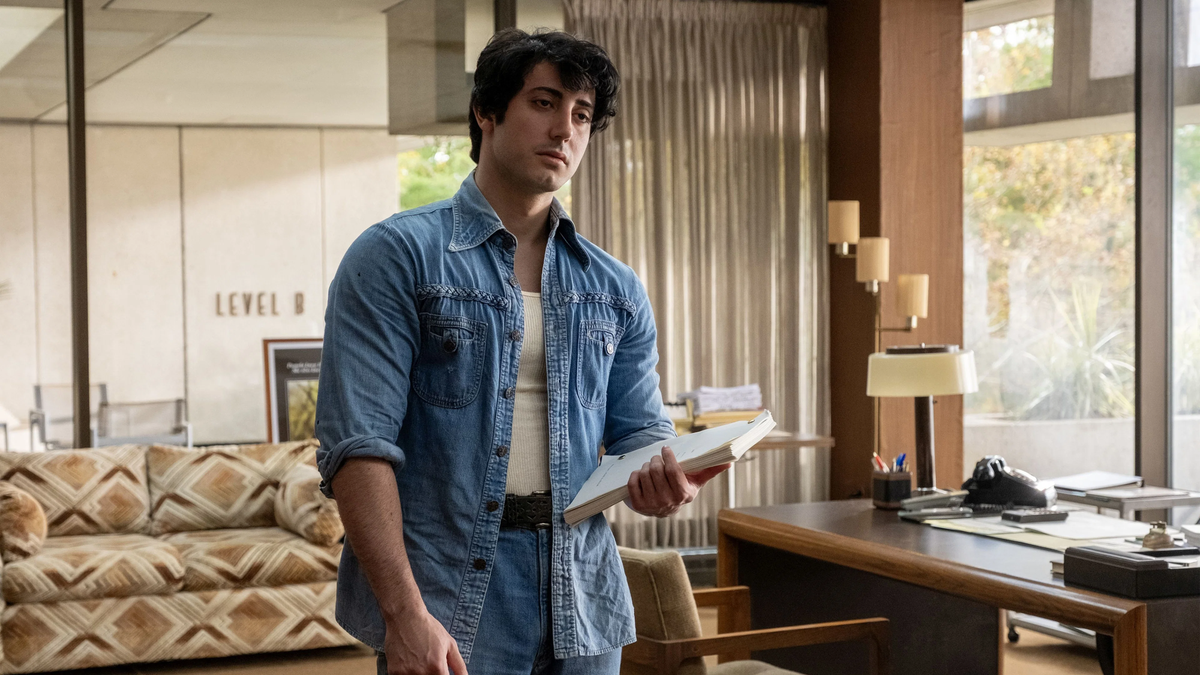
It hasn't even been a decade since long-time comedy director Peter Farrelly dipped his toe into drama with Green Book. Doing so won him Best Picture, won Mahershala Ali Best Supporting Actor, and earned the film a place alongside 2005's Crash and 1989's Driving Miss Daisy for most embarrassing Academy honorees. After returning to his roots for a few movies that made zero noise (including Balls Out, which I was stunned to learn came out this year), he's taking another swing at the Oscars, barely even hiding his ambition as he checks every "Oscar bait" box. Biopic? Check. About making movies? Check. Underdog story? Check. Nostalgic for 70s Hollywood? Check. Celebrating the anniversary of a classic film? Check. Transformative impression of a real person at its core? Very check.
When someone with as distinct a look and manner of speech as Sylvester Stallone permeates the public consciousness, playing them at the start of their career becomes a fascinating exercise. People's personas and presentations evolve, often in subtle ways. So do you base your performance on who they were then, even if they won't be as recognizable to modern audiences? Or do you transpose their present day mannerisms into that earlier era, capturing more of an emotional truth than a literal one? Given Stallone's transformation into Rocky over the years, relative newcomer Anthony Ippolito chose the latter, and he absolutely nails it, with little discernible difference between the pre-Rocky years and the time he spends filming. The reality is only highlighted once the credits conclude and we're treated to a montage of Stallone on Carson promoting the film, talking about "when they eventually make a movie about this".
While impressive, a pitch-perfect impression means nothing if it gets in the way of helping us understand the character. Fortunately, Ippolito again equips himself quite well, his eyes conveying more inner life than Stallone's stoic gaze ever did. At times, his mimicry can be a bit distracting, especially in the more shaky moments of his voice work, but it never collapses.
Unfortunately, he's surrounded by all the events in the screenplay for I Play Rocky.
Farrelly and screenwriter Peter Gamble are intent on drawing the well-worked over connections between Stallone and the character he created. And as in the 1976 feature, the only person who really believes in Stallone is Stallone, with the exception of his wife Sasha (AnnaSophia Robb), to a point. After he writes the now famous screenplay, he's determined to play the lead role. Producers Irwin Winkler (P.J. Byrne) and Robert Chartoff (Toby Kebbell) love the script, but are instructed by the studio (represented by Tracy Letts in full podcast mode) to buy it off him for increasingly eye-popping sums. With a baby on the way and on the verge of eviction, this is where she wavers, even as she refuses his invitation to tell him to give up. Everyone else gets a variety of cartoonish excuses or reasons to doubt him, from his father (Matt Dillon) denigrating his acting ambitions in front of Sasha all the way up to the crew questioning his ability once filming begins. It sets up a rote "me against the world" narrative, which ensures little room for emotional growth and produces a staid character piece. The real Stallone may not have been involved in the making of this movie, but it still feels like Gamble didn't want to risk pissing him off.
Instead, Farrelly and Gamble lean on nostalgia-bait disguised as insight. So many details only exist to elicit an "Ohhhhh" from you, purporting to explain the why and how. Stallone's daily outfits will later become the iconic wardrobe, he conceives of the story while watching a real fight in a scene fraught with the same uncomfortable racial dynamics as the whole Rocky franchise, and Stallone's even shown video of someone running up the steps of the Philadelphia Museum of Art to demonstrate Steadicam. A fictional film that feels obligated to provide one-to-one explanations like this argues against its own existence, especially when played out with little imagination, no matter how true those anecdotes are.
It's made even worse when they're so often played for cheap laughs, such as Winkler's nonplussed initial reaction to the now-legendary Rocky theme. Why should I care that Stallone briefly went by "Mike", ashamed of his birth name, until Sasha suggested otherwise (a scene Farrelly liked so much he played it back again two minutes later)? It all screams of a movie with no real idea or narrative or dramatic thrust, content to coast off the fumes of a classic whose achievements have since been supplanted by Creed.
Even the most noteworthy scene in the film can't help but explicate the connection between Rocky's initial anger towards Mickey (Robert Morgan) and his desperation for his father's approval. It manages to be moving anyways, a confluence of Ippolito's performance and the wonder on the face of director John Avildsen (Jay Duplass), with Rocky's goofy speech born of Stallone successfully inhabiting his protagonist. But once you wipe away the single tear that forms at him finally having found "that thing" that Avildsen said differentiates "good" movies from "great" ones, you're left with one good sequence in a sea of mediocrity.
The screenplay's original sin is that is that so much of the drama is played out in short bursts that get no room to breathe, making it hard to connect with them or feel anything. Carl Weathers (Stephan James) and Talia Shire (Kiki Seto) are crucial to the franchise (and thus Stallone's future career), but both get just one real scene before being relegated to the fringes. The first act is especially guilty of this pseudo-montage style, whipping through the early 70s in the lead up to Stallone's big break. As such, we've little to hold onto as production begins, save for our knowledge of the fifty year old film, from which this one never recovers.
Driving this point home with incredible efficiency is the ending, set at the sold out premiere (how a mere million-dollar film with little studio confidence drummed up such excitement is never hinted at). What follows is ten to fifteen minutes of clips from Rocky with the audience getting more and more psyched, while Stallone paces outside the theater, anxious that it will be a disaster. Meanwhile, Winkler admits he was wrong about the theme, the execs are startled by the crowd's cheers, and Sasha beams with pride before grabbing the man of the hour to witness the ascent of his star. The final shot is one of the most famous of the 70s, Rocky facing Philadelphia with his fists raised in triumph. Given all that came before, it would almost be funny that Farrell's film is so bold as to end on stolen valor, if it wasn't already so frustrating.