If I Go Will They Miss Me
"He sees you in a way we could never see our fathers - as a god."

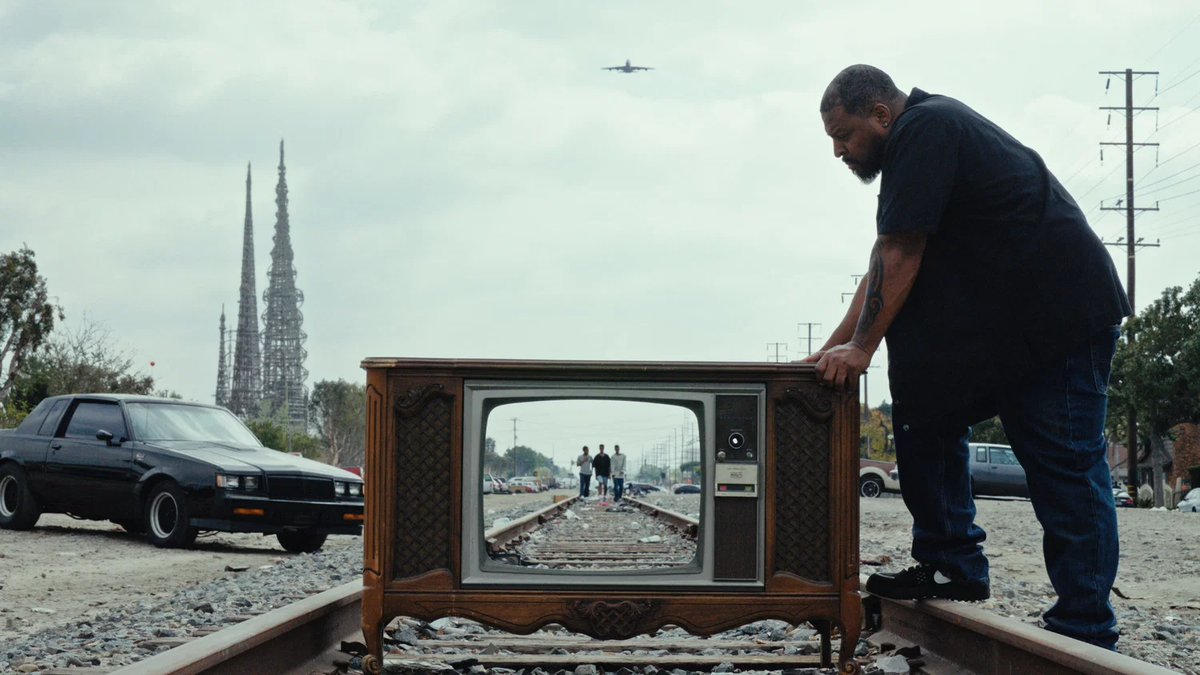
Walter Thompson-Hernández's debut feature, expanded from his 2022 short of the same name, is an excellent example of a movie in which plot doesn't matter. While you can line up the sequence of things that happen, and pick out the handful of scenes that chart a path towards the ending, none of those events are the point. Even when their specifics pack a punch, such as a missed going away party or a shocking outburst or especially the final few moments, it's always entirely about our experience of and empathy towards the characters constructed through meandering poetry over its 95 minute runtime. It's why the film can get away with opening on an extended montage in which we see the childhood exploits of Big Ant (Kameron J Meadows here, but usually J. Alphonse Nicholson) and JJ (Jeremiah King, and later Myles Bullock), with scattershot narration delivered by his present day son, twelve-year-old Lil' Ant (Bodhi Dell).
Given this technique will recur, it's fortunate that Dell is such a captivating listen, able to imbue his voice with a wonderful mixture of detachment and warmth, awe and distress, instantly conveying a child who's struggling. On the one hand, Lil' Ant loves his father, and yearns for a strong male role model. On the other, Big Ant seems to bounce in and out of prison, and when he's out, his time is split between his family, his side piece (Nandi Nfr Ka), and his job cleaning horse stables with JJ and his girl. And yet, nothing can disrupt this boy's reverence for his father; a question in school about Pegasus is all the excuse Lil' Ant needs to launch into a winding monologue that casts his own father as Pegasus's, the sea god Poseidon, and extols his many virtues.
It's not the first time the movie stitches together flight, family, freedom, and fatherhood, nor will it be the last. The title card even sticks a sketch of an airplane in place of a comma, just in case their constant presence in the opening went over your head. At least half the scenes feature a plane somewhere in the frame, sometimes multiple and sometimes at the center of it. Then there's Lil' Ant's stated desire to be a pilot, which justifies inserting them into the other half, be it as his drawings, the toys he keeps by his side at all times, or the plane-shaped configuration of gone-but-not-forgotten children that periodically arrange themselves outside their home in the middle of the night. It quickly gets exhausting, a bright flashing sign pointing at the Thompson-Hernández's key thematic idea long, long after we get it. The powerful composition of the quieter instances highlight what could have been if he'd been willing to gently hint at the association through distant images and sound design; instead, it reaches a point he can't even win us over by breaking it up with soaring, tranquil, POV shots from above the clouds.
But the powerful grounding force of the film, directed both at the audience and the main characters, Lozita, Lil' Ant's mom and Big Ant's wife, portrayed by the wonderful Danielle Brooks in a seismic performance. Not that it's big, loud, and brash. In fact, quite the opposite. While there are a few scenes where she allows herself to get angry and raise her voice to her husband (always in defense of her son), her power usually comes from her self-assuredness, her devotion to Lil' Ant, and the contrast between just how much she has her life together and how much Big Ant does not. We're privy to many of Big Ant's silent struggles, we see him give in to his weaknesses and frequently get mad at those who call him out, and we see his self-awareness. He's not a bad man, but a deeply flawed one, leading Lozita to give him more chances than he deserves in service of ensuring Lil' Ant has a father at such an important, confusing age. When he actually spends time with Lil' Ant, he proves to be a pretty good dad, even showing support for his son's more artistic, less traditionally masculine interests, a stark contrast to his own tough guy persona. However, next to Lozita, the portrait of patience and grace, deliberately brushing aside her own needs in favor of her child's, a trip to the beach doesn't begin to close the gap, despite involving quality bonding time.
This is a movie deeply concerned with the difficulty in figuring out how to be a parent when you're scared of passing on your own pathologies to your kid, when you're getting conflicting signals from the world about how to be a man, and when you're not quite sure how to manage the storm inside your own head. It's the presentation that makes this version of the tale unique. That it so openly screams at you its characters desperation to flee makes their choice to stay and fight like hell to make it all work that much more powerful. Its patience gives you the opportunity to turn every dramatic beat over in your head until it has time to settle, ensuring no scene ends without impact. The weakest link in this chain is the magical realism, in which Lil' Ant's imagination seems to interact with the real world in surprising ways. It's intended to suggest others catching glimpses of what's going on in that boy's head, but in the moment, trying to discern what's real and what's not is a bit distracting.
Thompson-Hernández's influences are on full display, the likes of Barry Jenkins and Terrence Malik and RaMell Ross and Charlotte Wells. He even slips in a Spike double dolly shot. While clear imitation, it's hardly a knock against any filmmaker to say their debut isn't on the level of such masters. Also, there's enough that doesn't quite fit, the emotions and characters so colorfully drawn, that it's clearly coming from a very personal place, whether based on his own experiences or those of his friends, or even a fabricated personification of his own anxieties. It speaks to the soul of someone still figuring out what makes their filmmaking unique, but who has stories inside they absolutely must get out. And given that this level of patience and poetry is not the order of the day even amongst indie films, so often choosing silence and contemplation over dialog, it's an incredibly refreshing entry into the year.