Is God Is
"Them twins burnin’. They been burnin’."

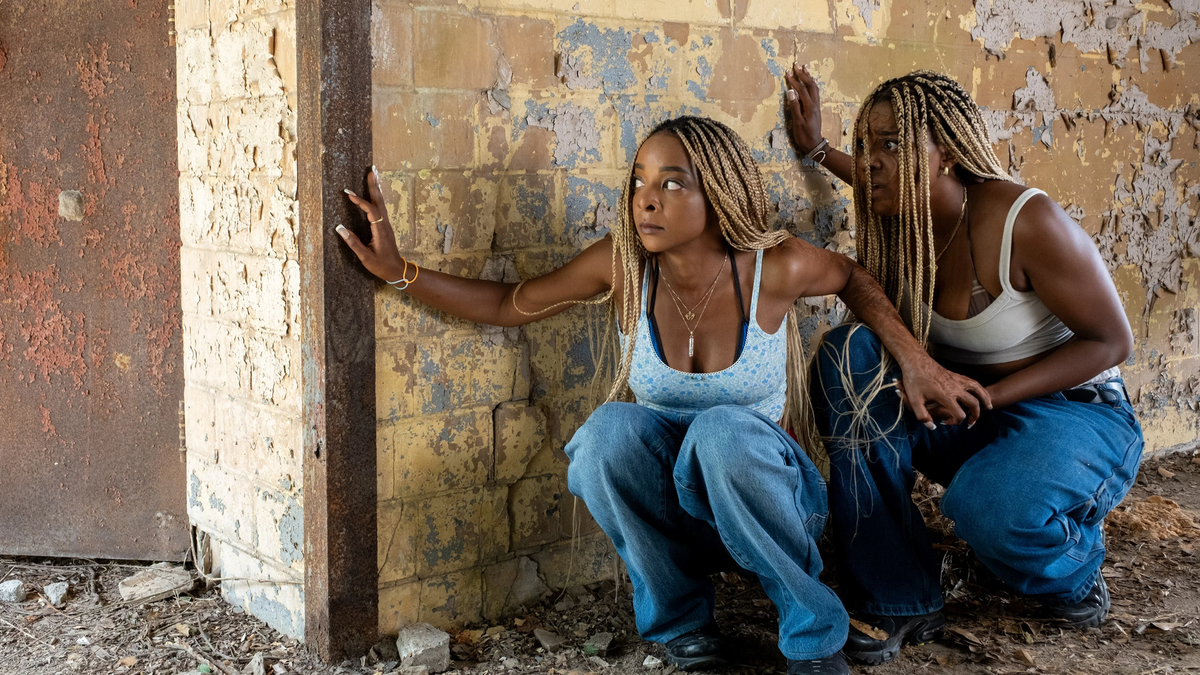
Out of the gate, Is God Is has an infectious energy. Its every scene is densely packed with information on the twins at its center, Racine and Anaia (Kara Young and Mallori Jonson). We first glimpse them as children, some time after the event that set the course of their lives. A boy calls Anaia ugly on account of the burn scars that cover her face, and Racine calmly gets up and goes after him and his friends with a bat, off-screen so we can stay with the other girl, while Mark LeBlanc's impeccable sound design ensures we don't miss a moment of the action. A slow, deliberate voice-over from future-Anaia grounds us in the situation and bridges us into their adult years, where they live together and are hilariously and creepily in sync, even for twins. Their every movement is like a choreographed dance, they call each other Twin, and they'll occasionally speak in time, like a single mind with two mouths. So it's hardly surprising when their cryptophasia is portrayed as indistinguishable from telepathy, the accompanying subtitles stylized with a refreshingly novel energy I haven't seen since the first John Wick.
This first chunk does a wonderful job introducing us to the women and the tone, pulsing through script and score, wickedly entertaining with a darkness that it refuses to shy away from for even a moment. It doesn't really get going until their mother Ruby (Vivica A. Fox) summons them, and gives them a task: "Make your daddy dead. Real dead." See, they haven't seen her in decades on account of not even knowing she was alive. Why? In a flashback during which his face is never visible, the motherfucker violated a restraining order to drag their kids, her kids, into the bathroom to watch their God burn alive. The scarring links the three women, although the army of nurses taking care of Ruby, present even when off-screen on account of the ever-clacking fingernails, make obvious that she had it worst of all, having been bedridden ever since. Racine and Anaia thus set off to rip a hole through the bastard's family, journeying through the Deep South accompanied by songs like Death Grips' "Guillotine", setting up a modern exploitation-style revenge flick.
Of course, while uncomplicated revenge movies still exist, prestige fare tends to focus on the dark side of getting even, from alternate methods of getting to your enemies to how it can all go sideways to the way even attaining success can cost you everything. Anaia's persistent protests breaking on the shores of Racine's eagerness immediately informs us the film does not view its protagonists as avenging angels sent from on high. Yes, their father is worthy of a thousand deaths, but that doesn't mean it's up to them to carry it out. The further they go, the more they abandon all that gives them the moral high ground.
But what makes this movie from first time writer/director Aleshea Harris (adapting her own Obie-award winning play) special is the strong voice it gives to all the nuances and complexities that come along with revenge. She refuses to choose a single path, instead taking it scene by scene. Racine is scarily exited about having an excuse to enact violence, sure, but that drive gives her the fearlessness required to further their quest. Meanwhile, Anaia's kindness is just as likely to get them additional information on their target as it is to get them into trouble. The result is a tale that charts its own path through a thorny subject, ultimately landing on a powerful and resonant statement that feels especially appropriate for the world in which we find ourselves.
Yet the the entertainment value never drops, even as the plot progresses and its deeper ideas bubble to the surface, from domestic abuse to individuality to religion to the myriad ways the justice system fails black people (and black women in particular). The humor becomes less frequent and more uncomfortable, but it's so baked into the way the women relate to each other and the world that it can never completely go away. To say nothing of the virtuosic partnership between Harris and cinematographer Alexander Dynan. An early visual twinning sequence using split screens is quite effective, and paves the way for it to return later when the women meet their half-brothers, twins Scotch and Riley (Xavier Mills and Justen Ross). The horror of the violence enacted upon them twenty years ago is dialed up through a quiet, unshowy oner, its black & white quietly punctuated by the color of the cartoon the girls are watching. But even the less flashy moments crackle with energy through uncommon camera angles and comedic pans and lovely compositions.
The performances from the two leads are sneaky great. So much of their screentime is big that it's easy to lose sight of the nuance: that you always feel it when the movie slows to hit a dramatic beat speaks to just how well they embody the sisters' connection contained within the screenplay. Hell, the denouement caused me to tear up at its beauty. However, it should not be a shock that the best performance is easily Sterling K. Brown, who's revealed as their daddy during the climax (although his name appearing in the opening credits makes this easy to guess). He's got to play menacing but gentle, quiet but intense, apologetic with just enough disdain that you can taste the violence that once coursed through his veins. And for one other visceral sequence, he's got to throw all that away to unleash the man he was back then, complete with an unsettling detachment and knowing calmness. It's chilling how effective it is, and deepens the understanding of an already rich text.
The stylization of every element of Harris's tale, combined with Anaia's intermittent voice-over that occasionally pivots to a moment of perspective from someone else, turn this into a modern folktale. The Parable of the Twins Who Burned. "Did you ever about the girls who..." It's a jaw-dropping debut, especially impressive given its origins in the theater. A whole host of films that start as screenplays nonetheless end up looking and feeling like the worst kind of stage production, making it all the more impressive that she was able to keep it more lively than even the biggest recent blockbusters on what must have been a meager budget. Maybe she benefited from lack of experience here: she didn't even direct the play's five week Off-Broadway run, never mind a feature or short film. Maybe that's what freed her to experiment without regard for the "right" way to tell such a story, allowing her to synthesize all she'd seen into her unique voice and vision for what a movie can be, resulting in a picture fresher than ninety-nine percent of mainstream studio fare, despite being produced by Amazon MGM through Orion Pictures.
Whatever the cause, what made it to screen is easily one of the best movies of the year, and one that deserves a bunch of attention both above and below the line come awards time.