Late Fame
"You wrote a masterpiece. Whether people know about it or not. That's forever."

The explosion in fandom over the past thirty years tracks closely with the flattening of cultural time precipitated by the internet. While "fan culture" is by no means new, the ease with which people can find others who share their devotion has turbocharged it. Additionally, little is ever truly forgotten; even works destined to become cult favorites often attain that status very quickly, such as Fight Club or Jennifer's Body, even if it takes a bit for them to re-enter the broader culture. You don't have to wonder if you're the only one who appreciated Freaky Tales; you can just hop on social media to find all who had as much fun as you did. That's even more true for the artists behind the work; once an actor or director has achieved some level of renown, they almost always maintain it to one degree or another, even as the praise they receive wanes. Their recent work might not be anything special, or they may have dropped out of the profession altogether, but if I can easily experience the art that made them, they can never truly disappear.
Of course, it wasn't always this way. Pre-streaming, pre-home video, when moviegoing was subject to scheduled programming (be it on TV or theatrical), it didn't much matter if you recalled enjoying some actor of yesteryear who'd fallen out of favor. If the monolith of culture wasn't on the same page, their work wouldn't be shown, and they would fade into the pages of history. Sure, some were occasionally re-discovered: one of the more famous examples in the pictures is Buster Keaton, a behemoth of 1920s silent cinema who'd mostly vanished from the screen by the early 1930s, until the burgeoning mid-century talk-show circuit slowly re-built interest in him. But it's nowhere near as common as the many creatives who were simply unknown in their time until being lifted up by later discovery.
It's not entirely clear where on that spectrum (fictional) poet Ed Saxberger (Willem Dafoe) is. He spent his 20s a part of the Greenwich Village artistic movement, rubbing elbows with the titans of the era, and quickly got his only book of poems published in 1979, Way Past Go. He makes reference to his brief moment in the sun and going to readings and such, but never much about how people responded. Did his friends appreciate his work? Did the public? Did the book sell at all? What did he do afterwards? By the late 80s, he accepted that his moment had passed permanently, and took a job at the post office, where he's worked ever since.
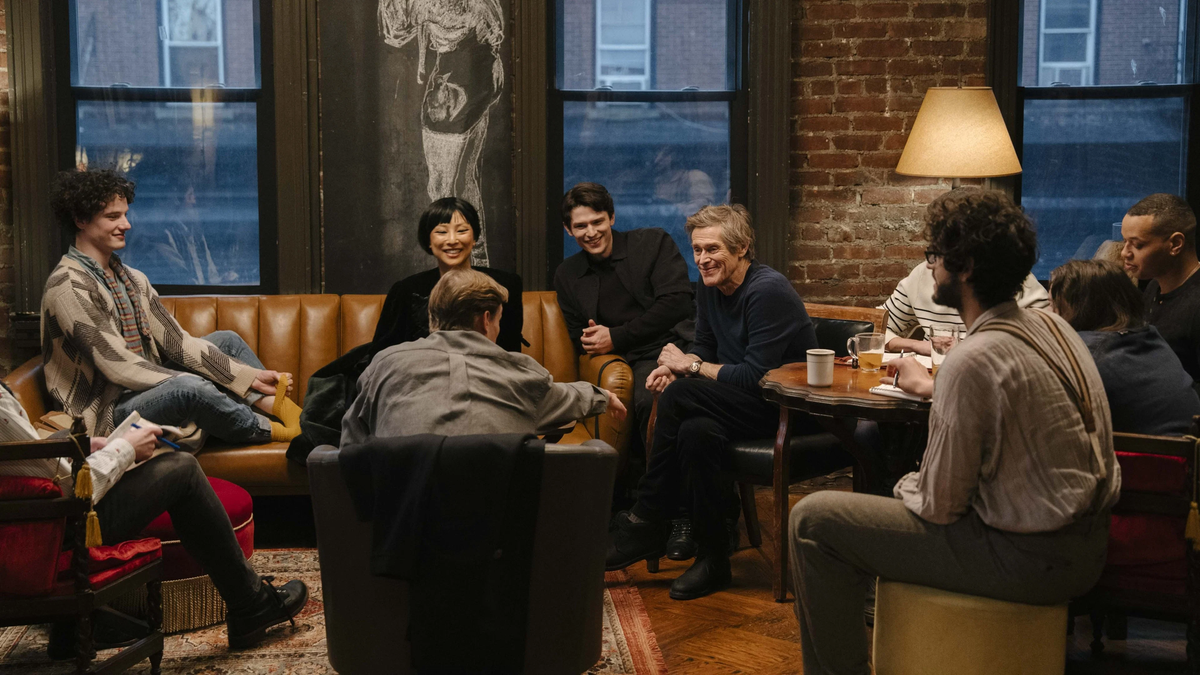
Thus, he's quite surprised to find Myers (Edmund Donovan) on his stoop, excitedly proclaiming him a genius. Saxberger is amused enough to humor the man, and after light protestation across a few chance meetings, accepts an invitation to meet the rest of his friends at their coffee shop hang out, a collective that would eventually be dubbed "The Enthusiasm Society". They're a group of self-identified intellectuals who scoff at mass culture and social media and technology and diminished attention spans and influencers, "whatever that means". They're essayists and playwrights and poets. Except they all seem to come from money in one way or another, replete with the kinds of connections that ease getting one's work seen. Not that we have any sense that much of it has been: for all the references to agents, we get but a single instance of any of their work being published, and it's an anonymous hit piece against the other members of the group. They're petty, they're pretentious, they're insecure, and they're lame as hell.
In other words, they're quite recognizable if you've spent any time with people who think deeply about (or create) art. I absolutely see parts of myself in many of the crew: the arrogance of Brussard (Clay Singer), the lack of confidence of Winn (Luca Padovan), and the frustrated self-seriousness of Meyers. They're instincts I fight, but I cannot deny their existence.
Which is why the way Samy Burch's screenplay and everyone's performances gently but constantly skewer them is so damn funny. They're so rooted in reality and ridiculousness, in sincerity and hypocrisy, in effort and incompetence, that the only response is to chuckle at them. Their earnestness is endearing and admirable, despite the fact that they're all assholes. Their inherent contradictions seem to intrigue Saxberger, their flattery igniting his desire to impress and even emulate them, such as going to the corner store to request "the kind of brand [of cigarettes] NYU students smoke". It boosts his own pride and self-importance, painting a warm smile across his face. He finally gets the courage to show off his poems to his work friends, which is a disaster: they tease him about who "really" wrote them, and in turn, her angrily asserts they're too dim to understand before storming out of the bar.
Here we get to the issue the movie never resolves, which doesn't quite collapse under its weight, but comes close. While the idea of a working-class guy allowing it to go to his head that young artists revere his work is solid, we don't build to it. It just kind of explodes out of him, an uncharacteristic outburst that completely changes the tenor of the interaction. This happens repeatedly. While he's laid-back and reserved ninety percent of the time, in certain moments that are convenient for the plot, he lashes out. It's clear that he feels like a fish out of water in his life, the soul of an artist setting him apart from his work buddies, but his average Joe upbringing prevents him from fitting in with those who can afford to be full-time failing artists while living in an ostentatious NYC loft. But there's little sense of that conflict until it erupts, which prevents it from feeling like a natural character extension, despite the emotion being understandable. What's most frustrating is that you can see a plethora of moments where such reactions or bits of dialog could have fit to stitch it all together seamlessly, but not a single one was utilized.
The grounding contrast to all of this is Gloria (Greta Lee), a far bigger and more important part of the narrative than me introducing her over 1000 words in would suggest. The Enthusiasm Society's only female member, and their only actor, she's adored for being glamorous, melodramatic, slightly older, and mysterious. But the more we get to know about her, the more we come to understand that the reason her and Saxberger are so taken with each other is that she's the only one who's not a rich kid playing pretend. She's constantly absent because she's either performing or rehearsing, and when the movie sees fit to show us her performance, it's incredibly revealing, both of her talents and what she has to do to get by. Her anxiety about pursuing bigger acting opportunities is understandable if distressing, but her choosing to confide as much in Saxberger makes perfect sense. In fact, he's the only one who gets to see her with her guard truly down, a wonderfully performed scene that truly lets Lee stretch her legs. Whereas the entire Society has felt phony and faux-erudite, calling into question whether the actors are skillfully embodying their characters or just not up to the task, Lee proves her's is very deliberate: in the short, few minute scene, her whole demeanor is different, the mystery gone, the glamour washed out. Behind closed doors, she is a completely different person, highlighting the contradiction of Saxberger's own dual existence.
Apart from this subplot and the needling of the intelligentsia, none of the movie's ideas are well-developed. So many are hinted at before fading away, forever remaining slight (but funny) jokes that elicit a chuckle, but nothing more. Far too many details of the past are omitted, leaning on implication to the point it becomes ambiguity. Even the time skips within the plot are murky: the Society goes from planning their grand debut to the day before with a disorienting swiftness, confusing the level and depth to which the personal relationships have ebbed and flowed. How much time has Saxberger been spending with them? What about his bar buddies? Does he always listen to his sizable collection of cassette-tape poetry readings, or just when searching for inspiration to write? Who even is Saxberger outside of the growing desire to be accepted by today's youth?
Late Fame never feels settled with its portrait of the artist as an old man. It's appropriate for the characters to be constantly searching, their confidence in their station undermined as soon as it crystallizes. But Burch and director Kent Jones keep wandering down alleys with no payoff, such as when they repeatedly show Brussard approach one of the "influencer zombies". Quieter but more damning is their hesitation to commit to Saxberger's reflection on his experience. With no friends to weigh in on his fifteen minutes of fame, we're forced to rely on Dafoe's face to understand Saxberger's inner life. To his credit, he does a marvelous job communicating through body language alone, before the dialog undermines him and calls our impression into question. Having only given us a brief glimpse of his life before meeting Myers, as he silently sorts mail during the opening credits, we have no other context for what he's feeling. So empathizing with him requires bringing even more of ourselves, blurring the line between text and baggage, the filmmakers losing control of their story.
What they've created is bursting at the seams with things to say and contrasting warmth with passion. But while a common filmmaking problem is simultaneously vomiting of all of them into the movie at once, Burch and Jones can't figure out how to land any of them hard enough to stick.