Marty Supreme
"I have a purpose. And if you think that's some sort of blessing, it's not. It means I have an obligation to see a very specific thing through. And with that obligation comes sacrifice."

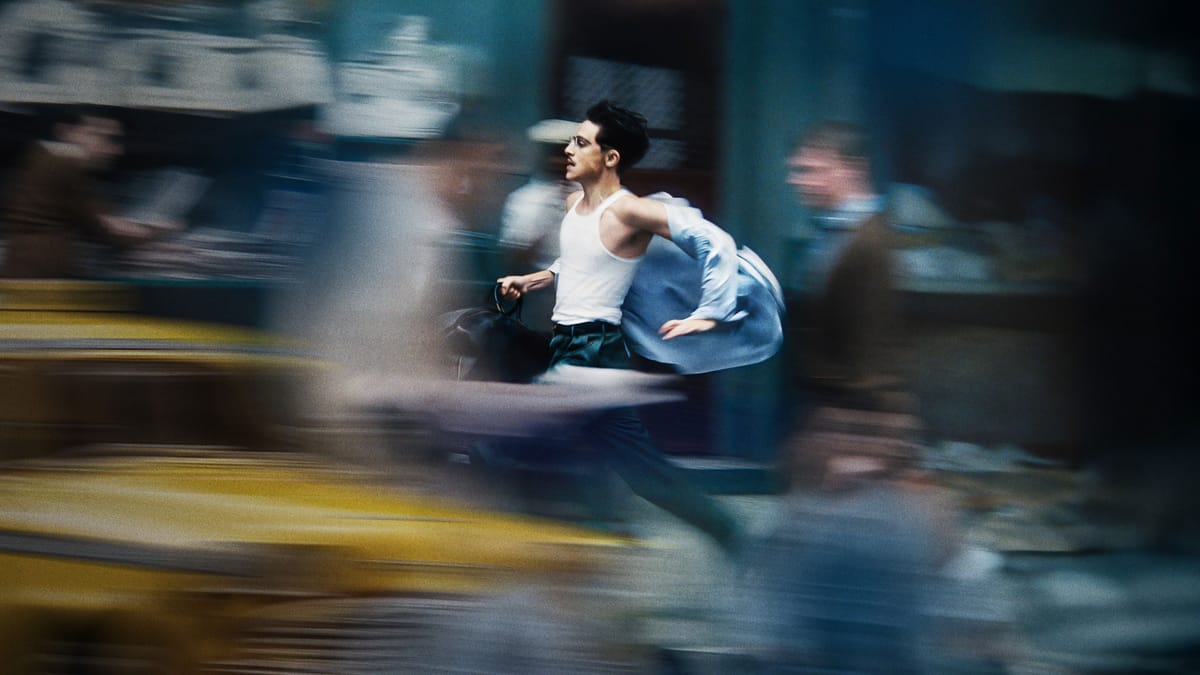
It does not take long for Marty Mauser (Timothée Chalamet) to show us just how serious he is about table tennis, and how little he cares about the consequences of his drive.
Needing money to fly from NYC to London for the 1952 British Open, he's been working in his uncle Murray's (Larry Sloman) shoe shop. When Marty returns at the end of the day to get paid, he finds Murray gone, and Lloyd (Ralph Colucci) closing up. Lloyd refuses to take the money out of the safe for Marty, so Marty retrieves the gun from his uncle's desk (so quickly as to suggest he might have planned for this), points it at Lloyd, and reissues his demand. Lloyd is unfazed; he knows that Marty is a world-class bullshitter, and wouldn't risk getting arrested so close to a tournament. But Marty's been talking this whole time, explaining why Lloyd should help him. Then, it comes to him. He presents the business card showing he's to be made manager, despite telling Murray to his face that he hates this job, and despite Lloyd's hard work and determination. In one fell swoop, he destroys this man's confidence, breaks his uncle's confidence, and gets the cash to compete.
This pattern is the template by which Marty crashes through life, exploiting any trust or kindness he's extended to further his own selfish ambitions. The result is that he's running in front of a building tidal wave that threatens to swallow him whole at any moment. He can never look back, never take a moment to rest, never hesitate for an instant, for fear of falling. It's hard to convey just how exhilarating it is to watch him navigate his self-made nightmare. His lack of concern with social decorum is simultaneously hilarious and uncomfortable, as he complains about the tournament lodging and cold calls long-retired movie star Kay Stone (Gwyneth Paltrow) and states that in the semi-finals against his friend Kletzki (Géza Röhrig), he's going to "finish the job that Auschwitz couldn't".
His unabashed confidence and lack of inhibition render him an intoxicating presence. He disarms people with his refusal to compromise or acquiesce to their requests or what's expected. And as much as it pisses them off, as much as it damages them psychologically (and sometimes physically), they keep coming back for more. His behavior gives them something they can't find anywhere else. Why does Kay continue her affair with the much younger man when he mocks her for having sex with him and attempts to steal her jewelry? Why does Dion (Luke Manley) remain his friend despite his abuse of Dion's kindness? Why does Kletzki continue to hang out with him, despite his showboating and general disrespect for his competitors? Because in addition to being an insufferable asshole, he is crazy talented, a great salesman, and a consummate entertainer. He is alive in a way few people ever are, his belief in himself and drive to grab onto what he's convinced the world owes him is unbelievable, and he refuses to take no for an answer.
Marty Mauser is based on real-life NYC table tennis champion Marty Reisman, but one can only hope the fictionalized Marty is a gross exaggeration of the real man. The screenplay expertly constructs Mauser to elicit revulsion, which Chalamet brings to life in an electric, Oscar-worthy performance. The destruction in Marty's wake is extensive and varied. Sometimes, it's just making people wait. Other times, it leads to their deaths. He's simultaneously so intensely unlikable that you root for his failure throughout the film, while also being so immensely entertaining and laugh out loud hilarious in word and in deed that you can't tear your eyes away, nor do you fully want him to stop. Marty is so frustrating because each slip of the noose reminds us that this is the way our world operates. The most powerful people, whether in business or politics or the public square, tend to be those who confidently say and do whatever the hell they want with nary a concern for anyone else. They claim they've gotten where they are entirely on their own without any help from others mere moments before asking for a room to spend the night or to borrow a friend's car. They're experts at pushing the envelope as far as it can go, and knowing the exact right moment to pull back and offer meaningless contrition to convince those operating in good faith to cut them some slack. Slack which they will immediately exploit for their own means.
Despite the character-centric plot, this is fundamentally a sports movie. Table tennis is what drives Marty, and all his antics are in service of scraping together the money for the next tournament. Especially after his early defeat in the finals at the hands of Koto Endo (real-life deaf table tennis champion Koto Kawaguchi) and his penhold grip. As a result, you'd expect the table tennis sequences to be some of the most dramatic of the whole movie, and you would be correct. The camerawork is fluid yet clear, the play is fast yet easy to follow, and their varied shots are perfectly calibrated to increase your heart rate as you watch them lunge for the ball. I had to stifle the urge to jump to my feet and applaud at the conclusion of each game. Yes, the ball was CGI in the wide shots to give director Josh Safdie the control he required. But it's not at all distracting: you'll only notice if you're explicitly looking for it. Additionally, Kawaguchi's and Chalamet's authentic skill helps to sell their motions and reactions, and footage from their real points was used in many of the tighter shots. All of this brings the energy and excitement of a real game to each scene, to say nothing of the ever-increasing stakes.
Although the supporting cast is fleshed out with a bunch of small characters who have just a scene or two to bask in Marty's scorching light, each adds so much texture and depth, and explains how a man such as he can persist. Wally (Tyler Okonma) illuminates the world of the hustler that Marty comes from when they rip off some arrogant jerks at the bowling alley. His mother (Fran Drescher) is the queen of the guilt trip, although Marty has since become immune, but whose influence helps explain both his own skill at conning and his bizarre relationship with a woman thirty years his senior. And Ezra, played by Abel Ferrara as the gruff and tough embodiment of NY, demonstrates what happens when a hubristic punk runs up against a ruthless gangster.
Of course, that omits the three most important figures in his life. Paltrow is outstanding in her first movie role in six years (and first non-MCU role in ten), wonderfully conveying every bit of bitterness and resignation, even perfectly dominating a late scene in which she gets to give this little twerp an incredibly satisfying dressing down as she's finally seeing right through him (maybe she always was). Her cucked husband is pen magnate Milton, played by a quietly terrifying Kevin O'Leary, who's attempting to use Marty's abilities to break into the Japanese market. While Marty is frequently able to get under his skin, Milton holds actual power in their relationship that he's not afraid to wield, and O'Leary does so with a palpably devilish glee.
Most notable is Marty's girlfriend and soon-to-be baby mama Rachel, played with an unquenchable fire by Odessa A'zion. She's been one of my favorite actors since popping in Fresh Kills, so I've been delighted to see her show up in a bunch of movies throughout 2025. From jump, Rachel is the only one who can go toe-to-toe with Marty, matching his talent for misleading people from the moment she appears on screen. A'zion is excellent from start to finish, nearly as convincing as Chalamet, if a bit less smooth, given that while she's clearly very practiced, bullshit is his religion. Still, there's a couple scenes in particular that require A'zion to emit the same energy as Chalamet, and you never doubt her for a second.
Tying everything together is the music. Most memorable is the odd mixture of 50s and 80s needle drops that lift this movie out of time, which both comments on the eternal struggle of its subjects, and casts it as a reflection with the benefit of thirty years of hindsight. But Daniel Lopatin's score is the highlight, unique in its dark, pulsing, electronic beats punctuated by distant, screaming saxophones and ethereal soundscapes. It sounds like nothing else while perfectly complementing every moment of the film, adding to its propulsion and underscoring the drama. It's easily one of the best of the year, and should be in the conversation come Oscar time.
The stew that emerges feels like a sports movie version of Uncut Gems, but if Howard Ratner was actually good at what he did. Like Good Time, but just enough above-board to not make him a criminal. When compared to his brother Benny's first solo effort, it begins to seem like all the anxiety and bold choices and propulsion lives in Josh. While both were able to coax outstanding performances out of their actors, only one of them has anything meaningful to say about life, only one has an undeniably infectious energy, and only one will be discussed for years to come. Maybe if their quality was more comparable, there wouldn't be such a strong impulse to compare them. But as it is, only Marty Supreme is positioned well for awards season, and deservedly so.