Mercy
"You are speaking to the Mercy Court. I'm AI Judge Maddox."

It's telling that the man most associated with evangelizing the screenlife format has only directed a single such film. Timur Bekmambetov's Profile was a political thriller which garnered a shrug in the same year audiences went nuts for the wonderfully acted and fully realized film he produced, Aneesh Chaganty's Searching. In fact, Bekmambetov has produced many of the most notable screenlife films, for better or for worse: a new wave of viewers was introduced to the format last year with War of the Worlds, which was instantly added to "worst of all-time" lists. Still, his consistent production of unique looking movies (e.g. Hardcore Henry, shot entirely in the first-person) implies he bolsters interesting projects rather than makes them. So it's appropriate that it's been decades since any of his directorial efforts have received any fanfare.
Mercy is not, in fact, a screenlife film. Instead, it blends extended screenlife sequences with a traditional single-location thriller, continuing to play with the way technology allows us to impact the world from afar, while also stepping back to demonstrate the way it rules our lives.
It has the benefit of starring two A-list actors. If there was any doubt of Rebecca Ferguson's stature, look no further than the lament of Mission: Impossible fans at her exclusion from The Final Reckoning. And Chris Pratt has known Bekmambetov since they worked together on Wanted, during which time he became a comedy star on Parks & Rec, then transitioned to a bizarre, snarky action leading man with limited success outside of the MCU. Only a circuitous route could land you here.
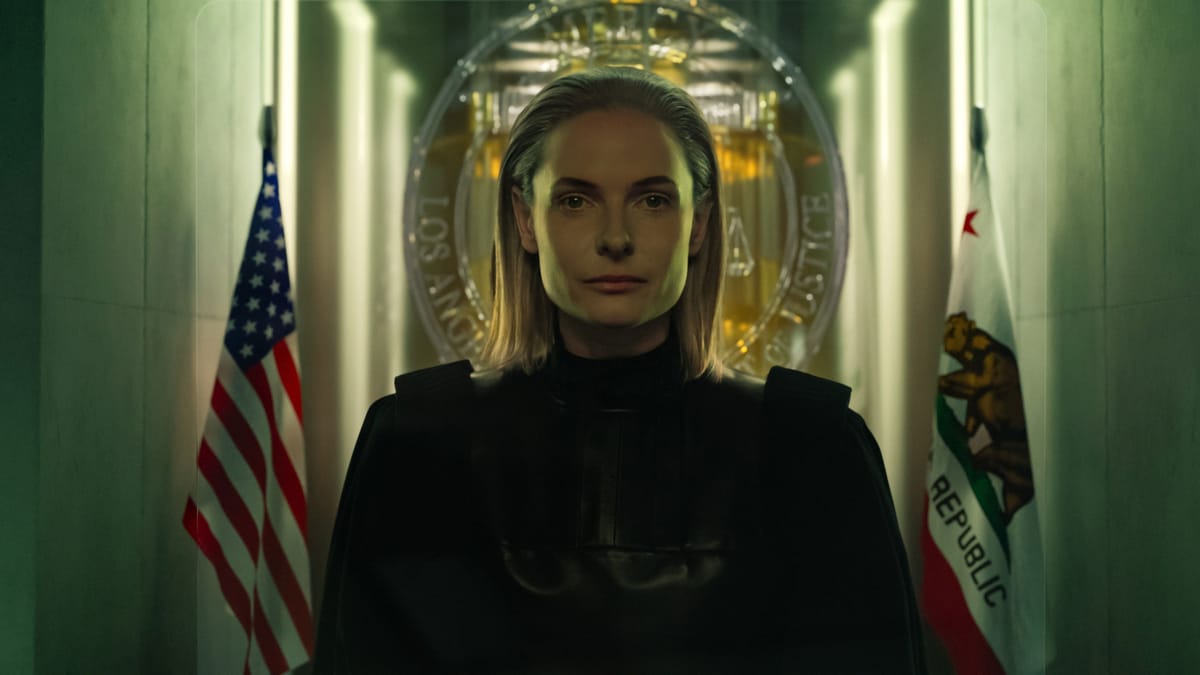
Our time is largely spent in a single room in the Mercy Court (a name which would make George Orwell proud). Officer Chris Raven (Pratt) is "on trial" for killing his wife Nicole (Annabelle Wallis) mere hours earlier. But calling it a court deliberately evokes the wrong image. Raven is bound to a chair as if about to be electrocuted. He's surrounded by digital walls, blank save for the one directly in front of him, until he's inexplicable immersed in a recreation of the outside world. He's staring up at the imposing, stoic face of AI Judge Maddox (Ferguson), which sits perfectly in the uncanny valley, an effect deepened by the sickly green glow of the adjacent stone walls "reflecting" off the robojudge's face. Raven has ninety minutes to reduce the probability of his guilt below 92%, or he will be executed: for those the AI deems almost certainly guilty, presumption of innocence does not apply. As the Court's biggest proponent before his arrest, Raven angrily declares the futility of his task: it was constructed as a kill box, with the "trial" added to satiate the public and politicians.
In an LA reminiscent of Mega-City One, where the poor and unhoused are herded into decaying and dangerous "red zones", the movie's energy comes from the state's constant and broad surveillance of its citizens. Personal computing devices must be registered to the city's cloud, allowing Raven unfettered access to anything on the network, from personal phones to corporate mainframes to municipal cameras. With Maddox's ability to quickly correlate disparate data and Raven's uniquely human ability to think illogically, they chew through possibilities as Maddox calmly informs him why his emotional appeals do nothing to move the needle. But it gives the audience tons to look at as Raven digs through screens and files, and editors Austin Keeling & Lam T. Nguyen deploy screenlife's hallmarks to keep everything clear and engaging.
What makes the story work as long as it does is that Raven is an asshole. And not a grizzled, jaded cop, nor a by-the-book stickler. He's a mean drunk, an inattentive husband, and an absent father, stemming from turning to booze to cope with the death of his patrol partner, Ray (Kenneth Choi), a couple years ago. Raven is simmeringly pissed the whole time, as Pratt capably sheds the bubbly, quippy armor of Star-Lord, snapping at the people who agree to help him via phone. Despite the believability of his guilt, we're challenged to refrain from rooting for his execution as long as doubt remains, no matter how much we dislike him. It's an even more fraught ask given his employ by the very apparatus that enforces the technofascist order.
Bekmambetov's approach to worldbuilding is to throw a bunch of unremarked upon background details at us. Black market phones, the aforementioned "red zones", a couple blink-and-you'll-miss-it moments of police brutality and abuse of power, the terror of their "shoot first ask questions later" ethos, and more. AI is of course a central concern, especially given its increasing role in shaping our lives, and its insistence that it has all the facts, failing to understand the measures people will take to evade its grasp. He doesn't have much to say about these horrors. They're largely assembled from well-worn tropes, and none of them dovetail together very nicely. But the Frankensteined future LA is recognizable enough to communicate the fundamental idea that things are Very Bad, and that they're not as far removed from our present as we'd like to think.
This lack of focus means the story is a house of cards, no matter how compelling it might be. Sure enough, the biggest wobble is about halfway through, when Raven pushes Maddox to express its gut feelings, causing it first to state it wasn't programmed to feel, then momentarily glitch. Another trope, although a pretty low effort version. The lack of effort or cleverness it takes Raven to exploit this weakness is a sign of things to come.
Despite the action in the real-world that Raven is both driving and witnessing, everything is small and contained for seventy-five percent of the film. But the dam fully breaks down with the director's lack of restraint. As Raven's investigation progresses, Bekmambetov cannot help but spin it into a full blown action movie, complete with broader implications for their world and the systems that comprise it. It literally bursts out of its confined space into a high speed, high stakes chase as we look on. The tension breaks, and with it, our investment. Maddox behaves in ways completely baffling, highlighting the shoddy script less concerned with serving its story than connecting the dots, which it does poorly. Even more frustrating, plot threads that were slyly set up earlier to at least inject some intrigue into the bombast are tossed out in favor of drawing clear lines between hero and villain.
I've spent a lot of time in the past year noting movies that fall short of greatness courtesy of a disappointing climax, even taking a step or two backwards. None have fallen on their face (servers?) as hard as Mercy. Not only does it throw boring twist after twist at us, not only does it turn everything into a grand plan, and not only does it muddy its ideas about the dangers of turning our lives (and government) over to AI and cops in the name of public safety. It completely betrays its entire conceit in the name of angling to become a blockbuster. The escalation comes on suddenly and swiftly, so that while it may take you along for the ride in the moment, as soon as you think about it for half a second, your brow will furrow.
That it came so close to rising above its Dumpuary placement makes its crashing back to Earth all the more frustrating, and continues the month's disappointments, so far only broken up by 2025 festival movies finally getting a wider release.