Minions & Monsters
"Baby! Piñata, carbonara, lasagna."

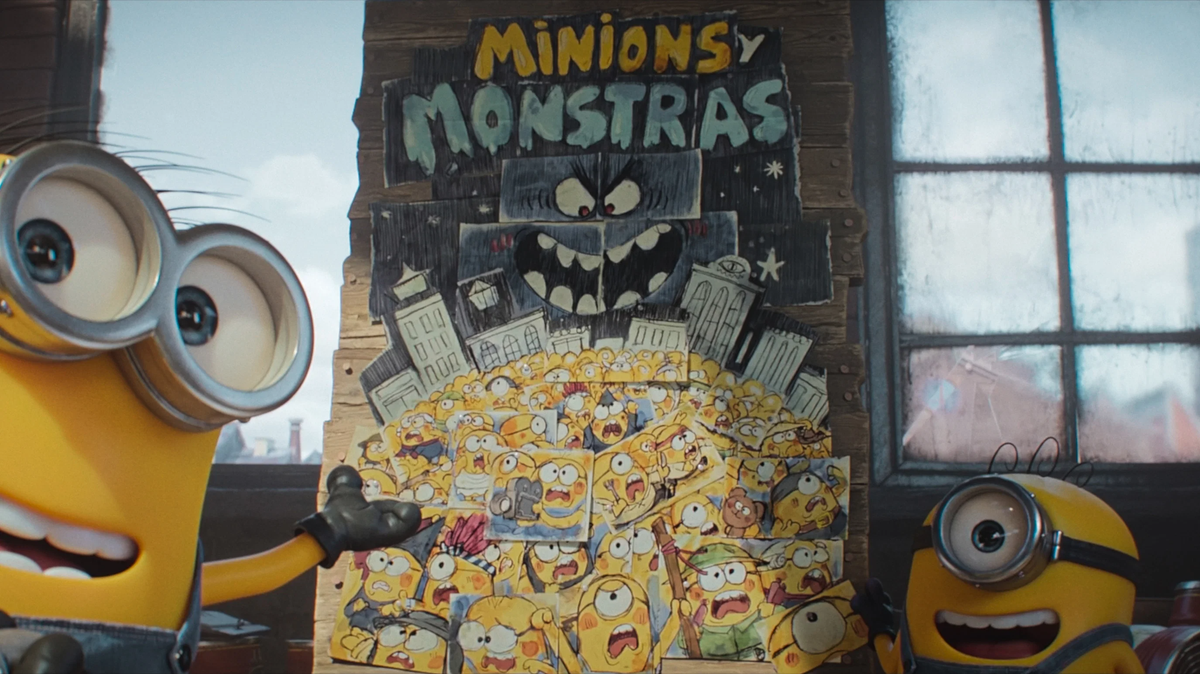
There is no reason for me to have any interest in seeing the new Minions movie. Sure, the original Despicable Me was great, and the sequel was an excellent excuse for an early date with the woman who would become my wife. But as characters whose humor is largely built on loud, babbling anarchy, even their increased centrality in Despicable Me 2 got a little grating. Sure, their goofy slapstick is often entertaining, and who amongst us hasn't periodically let out a little "Buh boi!"? But the mere thought of them carrying an entire narrative on their back, while screaming unintelligibly and running around like maniacs, was unbearably exhausting.
Minions & Monsters bore that out, while also demonstrating that their comedy and story potential remains strong, even fifteen years after their debut.
One particular scene finds the little yellow hoard adorned as knights on a 1920s(-ish) Hollywood film set, facing off against a bunch of extras dressed as Vikings. Their chintzy prop weapons are useless, causing them much distress. So they look at each other, shout something in Minionese (yes, that's what it's called), excitedly pull out chainsaws and spiked darts and flower pots and the like, and go to town. It's a short, meaningless scene, but it's an absolute delight that wonderfully channels their chaos in an entertaining direction. Lemme tell you, as simple as it is, watching a Minion hammer a dude into the ground with a wooden mallet at least three times his size that he pulled out of thin air is comic gold.
Minions & Monsters does not just include a single scene that gestures at Hollywood history; it's the whole premise. It starts with a modern-day tour guide (Allison Janney) at a film history museum expressing shock that no one in her young tour group have ever heard of the Minions, despite their importance to the history of Hollywood, having literally saved cinema. This is driven home by the opening montage in which they're inserted into early films with impressive fidelity, especially as it includes scenes the average cinemagoer is unfamiliar with: while everyone knows the Man in the Moon with a capsule in his eye, fewer have seen the cannon and line of chorus girls that precede its firing, never mind Workers Leaving the Lumière Factory. Would it surprise you that director (and the voice of all the Minions) Pierre Coffin co-created the little guys as the co-director of Despicable Me?


Anyways, we proceed to meet the Minions of the late 19th and early 20th century (different from the tribe that would link up with Gru), nomads constantly searching for a Big Boss to serve. They find a few archetypes, including a wizard (Tim?) they accidentally kill by summoning a deceptively deadly bunny rabbit, after which they make off with his spell book. Their next adventure lands them in Hollywood, where director Max (Christoph Waltz), modeled on Erich von Stroheim, instantly makes them the star of every iconic classic, a feast for the film nerds in the audience. Same when the plot syncs up with Singin' in the Rain, Babylon, and The Artist: the talkies come, and although Minionese contains far more loanwords than it originally did, it's not enough to avoid "Rosebud..." being replaced by "Poop!" Unable to handle the transition, the Minions are once again without purpose. Thus, the main plot begins, which blends The Day the Earth Stood Still with classic monster movies, from H. P. Lovecraft to the Universal monsters to The Blob.
Once they have to hold down an actual story, and James must evolve into more of a character, the movie devolves into a relatively bland, forgettable mush. The specificity that defined the first half's comedy melts away, replaced by Illumination's standard grab bag of plot points mixed with general goofiness. Forced to anchor a narrative instead of a sequence of referential gags, that approach to humor just doesn't have as much juice.
It doesn't help that if you have any knowledge of the history of that time period, the timeline is distractingly out of whack. I understand the desire to parody The Maltese Falcon and Citizen Kane, but given their release fourteen years after The Jazz Singer, it's a bit late for an inability to speak causing the Minions problems. On the other side, how did they appear in Train Pulling Into a Station in 1896, when they only discovered Hollywood by inadvertently interrupting a grand Western chase scene, the kind of which only began following the success of The Great Train Robbery, nearly ten years later? Even apart from film history, Debbie (Zoey Deutch) is a suffragette, and women won the right to vote in 1918. None of that ultimate matters, but then a blink-and-you'll-miss-it moment informs us it's 1927, which does not square with all of the above. Such incongruous specificity ensures part of your attention will always be spent trying to reconcile the clues.
Additionally, references don't substitute for story. Sure, it was fun to see the rewinding Universal logos, the Illumination fanfare with characters styled like Merrie Melodies, and their acknowledgement of the silent comedy masters as they ran through Modern Times, Steamboat Bill, Jr., and Safety Last!. But any time we lock onto James, Henry, Ed, and Dick, or take stock of Goomie's (Trey Parker) plan, or spend time with Dort (Jesse Eisenberg) and Debbie, the air goes out of the balloon. Illumination has long struggled to craft engaging narratives, choosing instead to lean into the loud, obnoxious characters that repel adults and attract children. While not inherently a problem, Pixar continues to demonstrate that you can do both at the same time, making Illumination look lazy by comparison. It's further exacerbated here, since the narrative doesn't really kick in until the second half, so they have even less time to pull off a pastiche of classic genre films while speedrunning some basic character beats.
While you'd be a fool to come into a Minions movie with an expectation of emotional dynamism, there's more character development than you may expect, simple and straightforward as it may be. While sophisticated storytelling is not their focus, the layers of metanarrative at work call to mind Wes Anderson's most celebrated films. And while known for the kind of unbridled chaos that drives parents to drink, there are enough jokes for them alone to lessen the pain just a bit.
All of which is to say that while this movie doesn't quite get there, it does well enough to be worthwhile, especially in light of the joyful highs of the first half.