Nuremberg
"We are able to do away with domestic tyranny only when we make all men answerable to the law, so that it can never happen again."

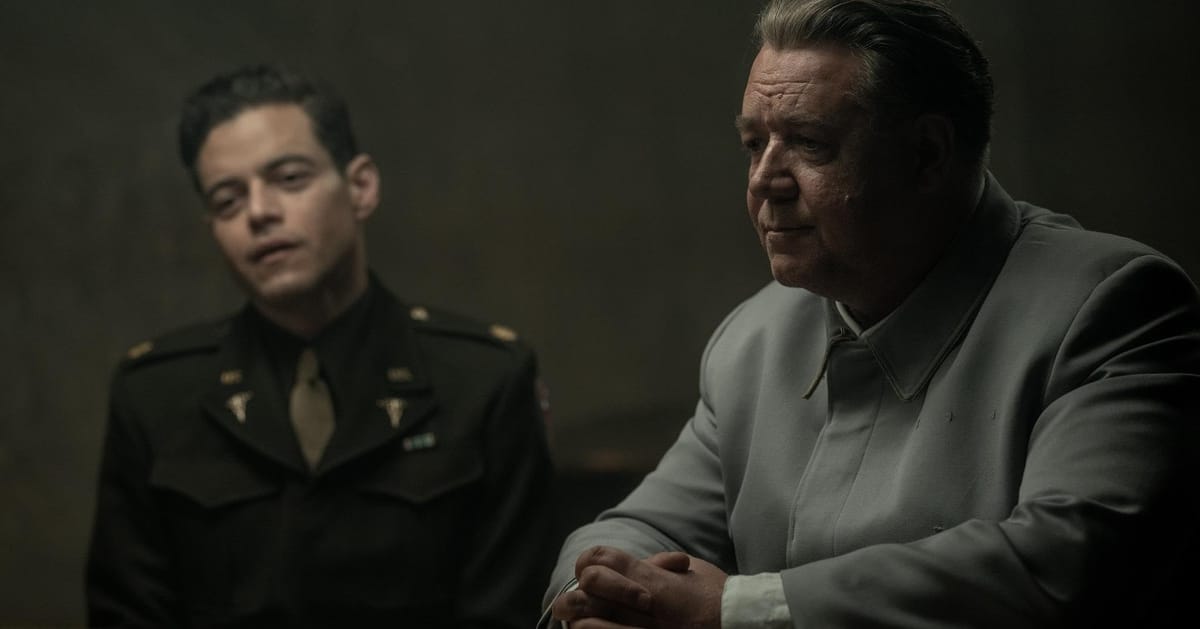
It doesn't take a rocket scientist to figure out why a film about the Nuremberg trials, featuring a handful of A-list actors and rising stars, is being made now (you may be sick of me referencing the current political climate, but I'm even more sick of their heinous shit). Its particular angle is telegraphed early on, when Army psychiatrist Douglas Kelley (Rami Malek) declares his intention to use interviews of the recently captured Nazi high command as a way to investigate what makes Germans different from Americans, and how it enabled the rise of a racist, militaristic, authoritarian state. Of course, his ultimate conclusion could only ever be that such a difference does not exist. Further, if we allow ourselves smug superiority, we remain vulnerable to the ascension of a leader who "speaks the truth" by promising the Moon in a time of widespread despair. It's an idea as prescient as it was plain to see, and yet the closing title cards inform us of the trouble Kelley had getting anyone to take him seriously. Same as it ever was.
En route to this conclusion, we spend much of our time with Kelley as he builds trust (friendship?) with Hermann Göring (Russell Crowe), trying to peel back the layers of how this man works, compiling all the information he can for the book he plans to write. That story line is split with with US Supreme Court justice Robert H. Jackson (Michael Shannon), who's been tasked with constructing (in personnel, in legality, and in space) a way to try the surviving Nazi leadership in a court of law. No easy task, since in 1947, there was no precedent for law crossing national borders (the Geneva Conventions would be crafted two years later). Additionally, he would be the lead of the multi-national prosecutorial team, setting the stage for Kelley's activities to intersect with his own.
Despite the simplicity of the conclusion, the route takes nearly 150 minutes to traverse owing to melodramatic pit stops of questionable utility. The structure overlaying the events of the film is that of a historical fiction gunning for an Oscar, complete with every single cliched phrase that could possibly be uttered in a war film. Kelley is morally conflicted, and his impulsive and individualistic tendencies lead him into repeated conflict with his superiors. So much so, in fact, that they assign the straight-laced, by the book Dr. Gustave Gilbert (Colin Hanks) to work with him on assessing Göring. Frustratingly, he is deployed in exactly the way you might expect, except his complete lack of impact on the plot.
It's an issue that arises multiple times. Writer/director James Vanderbilt includes various asides that feel tiresomely constructed for an injection of drama, but never come to anything, rendering their inclusion baffling. It's as if he's working his way down the Oscar-bait checklist. A few of these asides do deepen the emotional tenor of the film despite their lack of narrative importance, such as Kelley's relationship with Göring's family. But even some that drive the plot forward are so underdeveloped that they escape the mind nearly the moment they enter it. While I don't think making journalist Lila (Lydia Peckham) Kelley's love-interest would be a good choice, she would have at least have been a one-dimensional character, instead of a zero-dimensional plot device.
Much of this sloppiness seems driven by Vanderbilt's interest in the relationship between Kelley and Göring. At least his focus is born out; their interactions are by far the most engaging part of the film, a cautious sparring match that opens with Kelley quickly uncovering that Göring has been lying about his comprehension of English in order to covertly listen in on conversations, seeking any advantage he can get. From there, the game is all about the line between getting to know someone and gaining affection for them. Is it a staunch insistence on maintaining patient confidentiality? What about visiting Göring's wife and child? Where does Kelley's obligation to his patient end and justice begin? He certainly pushes that last question, going so far as to carry out forbidden favors for the war criminal under the nose of his superiors. At some point you're forced to confront the question of who's manipulating who.
What makes this back-and-forth work is the gulf in energies between the men. Malek (mostly) pulls off Kelley's vibe: twitchy, confident but on edge, and overeager. He can get a bit lost in some of the subtle moments, and isn't always successful at conveying Kelley's thoughts in silence, although he perks up for a few grand explosions of emotion late in the film. However, it's Crowe who's really cooking here. The gently bemused smirk, the laid back jovial confidence of a man who knows something that you don't, the quiet tension in his every motion alerting you to his ability to snap at a moment's notice, as we see a few times. Despite spending 95% of his screentime sitting down, he takes command of every scene he's in, projecting an inner calm that pisses you off even more than his smug mug. The performance is perfectly calculated to unsettle the viewer but not call attention to itself, an impressive tightrope walk that Crowe pulls of admirably.
It helps that he mostly avoids the quip machine. Because sitting alongside the tired, trite dialog you've heard a million times before, are quick, snappy, sarcastic retorts that feel more becoming of a Marvel movie than an adult drama about the rot in men's souls. The subject matter is fundamentally bleak, dealing with some of the worst atrocities in human history, and staring into the eyes of evil. To undermine the pit it forms in your stomach with playful banter creates an incredibly awkward tone that is rarely abandoned long enough for the weight of its events to breathe.
Adding to the dissonance is one of the most confounding decisions I've seen on screen this year. Shockingly, Göring's trial includes real footage from the Allied liberation of the Nazi concentration camps. Suddenly, a movie that wanted to distract us from the deeply upsetting nature of war crimes is shoving our faces in some of the most disturbing brutality ever witnessed. Even more bizarre is that Vanderbilt frequently cuts away to show the courtroom attendees' reactions to it, especially Kelley's and Göring's. It's another indication that Vanderbilt is worried about his audience's appetite for darkness, and more proof he's failed to control the movie's tone. Even more frustrating, it's a set up for the best scene of the movie, in which Kelley furiously confronts and condemns Göring as either incompetent (if he didn't know about it despite being second-in-command) or evil (if he did). While effective, using such sacrosanct footage to bolster your story's emotional stakes is misguided at best, and exploitative at worst.
The thought process leading there is a pretty good microcosm of the whole film: well-meaning, decently executed, but with a profound lack of understanding why. Most of the pieces are in place, so when going through the motions, a cursory glance just reveals that something is off. In this case, it's faith in the audience, and the filmmakers' conviction that they know the right way to make this thing. No matter how uncertain it is, that is the path to making powerful, poignant films of any sort. What we've got instead is a long, uneven experience that hits on some ideas before snarking away from them, then punches you in the nose with footage of the Holocaust. Not exactly a failure, but far from a success, Nurenberg will quickly sink into the sands of time, dwarfed by its far more impactful and narratively surefooted predecessors.