One Night Only
"If I could fall / Into the sky / My vagina / Would be just fine"

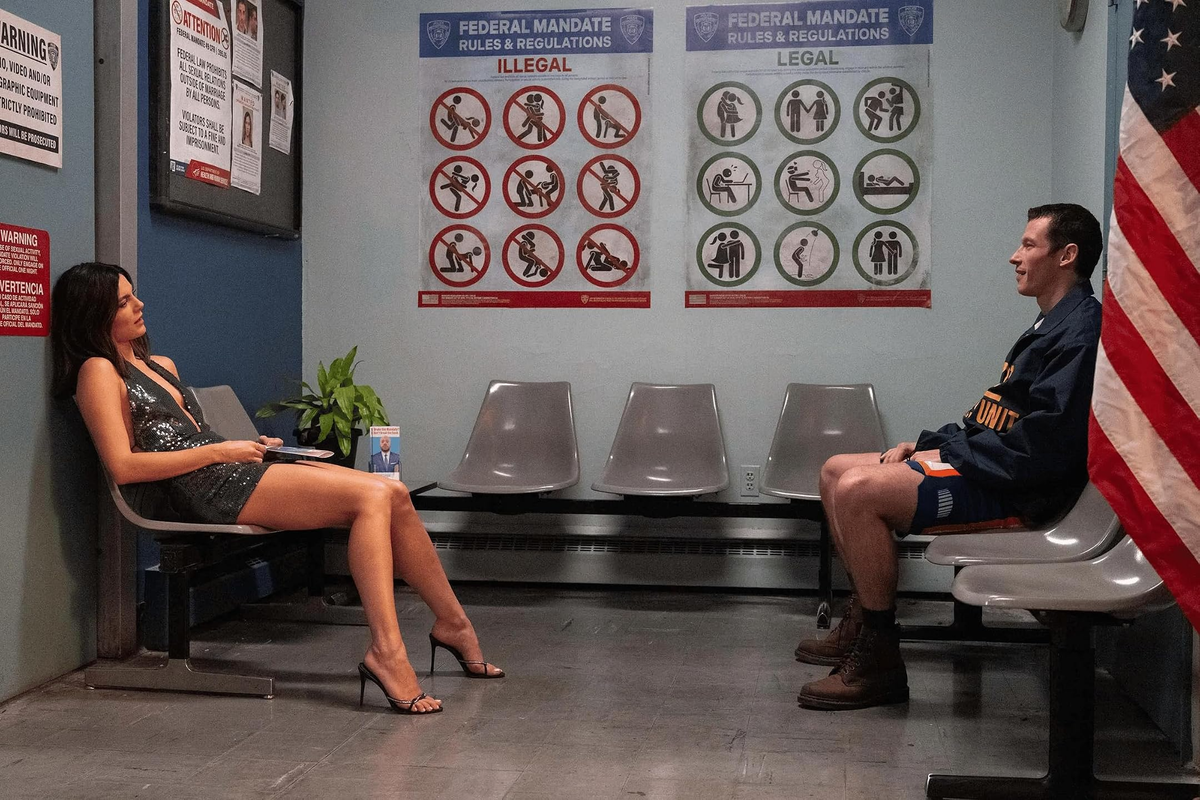
On its face, the premise of One Night Only is preposterous (although it feels less so every time John Roberts opens his mouth). Three years ago, pre-marital sex was outlawed, save for a single twelve-hour pressure valve once a year. Why wouldn't people tell the government to screw themselves while they screw each other year-round? Because the law also mandated everyone receive a biomarker, a "smart" tattoo that alerts the authorities if two unmarried people with elevated levels of hormone-detected arousal are near each other. Even on The Night, contraception is compulsory (although the particulars of its enforcement are never addressed). The result has been a conservative wet-dream: young people frustrated by The Mandate throwing up their hands, admitting KO by horniness, and getting married (the divorce rate in this world is also never addressed). The Night itself is a nightmare of insatiably thirsty people, and has erected a cottage industry of products and companies and cheeky advertisements targeted squarely at the needs of this mad-dash fuckfest, a perfect example of late-stage capitalism's willingness to (passively or actively) trample the rights of man to capitalize on oppression.
There's a version of this movie that leans into the social commentary. Say, following a free-love commune turned underground terrorist cell, or a bright-eyed lawmaker who comes to loathe the fascism they (let's be honest, he) helped wrought, or even someone just determined to subvert the system for themselves. But it's not the early 00s any more; systems loom large enough to stamp out our belief in the impossible, people have forgotten the nobility of righteous resistance, and gun kata isn't real. Writer Travis Braun and director Will Gluck are certainly aware of this angle; Allie (Monica Barbaro) lectures a cop with "Don't you have anything better to do?", and we see a few bits of a television interview in which the stuffiest shirt you ever did see (Senator Holloway, played by Tom Johnson) lamely and xenophobically defends the policy. But each feels half-hearted at best, more an obligated response to test audience feedback than anything they care to explore.
Granted, they never pretend otherwise; the movie opens on a series of title cards laying out the situation, and concludes with the firmly tongue-in-cheek line, "It was a lot." Thus, the filmmakers instantly plant their flag on the side of "Just roll with us", attempting to short-circuit any critique of their refusal to engage with the fallout of their conceit. It presents an absurd world, one which requires they lean into it incredibly hard for it to have any value.
Fortunately, that is the goal. Gluck's previous romcom was much bigger in scale (and a big enough hit to earn its stars brief cameos), but severely hampered by the strange desire to keep everyone on their leash. Despite One Night Only compressing the vastness of NYC with repeated characters (and lampshaded by Allie upon one such encounter), every detail of it is huge and outsized, milking every last drop of humor from it. Without such committed performers, it would not have worked. But Barbaro proves a pitch-perfect and relatable sad sack while wielding facial expressions like barbs. Her opposite and co-equal is Callum Turner (playing Owen), who keeps pace with the tone she sets, but gets to engage in a lot more physical comedy, at which he proves shockingly adept. Whether tumbling through a window, recoiling from a comment about his receding hairline, or tacking on a small but exaggerated dry heave following the vomit that ruins their meet-cute, Turner pulls off all that's asked of him with aplomb, ensuring you have precious few moments between belly laughs.
That's not to say One Night Only is devoid of heart; it just picks its moments carefully. The smartest decision the screenplay makes is holding the two leads apart for quite a while, despite the obvious chemistry between them. We begin by following each separately: Owen's girlfriend Malika (Maya Hawke) dumps him right before the festivities begin in oder to sleep with a neighbor, and Allie's best friend and wingwoman Jacinda (King Princess) abandons her for Prince Tejan (Okieriete Onaodowan) (accompanied by the perfect comedic "A Thousand Miles" needle drop which morphs into an even more perfect rug pull). While both are romantics, and thus reluctant to hunt for sex that leaves them feeling hollow, the prospect of waiting another year to maybe have sex again is equally as daunting. Well, and each is more or less forced out for the evening. Owen lives with his single mother (Molly Ringwald), who's made plans with Richard, played by a delightfully crass LeVar Burton. Allie's roommate (Quintessa Swindell) feels no need to treat this night as anything special ("This night is for the straights. We've been working around your rules since...well, the Bible."), and so has taken a lucrative job baby-sitting the world's worst twelve-year-old (Mateo Ray), whose every comment is something about how "the only sitting you should be doing? Is on my face", to their great disgust and our utter delight.
The chaotic, parallel paths of Allie and Owen keep them meeting and conversing, providing small but meaningful opportunities for their attraction to grow and for us to better understand them, before spiraling back into gut-bustingly funny madcap shenanigans that inevitably send them on their separate ways again. In another clever twist, convenient circumstances never get in their way; each time they split, it's of their own volition. There may be a twinkle of regret in their eye (as much for the abandonment as for a stolen condom), but the world never conspires to keep them from each other. Rather, as the night goes on and each chases what they want, more and more it highlights how much they value being seen for who they are over achieving some fantasy. Not the most original emotional core for a romcom, true. But incredibly effective, especially when the script allows the characters to come to that realization so naturally.
Throughout the film, our cinematic blue balls are further emphasized by most needle drops either being played for comedy, or else featuring crescendo without ever really bursting into a satisfyingly bombastic chorus. The score gets in on the fun too, both with the theme whenever they're together, as well as its repeated usage of the restrained, dream-like opening of Robyn's "Dopamine". The importance of music to the plot (after all, Allie is a singer of sorts) makes it an even smarter choice that at each moment they reunite, the sound completely cuts out, score and all, the absence emphasizing the importance of the moment before the rest of the world bleeds back in.
In a movie that eschews simply performing the genre's tropes, instead electing to converse with them, it's fitting that the climax involves another fake out. Granted, it's heavily telegraphed, in part by hitting the more obvious ending incredibly hard, a move far too cliché for a romcom where our protagonists are prevented from disastrous one-night stands with other people by dumb luck rather than "values" or "ideals". That the result ends up calling out to In the Cut and Sleepless in Seattle at the same time is impressive, leverage the iconography of each in interesting ways.
With the exception of Hit Man, which barely got a theatrical release, this is easily the best romcom of recent years. You could point to both Pillion and Materialists, but their lack of concern with and subversion of the genre's traditions is what enables their greatness, putting them in a different class from One Night Only. The only other contender is my beloved The Roses, but for as delightful as it is, neither the chemistry between the leads nor the energy of the story is sustained as beautifully as it is by Barabaro and Turner. That it never falters even when slowing down for drama is a credit to Gluck's direction, elevating it far above every single one of his previous efforts (apologies to Emma Stone). It stops short of the highs of the 90s classics, its high concept reflecting our post-modern distaste for a straightforward story of two people falling in love. But if there's any alchemy that can hope to resurrect the genre, Gluck has found it here.