Onslaught
"It is done."

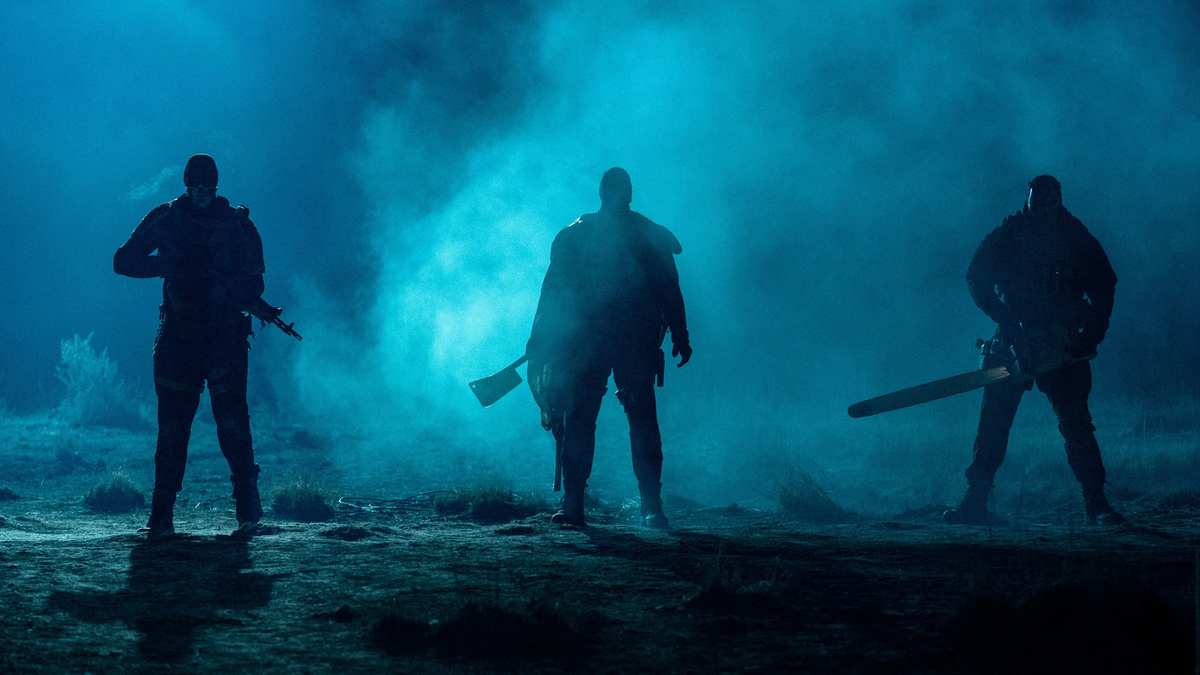
Director Adam Wingard hasn't exactly had an illustrious career since gaining widespread attention for You're Next, a nasty home invasion thriller with knives out for the ultra-rich. His immediate follow-ups were promising, as he participated in a handful of anthologies and eventually another feature, The Guest. But since then, he's taken on a controversial remake, a reviled live action anime adaptation, and a couple films in the MonsterVerse. It's now been over a decade since he's dipped into original storytelling, and while I'm not sure the world was exactly clamoring for his voice, the gusto with which he attacked his new project argues that maybe it should.
The story is relatively thin, setup by and structured around our country's disregard and abuse of veterans, despite the powerful's insistence on plunging us into war after war. The opening credits hammer home the corruption at the core of American leadership. A breakneck montage whips through articles and clippings and footage concerning torture and combat and the military and the Nazis and more, overlaid with congruous sound bytes from presidents stretching back to WWII (although conspicuously omitting both Biden and Trump), all driven with incredible energy by the title track of Matthew Pusti's pulsing score, easily one of the best of the year so far. It's high on style and cinematic tradition with a grounding (if not exactly "inspired") idea, a perfect microcosm of the film as a whole.
Take Dan Stevens as Dr. Hans Kammler, introduced as the architect of all that's to come. Donning an unnatural bald cap, a milky eye that's never addressed, and an all white uniform topped off with a Fauntleroy-esque cape, he could easily disappear into Lord of the Rings. But we first meet him licking his wife's shoe, mein perle, Hanna (Rebecca Hall), before she pins his head under her heel in a sadomasochistic ritual as menacing as it is cheesy shorthand for "depraved". We're later informed he's "third generation Paperclip"; as if we needed confirmation of that after getting a tour of his facility (and hearing his accent). On behalf of the Feds, he's striving to develop the perfect super soldiers (Alex Pereira, Dave Campbell, and Tyler Hall) by reprogramming severely wounded and traumatized veterans into a hyper-efficient unit that doesn't feel pain, can tense their muscles to repel bullets, and will not stop killing until all targets are eliminated. It would be hard to draw a more deliciously cartoonish evil bastard.
That's intercut with getting to know our protagonist, Celeste (Adria Arjona). A retired soldier who lives alone in a trailer park nearby, she's plagued by slow-motion, black & white memories of her time in the Middle East, and a particular incident whose disastrous results she blames on herself. She's neither entirely put together, nor a complete mess. What she is, though, is surprised when her six-year-old daughter Daisy (Blake Kennedy) is dropped off for the weekend. We're delighted, however, as we get a delightful window into her child's hilarious imitation of a responsible adult, as she immediately sets about doing chores. In every scene, from these more down-to-earth dramatic ones to her loner marksmanship training to the relentless action that's coming, Arjona equips herself incredibly well, very believably playing a grungy, rugged badass, in stark contrast to her most popular roles as a bombshell.
These ingredients, plus Celeste's cache of weaponry, spell out how the first act will end; the super soldiers break out of the base, killing everyone on the way, and head for the trailer park after catching sight of Celeste's car at a gas station (slaughtering everyone inside first, of course). This highlights the film's biggest weakness; the plot is poppycock, full of glaring contrivances and contradictions and pointless characters. You could argue that Wingard and long-time writing partner Simon Barrett don't care, only viewing the plot as a mechanism to bring the two sides into conflict. But it's hard to stop wondering why the soldiers drive dozens of miles to find "targets", then go to a specific housing complex despite no one of note living there. Celeste's shoehorned story about a bare-knuckle boxing match while deployed features far too heavily to be ignored. And we keep checking in with Cyrus (Drew Starkey), a "janitor" tasked with containment, despite his presence having zero impact on the plot, and barely even providing exposition. He represents the Feds, but the point made by his behavior duplicates what we've already seen.
That said, when focused on the action, Wingard and cinematographer Oren Soffer shine. The assault commences after nightfall, and when combined with the super soldiers' ruthless efficiency and precise movements, it becomes a military-tinged slasher that puts you in the shoes of civilians in foreign lands that Dear Leader doesn't like, before evolving into a game of cat and mouse. There are some truly breathtaking shots, compositions that make wonderful use of the smoke wafting across the light pollution-free night sky, as well as cameras placed in just the right spots to heighten the tension, the action, the danger. Sure, there are a few overindulgent slow-motion shots, but most emphasize the way memory distorts time in Celeste's flashbacks: they're also hyper-clear, and the obvious CGI used for the rain of debris adds to the aesthetic rather than taking away from it.
That the men are truly terrifying is a huge credit to Pereira, Campbell, and Hall, as all three give excellent, imposing, unnatural physical performances despite never uttering a word and rarely showing their faces. No one should mistake Onslaught for a horror movie, but the speed with which these hulking brutes move so deliberately, and the ease with which they burst through any poorly secured barrier, drives the feeling that there's no escape. The costume department played a huge role, too, outfitting them in practical yet intimidating gear. As did whichever department was responsible for the points of light that illuminate their eyes at all times, the inverse of a nocturnal animal in a flashlight, ensuring that you feel their intense gaze despite the empty blackness where their face should be.
Through committing hard to the premise and approaching a B-movie plot with artistry, Wingard and his collaborators managed to elevate a cheesy idea into an excellent moviegoing experience and a ton of fun. They manage to avoid the biggest pitfall of such a movie: leaving opportunities for the audience to laugh at you. Make no mistake, there are plenty of moments of levity to be found, be it in Celeste's confusion at her daughter's formality or Kovacks' (Eric Wareheim) song choice as he returns to his trailer after work or the whole attitude brought to Celeste's fellow vet and ally in this ordeal, Josiah, played by legendary character actor Reginald VelJohnson. But all are either intentional pressure valves that momentarily reduce the intensity, or they precede some of the more upsetting instances of brutality in order to heighten the impact through juxtaposition. Wingard's command of tone ensures that despite the gnarly violence that you're in for, you'll more than likely walk out of the theater with a big ole smile on your face.