Paper Tiger

Writer/director James Gray has made a career out of intense, earnest melodramas that focus a lens on the complicated interplay of family and business, although it's often the kind of business that finds one at the business end of a gun. His filmmaking identity was largely forged by his first three movies, indelibly New York crime stories, moody and nuanced and fraught. Which makes it fascinating that he's spent nearly twenty years away from that milieu, despite a few stories taking place in the city. But he's maintained his central interest in those who hunt for a way out of the shadows, whether cast by their father or their circumstances or their heritage, striving to make a name for themselves in whatever way they can. They embody wounded masculinity, calcified into the belief that no one can protect themselves or their loved ones but themselves. Collectively, his filmography paints a portrait of an America that is kindest to those willing to be ruthless in their attempts to seize wealth and prestige and wield their power in grotesque ways, collateral damage be damned.
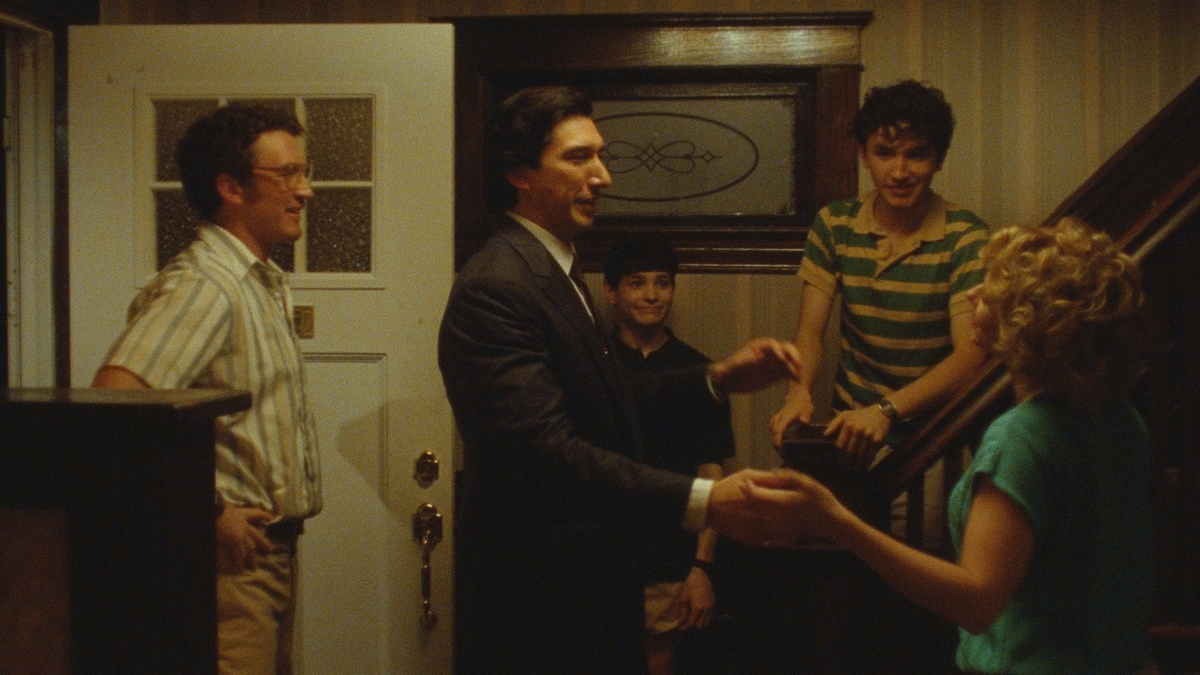
Whereas all of Gray's earlier protagonists are deep into their journey by the time we meet them, at the outset of Paper Tiger, Irwin Pearl (Miles Teller) is not. He has a cozy little house in Queens with his lovely wife, Hester (Scarlett Johansson), a good job as a respected engineer, and solid enough financials that his whole family just returned from a trip to Italy. That said, Irwin's biggest regret was not going to one of them fancy colleges, so he and Hester are determined to send their boys to an Ivy League. Given that Scott (Gavin Goudey) is already eighteen, and Benjamin (Roman Engel) isn't far behind, it's uncertain how that will come to pass: Rome's got nothing on Harvard. That is, until his brother, Gary (Adam Driver), drops an opportunity in his lap.
The dark atmosphere, the reports of crime blanketing the radio, the trepidatious but sweeping minor-key orchestral score from Christopher Spelman, and Driver's perfect embodiment of a friendly but gruff retired NYPD officer lend all an air of illicit dealing. Which makes it all the more surprising that the job itself is entirely on the up-and-up: Gary's caught wind of City Hall's desire to pressure polluters along the Gowanus Canal, and he's gotten in with the incoming "Russian businessmen" who've taken over the area as the mafia's grip loosened. Granted, there are early indications that he's smoothing over the less savory aspects of their character to pursue making some serious cash advising them on regulation compliance. While wary, this isn't Irwin's world: he's nervous enough about the boys owning BB guns, never mind organized crime. So all he can do is trust his well-meaning brother. As you can see coming a mile away, this sets the stage for Irwin's integrity to put him somewhere he doesn't belong, where he'll see something he shouldn't have, and draw the ire and attention of people to whom his and his family's lives mean very little.
That none of what follows was necessary from any side, that it disrupts an idyllic-seeming American family who's carved out a nice if imperfect slice of the Dream for themselves, and that it all ends up so meaningless in the grand scheme of things while irrevocably changing those involved, heightens the tragedy already palpable from its early moments. While the temperature rises fast and far, it never feels out of control, never bombastic, never simple. Whereas Gray's debut, Little Odessa, memorably opens with Tim Roth calmly and coldly shooting a guy at a bus stop in broad daylight on a busy Brooklyn street, the violence in Paper Tiger is mostly confined to threats, with momentary outbursts confirming their credibility. One of the more harrowing sequences features neither the audience nor the Pearl family ever seeing the thugs who've broken into their home while they sleep, as Irwin stands on the stairs with a BB gun. They were there to take some pictures and rearrange the furniture, the type of intimidation more effective than targeted violence could ever be, making it clear that neither you nor anyone you love will ever be safe again.
Such slow-burn dramas replete with heightened, blunt language delivered in deliciously old school New York accents run the risk of landing as overwrought or cheesy, but as always, Gray is so committed to his native style that it works. You never for a moment question the authenticity of any single character, in part because they're all wonderfully calculated. It'd be hard to buy Miles Teller as a heavy, so he never tries to present as such, instead crafting a man desperate to protect his family despite his inability to do so, causing him to lean on his much more street-wise brother until it nearly breaks their relationship. The consistency and skill with which Gray deploys shadows sets him apart from most modern filmmakers, crafting an oppressive yet striking mood at all times. The final set piece is brilliant, a wonderfully fresh use of a cornfield to build a scene that will have your heart racing despite how small and intimate it is.
The plot is the one piece that really wavers; it's just not as tight as his best work. There are details here and there that stick out, ideas and allegiances and motivations that are raised only to be forgotten or paid off in strange ways. When we find out the Russians' main goal, some of their earlier actions seem wildly counterproductive. But the worst element is Hester's subplot, an overwrought health journey that struggles to find its place in the larger story. It introduces new questions about the strength of the Pearls' marriage, and quietly raises the specter of the boys losing both parents, neither of which the screenplay is interested in engaging with. Given the nature of such a health scare, it's a slow moving prospect, so every time we cut to her silent struggle lessens the intensity. While it shows that both parents are inclined to handle the family's issues in isolation, convinced they alone should be tasked with shouldering the burden, the lack of consequences from Hester's actions make it feel so weightless, especially where the movie ends up.
Still, it's wonderful to have Gray back in this world, even as my favorite isn't set in it (that would be The Immigrant). So few modern crime dramas feel anything like this, confident enough to pull you along with a compelling story without relying on undercutting it with quips or jokes. The family is warm and friendly with each other, putting a huge smile on your face in the opening scene in which they all sit down to dinner, and it's very touching how the Pearl boys stop bickering and start looking out for each other in the face of danger. Even when relationships are strained, there's little reason to believe they're irrevocably broken, as all are underpinned by love.
Every year can use a few movies like this, imperfections and all, reminding people that adult dramas are not the same thing as dull and sappy Oscar-bait. We'll never get back to the days of Kramer vs. Kramer topping the (domestic) box office, but maybe they could crack the top ten once again. Wouldn't that be something...