Primetime
"What are you doing here?"

The phrase "Think of the children!" is one of the most damaging, disingenuous, and deflective defenses in the English language. All sorts of hogwash has been justified by its utterance, from the Satanic Panic to censorship to political witch hunts to all manner of vigilantism. It's an easy cop out that's always wielded as a cudgel to shut down discussion: what kind of monster prioritizes their own rights over the safety of children? But such a phrase tumbling from someone's lips instantly informs you their incentives and activism are truly aimed in a much more self-serving direction. Our current moment's favorite flavor most often aims to justify dehumanization of queer (especially transgender) people, with book banning a close second.
You can trace that attitude clear through to NBC Dateline series To Catch a Predator, which ran from 2004 to 2007. Across twenty episodes, its impact on American popular culture was seismic, owing as much to its revelations of depravity as to its gotcha tactics and the theatrics of its host, Emmy Award-winning journalist Chris Hansen. For the uninitiated, "Predator" featured hidden cameras capturing adult men arriving at the "home of a teen/pre-teen" (actually a house set up by Datetime, the teen a decoy played by an adult actor), who were lured there via catfishing by vigilante group Perverted Justice. After a brief interaction, full of tropes and set design that would become infamous, Hansen would emerge and confront the men with quips and catch phrases ("Why don't you have a seat?"), before telling them they can leave, and law enforcement would descend upon them, guns drawn for some reason.
There are a whole host of ways in which this seemingly well-meaning setup is deeply perverse and abusive (as well as the textbook definition of entrapment), explored powerfully and upsettingly in the excellent documentary from last year, Predators. Whereas it attempts to grapple with the show's incredibly cruel treatment of its targets by people who lack any relevant training and complete disinterest in empathy, director Lance Oppenheim's debut narrative feature Primetime (written by Ajon Singh) seeks to wrestle with those involved in making the program. Despite hanging its marketing on the incredible, transformative performance from Robert Pattinson as Hansen, the story is most interested in the experience of decoy Dan Plumb (Skyler Gisondo), a fictionalized version of real-life decoy Dan Schrack. Although I would be remiss if I neglected to mention Andie (Merritt Wever), a composite of a handful of the show's producers, whose behind-the-scenes role causes others to underestimate just how sharp and important she is, the narrowing of her eyes as she orchestrates through the chaos clarifying she is a shark in these waters.
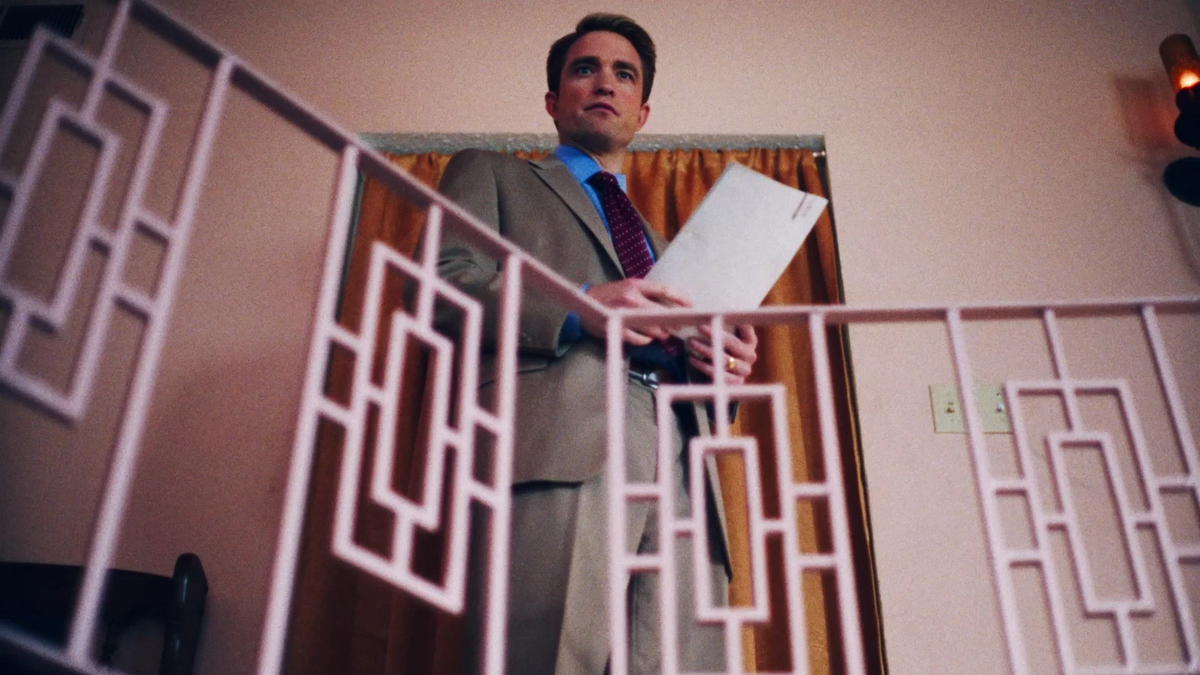
There's no way to avoid the incredible darkness that comes with making a movie about a show that highlighted child sexual abuse (see, again, Predators), so Oppenheim and Singh seek to balance that out with a bunch of humor from the outset. One of the earliest images is that of Hansen looking frazzled as a mark is arriving earlier than expected, so he must scramble into position. As we watch the awkward, stilted interaction between predator and decoy (Tony Revolori and Phoebe Bridgers), he slips unseen across the back of the shot. Why? So he can dramatically emerge from behind a curtain on a second-floor balcony, imbuing even more flare into his movements. As much of the humor comes from written jokes as from the audacity of Andie and Chris, from their easy dismissal of Dan's day one concerns to his later cheerful interrupting of a serious conversation to ask if the show will cover snacks on their flight, from the montage of Dan's rolodex of greetings for the pedophiles. delivered smiling and direct to a camera that is gently looking up at him.
That everyone on set is less focused on the well-being of children than their own goals is obvious from the start. The opening shot is a dimly lit close up on Hansen's lips as he repeatedly practices reciting lines from a transcript to parrot at the target ("I will undress you, and you will undress me"), as well as his signature: "You see how this looks, right?" He's convinced himself that being a father of two has tuned him in to the harm the world throws at kids. But when Jeff Zucker informs him that his show is getting moved to prime time, his unhinged expression of ecstasy ensures we know he's far more focused on beating Lost in the ratings than ensuring people are aware of the threat. In contrast, Andie is clear-eyed about her goals; as producer, her primary job is to ensure the show gets seen by as many people and brings in as much money as possible, necessitating ever more salacious and disturbed targets, especially given their more prominent time slot. Even Dan doesn't get off the hook: although Oppenheim, Singh, and Gisondo clearly empathize with him most of all, Dan is determined to make this gig the realization of his life-long dream of being an actor, constantly looking for ways to deepen his character and asking for feedback on his performance. We're always privy to his pain and disillusionment, which makes one particular scene in which a transformation momentarily comes over him all the more chilling.
As the stakes begin to rise in the lead up to one of the most infamous moments in pre-taped television history (which somehow both aired, and did not end the show), the humor becomes a more and more awkward fit, undercutting the tension at certain moments and pulling you out of the events. You can absolutely get away with mixing humor and darkness, as demonstrated by jaw-droppingly callous lines like Andie's final utterance of the film, "I think I can use this". But Hansen barking like a dog at the prospect of Andie driving ratings higher, or his drawn out bellow for Decoy Dan, are goofy at a time that hurts the surrounding events.
More frustrating is how many side plots go nowhere and do little to reinforce the characterizations of their subject. Each of the central trifecta gets one such subplot whose presence is strange at first, but graduates to baffling when their conclusions land with a thud. To say nothing of a few completely out of place scenes that slam your face into visual ideas more elegantly portrayed elsewhere. All of that actively takes away from the core story by watering down the overall experience. Even the very final scene, a small coda intended to ensure we walk away with the impression of the rot that rubs off on all who touch the show, ends up distracting from the previous shot's powerful gut punch. We could have ended on a 4-way split-screen focused on each primary character, the only audio Hansen muttering his lines under his breath, the screens slowly switching off, before we cut to a close up, hear Andie's final line, and finally, another famous Hansen catch phrase, thrust into a new context: "What would have happened if I wasn't here?" Instead, we end on a shot of Dan's face as someone off-screen asks him "So you're an actor?"
The key exception are the news reports on Saddam Hussein's capture and pending execution, delivered by Hansen's fellow Dateline journalist Stone Phillips (Bill Heck). We only glimpse a few, but they play up a post-9/11 media landscape obsessed with retribution, with cheering on the deaths of those we've pre-judged, which would culminate a few years later with the military execution of Osama bin Laden. What is To Catch a Predator except a simulacrum of killing the bad guys while doing nothing to address the "ancient evil" that drives them? Along with the appalling sensationalism at its heart, it speaks to a transition period for American television, one in which the audience's tendency to accept what's on their TV sets was turbocharged with a spate of "reality" shows, and a willful denial of their deliberate contrivance, if not staging.
Heightening this break from our world is the gorgeous, insane, dream-like fantasia crafted by Oppenheim's regular cinematographer, David Bolen. A handful of scenes look like low-res video, not just the handful of depictions of the show. Much of the rest is processed to look like film, but with an incredibly soft focus and color grading that recalls the lush technicolor of something like The Wizard of Oz. The love of bloom filters Bolen and Oppenheim have previously demonstrated once again gives the lights (and indeed, the whole image) extra hazy boundaries that subtly ask us to question the line between fact and fiction. There are additional surreal elements and off camera locations and even the image starting to fall apart as Hansen's mental state evolves, all of which creates an incredible atmosphere. The score (from another Oppenheimer regular, composer Ari Balouzian) plays a role in reinforcing the vibe, despite occasionally feeling like it would be more at home in Eternal Sunshine of the Spotless Mind.
Lance Oppenheim is primarily a documentarian; You Can See Everything, co-directed with comedian Nathan Fielder, comes out in a just a few weeks. But across his two previous feature-length docs and one docuseries, he's always felt like a narrative filmmaker waiting to burst out. That's not to cast any aspersions on the format, although it may be to call into question his suitability for it. Each feels like it's straining to be cinematic, and not very successful at hiding the filmmaker's hand. Their camerawork is marvelous and their character ensemble so wide as to be weakly defined, both of which distract from his subject. But those imperfections in a (still quite good) documentarian become strengths when he has more-or-less complete control over where the story goes. By basing his first feature on a real person and real events instead of pure invention, he may have hamstrung himself in the expression department, as even some of the most interesting flourishes clash with the story being told. However, the skill with which all of it is executed speaks to an incredibly talented director who is bound to improve with each outing, and I cannot wait to witness every single attempt.