Project Hail Mary
"I'm wrong about everything. And everything is wrong.

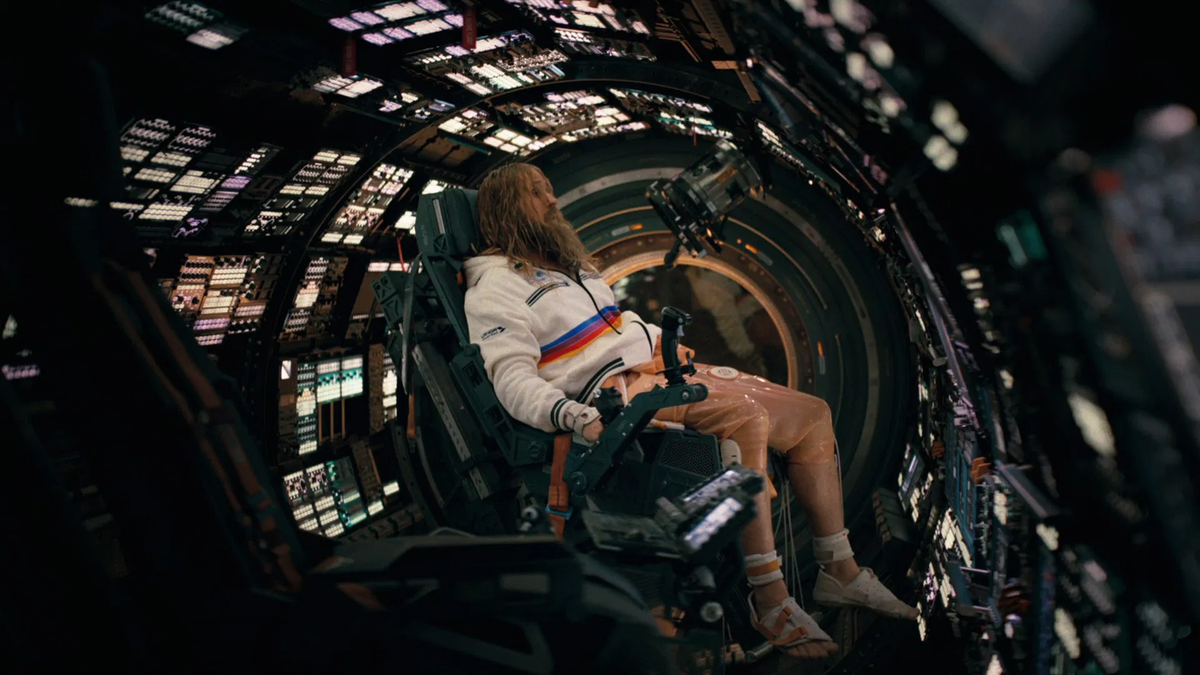
A huge part of what made The Martian so compelling was watching a guy stuck in an insanely inhospitable environment figure it out through his cleverness and extreme competence. He was lacking proper supplies, but his know-how (augmented by the base's reference materials) mixed with a raw determination to not die made his successes as compelling as they were thrilling, especially as he faced some truly incredible obstacles. On display was the same type of ingenuity that captivated us in the 90s in Apollo 13, but with the addition of more than a few million miles.
Project Hail Mary takes the opposite approach, presenting us with a bumbling goofball, while separating its protagonist from Earth by more than a few light-years.
Having not read the source novel, which was also penned by Andy Weir, I do not know where that comedic shift came from. The screenplay for both movies was written by Drew Goddard, who's often opted to soften his work with humor; anyone who claims The Martian isn't funny is either lying, or dead inside. But you'd also be hard-pressed to call any of his scripts "comedy-forward", which is the only way to describe Project Hail Mary. The easy scapegoat is directing team Phil Lord and Christopher Miller, as they had nothing to do with that earlier movie, and all of their writing and directing credits are built around non-stop jokes. Then again, star and lead actor Ryan Gosling has been successfully leaning into comedy in the past few years with Barbie and The Fall Guy, even as he rarely succeeds at hiding the effort it takes him.
Whatever the source, it means the narrative is focused on a schlubby "normal guy" just figuring it out for much of the film, who quips his way through unforeseen circumstances. Well, he's not exactly average; Ryland Grace (Gosling) has a PhD in microbiology. However, his strongly held belief that non-water based life could exist ended his academic career before it could begin, so he turned to teaching middle school science. He is decidedly not an astronaut, and only ended up on this mission by chance. The deaths of his crewmates during cryosleep left him as the ship's sole inhabitant, nearly twelve light years from Earth, on a mission to understand what is saving Tau Ceti from being devoured by the "Astrophages" that are dimming every other star on which astronomers train their telescopes.
That premise alone is intriguing, although it means most of his snarky comments are made to no one, purely for the benefit of the audience, without even the pretense of some diary for later discovery. However, upon arrival at the distant star system, he quickly encounters another ship, presumably studying the same phenomenon. Despite his initial reluctance and fear, the ship insists on making contact in an amusing "chase" sequence, which results in Grace meeting a spider-like being he dubs Rocky. Thus, Grace's immediate priority shifts: with Tau Ceti looming large, his loneliness and curiosity drive him to figure out how to communicate with Rocky, resulting in crafting an artificial voice (provided by James Ortiz, after an amusing montage of trying and reacting to various options).
The buddy comedy breathes fresh life into the story, especially as Rocky's chaotic, child-like behavior results in much physical comedy, despite their inability to breathe the same air. It calls to mind the relationships between robots and humans in earlier prestige space flicks, such as Moon and Interstellar. The whole movie is full of references big and small to the titanic space stories, so it's more expected than surprising when Grace greets Rocky by humming the most famous five notes in all of sci-fi. Their relationship argues that the most important difference between artificial intelligence and organic life is the excitement of discovery and a general playfulness. The ability for Rocky to express emotion is a key part of the story that unfurls, even as his inelegance is a constant source of entertainment.
Their relationship also contrasts starkly with Grace's memories from Earth, which slowly return (conveniently in sequence!), giving us the backstory on his crucial involvement in researching and addressing the planetary crisis. Each of those scenes is stolen by an absolutely brilliant Sandra Hüller, playing head of the "Hail Mary" project, Eva Stratt. Her soft demeanor never betrays any emotion except the occasional empathetic look of "This poor sap", Grace's every attempt at humor dashed on the rocks of her stoic face, which perfectly heightens the hilarity. Despite this limited view of Stratt, Hüller imbues her with such a rich inner life, fleshing out her worldview any chance she gets. We even get a taste of who she is in normal times, in a standout scene that begins as the closest thing we'll get to a heartfelt conversation between Grace and Stratt, and ends with her outstanding "Sign of the Times" karaoke.
For all its frivolity, this is a grand story of space adventuring, albeit one primarily confined to the ships, which are largely stationary. Still, the opportunities are plentiful for gorgeous shots of speculative tech and open space, as well as the threat of disaster. The production design is wonderful, especially the conception and execution of Rocky's ship, reminiscent of the tesseract from Interstellar. And the visualization of the unfathomable mass of Astrophages is stunning, depicted as a long, red-hued, gas-like structure curving from the system's star to a planet. The effects are seamless, and the camera frequently works with them for comedy beats (have I mentioned how funny this thing is?).
Project Hail Mary is in no way an escapist entertainment. The fictional Astrophages are doing enough damage to the Sun that it's steadily, noticeably dimming, severely altering Earth's climate and resulting in the impending deaths of billions all over the globe in the next thirty years. It's a perfect mirror of the realities of climate change (although the idea of every nation coming together to solve the problem is looking more and more like a fantasy...). And despite its grounding in a real, coming catastrophe, its offers of hope are confined to nebulous, hand-waving gestures that are emotionally satisfying without being all that meaningful. This is the dichotomy at the heart of Project Hail Mary; it tells a good story while managing to be fun and touching (in unequal measure), but it feels like it wants to be important and topical, making its landing less than graceful. So while this is the most-crowd pleasing studio tentpole so far in 2026 (my personal preference for the swings of The Bride! notwithstanding), its enduring place in pop culture is far from certain.