Quick Hits: June 2026
A more productive month means fewer unreviewed releases.


Despite seeing slightly fewer movies at the theater in June, and a handful of those being rewatches or repertory screenings, I published more reviews than usual. As such, there were only three new releases I haven't written about at length, marking this edition as truly worthy of its name. No time to waste: let's get to it!
Power Ballad
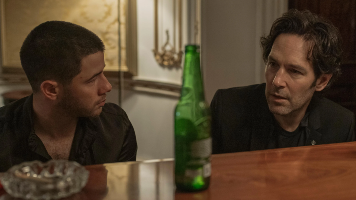
It's almost impressive how thoroughly writer/director John Carney squanders his premise. Rick Power (Paul Rudd) has been noodling with a song for years, and works on it with Danny Wilson (Nick Jonas), a pop star mounting a comeback. Next thing he knows, he's hearing his chorus and hook everywhere, as it's made Danny relevant for the first time in a decade. But Danny kept their meeting to himself, so Rick gets no credit. Thus, Rick sets out on an adventure to get Danny to simply acknowledge the theft to his face.
If we stayed with Rick the whole time, maybe everyone's insistence that he's delusional would be less annoying. But we spend lots of time watching Danny construct the song, and hide any trace of its connection to Rick from his girlfriend (Havana Rose Liu) and manager (Jack Reynor). We know that nothing will come of it until the end, removing any tension or intrigue from the intervening vignettes. But where the story totally lost me was the very end, which is a huge miscalculation, and completely undoes everything that came before, subverting its ideals.
Jinsei

Jinsei's issues stem from the very reason I admire it: ambition. We follow the protagonist (Ace Cool) across one-hundred years, checking in at ten key (unevenly spaced) points, and occasionally an era-spanning montage. His identity constantly shifts, even as his being and history carry through. There are narrative clusters, such as becoming a J-pop idol, that prevent you from simply vibing. But most find his circumstances so transformed that the shift is disorienting, especially when the thematic purpose is unclear.
The ending drags interminably, set up by a ten-minute-long montage in which we watch fifty years pass. All manner of bizarre objects appear and melt away with little purpose, only paying off passing comments from earlier. But this long stretch without seeing his face denies us their impact. That's when it became clear that Ryuya Suzuki's bold experimentation superseded his grasp on what he wanted to say.
The simplistic animation took some getting used to, but worked as a foundation upon which to play with some more interesting compositions. And it did occasionally stumble into some beautifully profound moments. But they were rare enough that they always felt accidental.
Toy Story 5
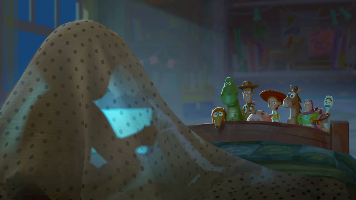
It's ironic that the series' first entry not to receive a G rating1 is also the first that feels solely aimed at kids. The emotional complexity is gone, replaced by a retread of the toys' fear of being abandoned, this time by "tech" (i.e. a tablet). Only Jessie, Woody, and Buzz get anything to do, sidelineing the beloved supporting cast for yet more new characters. There's a pointless sideplot involving tech-infused Buzz Lightyears looking for Star Command. And while the final message is fine, the journey there confuses the takeaway.
The narrative stays stuck in the past, opening with a flashback and only aging Bonnie a year or two since we last saw her. Instead, Disney prioritized the animation, and it shows. Pixar's style has slowly evolved, seen here in the gorgeously messy, crayon-drawing inspired visualizations of Bonnie playing with her toys. But even the rest of the film is stunning, placing the whole gang in a world far removed from the plastic-looking original.
Although that may just reflect an MPA that's getting more conservative. Only two Pixar movies in the past eleven years have gotten a G, a period that covers fifteen films (half their total output!). The last film to get it? Toy Story 4, in 2019.↩