Resident Evil
"Stupid...fuckin'......monsters!"

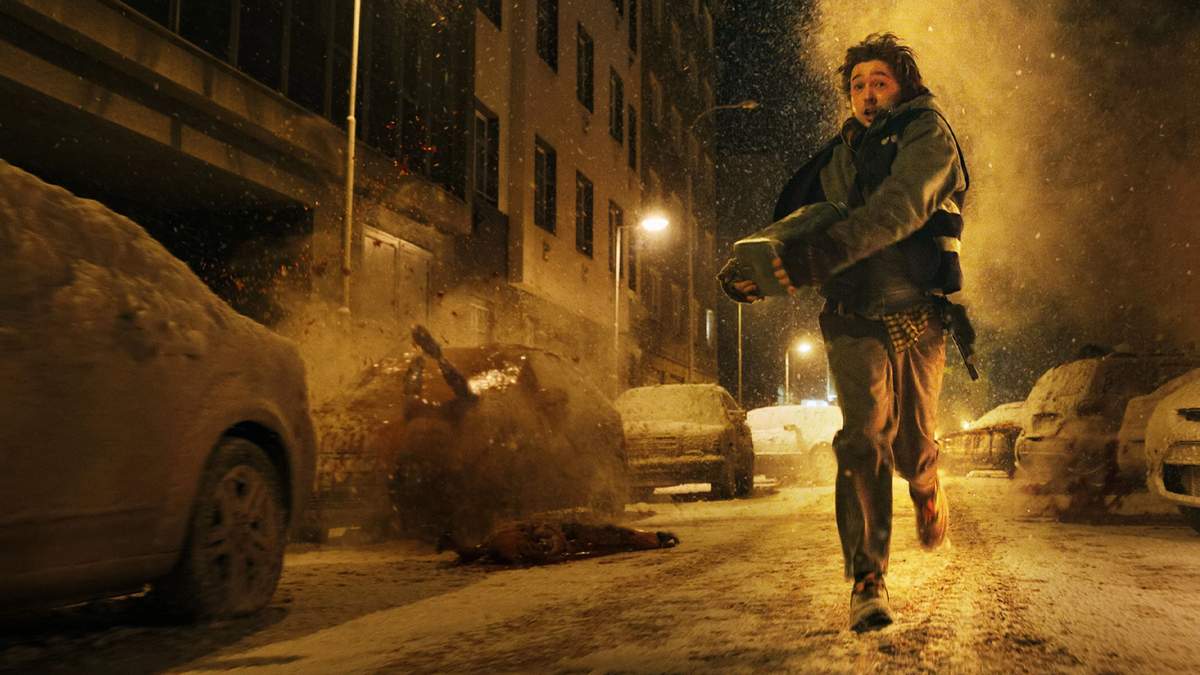
It speaks to the difficult balance inherent in the art of adaptation that this has quickly become the most highly regarded video game adaptation, despite eschewing the game's specifics in favor of setting a story in their world. Having never played the games nor watched any of the Paul W.S. Anderson (or Johannes Roberts) films, I have only vague familiarity with the franchise and its iconography, but that never proves to be a sticking point for writer/director Zach Creggar's third feature. Set in the fictional American town of Raccoon City, Resident Evil is a survival horror game, with all of the evil and mutants tracing back to the Umbrella Corporation. Those broad strokes stay in place in the movie, but just like Anderson before him, Creggar crafts an original protagonist to be played by his muse, Austin Abrams, who was previously the focus of the funniest segment in his wonderful, Oscar-winning Weapons.
That said, he does a lot to capture the video game feel. It opens with Bryan winding through the halls of a hospital, the camera focused a couple feet behind his back. It's the first of many long takes, with sweeping camera moves as Bryan swivels his head. When guns enter into the mix, you bet we get a couple of the classic first-person shooter POV shots, with the threat dead ahead and the gun poking into the frame from the right. Even his precipitating task is incredibly recognizable: he's transporting valuable medical cargo through a snow storm in the mountains to another hospital, and he must do so within an hour. It's alternately impressive and charming and immersion breaking and kitschy. Ultimately, he pulls it off more often than he doesn't, despite its lack of necessity.
For the first forty-five minutes or so, the entire movie is fairly minimal. After leaving the hospital, it's just Bryan for a while, talking to himself and occasionally phoning his newly pregnant girlfriend, until the signal disappears. He's a bit of a bumbling goofball, perfectly driving quite a bit of comedy the whole way through. The horror begins when other people enter the mix. First, a woman (Andrea Miltner) jumps in front of his car, and is seemingly sent into shock by the strike; something doesn't seem right, but he obliviously takes her with him anyways. One thing leads to another, and Bryan finds himself trudging across a snowy field to an isolated farm house, looking over his shoulder constantly, half-expecting "her" to be chasing him, despite having blasted her with a handgun.
This is all great stuff. Abrams proves himself a worthy lead, ably carrying the film through this long, cold, desolate section. The tension never lets up, and his frazzled demeanor perfectly blends with Creggar's comic timing to provide amusing little release valves. In the moments he's called upon for action, he dials up his charming everyman nature, competent enough to figure things out despite not being particularly well-suited to the situation. He just wants it all to be over, constantly asserting "...that didn't just happen" in a willful denial of reality, even after a "dog" goes Flurken on his ass. It's never scary, but it is gross, and there's a sense of dread and feeling for the guy who found himself in the middle of hell just for doing his job. Creggar slowly teaches us how this world works, most notably by showing us the creepy, disgusting way these mangled, mutated corpses merge into a katamari of limbs. Despite the middling CGI that cannot even hide in the dim light of the storm, it's undeniably effective.
Unfortunately, Bryan eventually leaves the farmhouse and heads into the city, and everything changes.
That's not to say the back half is bereft of awesome set pieces. Easily the highlight is the assault inspired by the best part of The Matrix Resurrections, a thrillingly gore and viscera-drenched gauntlet that Bryan must withstand. But the film refuses to drop its jokey, winky tone, even throwing in a handful of sarcastic comments about video games. So as the stakes should be ratcheting up, you remain at a remove, your ability to care about the outcome severely hindered by each occurrence being undermined by a joke, funny as it may be. If those going through it are going to remain in high enough spirits to crack wise about the events, then they can't be all that serious. It would seem all of this is in support of the ultimate gag of the ending, but winds up hollow instead.
It doesn't help that Creggar can't quite seem to decide whether to tell us what's going on or not. Upon hooking up with Umbrella corp employees Carl and Maxine (Paul Walter Hauser and Kali Reis) driving into Raccoon City, we get the fastest, most convoluted exposition dump I've ever experienced, forcing your eyes to glaze over as Carl briefly explains what his lab does, then clarifies the current chaos was caused by an accident in a separate lab. But it's over so quick and matters not at all, so it's uncertain why he even bothered. As with almost every non-mutant Bryan encounters, their threadbare purpose is just to help him get to his next target. While it may be intended as a loving pot shot at yet another video game trope, jamming too much information into your brain in too short of a time, the experience of it is indicative of how little this movie cares about its plot.
All of which prevents any part of the final forty-five minutes feeling the least bit satisfying, narratively or meta-narratively. Bryan's minor victories don't land, and his failures seem contrived. That's still another attribute it shares with triple A video games, but being forced back to the same well of deflection so often hints at a deeper problem. Creggar clearly accomplished all he set out to with this project, crafting a fun homage to a series of games he earnestly loves. But the result is a work of mixed success with regards to the medium in which he's made his career.