Resurrection
"Before we can fool others, we first need to fool ourselves."

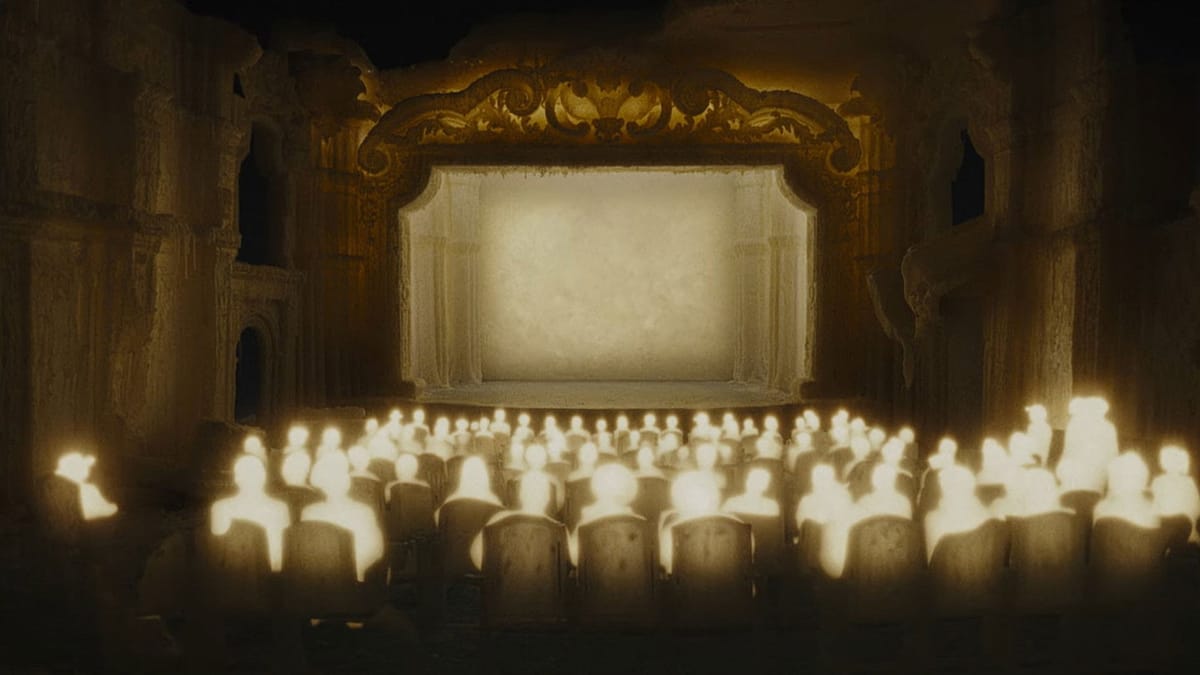
In a time when theaters are under threat, it's notable that writer/director Bi Gan's third film opens (after some title-card exposition) on a packed movie house, in which the audience's necks are craned around to look accusingly at us, the silent interloper who's just burned a hole through the fabric of their world. Especially since moments later, an unnamed woman (Shu Qi) shows up with a flash powder lamp to chase them all out. And the movie ends with the image's negative, as glowing, ghostly figures file in and slowly fill the seats in front of a large screen (the same screen?), before...well, I'll leave the actual ending for you to experience.
That's really the only word for all that lives between those two rhyming moments: an experience. I was fortunate enough to catch this for the first time at a film festival late last year, and sat glued to my chair at its conclusion as I mulled over all that came before, equal parts dazzled and stunned. Enjoying Gan's two earlier films could not have prepared me for this effort, whose ambition and scale far outstrips those quiet, contemplative, slow moving dramas in and about his home city of Kaili. Sure, they demonstrated his incredible technical and artistic ability, as well as his confidence in the audience's patience for stories that take their time unfurling, and never fully spell out their secrets. This work is simultaneously more and less personal, as it resists having a proper main character for you (or him) to identify with, instead installing fascination with for cinema as the central driver. This decision frees Gan to reach his full potential, unencumbered by the convoluted narratives that at times dragged down his previous two features.
The prologue and opening segment provide the super structure for the rest of the film. Humanity has discovered that dreams eat away at your life force; stop dreaming, and you'll live forever! So dreaming is outlawed, creating a new subculture of those who refuse, called Deliriants. Shot to look like a silent era film, with production design heavily influenced by the era, we watch as one such Deliriant (Jackson Yee) is tracked down by The Big Other (Shu Qi), who seems more fascinated and saddened by her task than anything else. In fact, she takes care of him as his life winds down, and puts him into an extended sleep full of vivid dreams that keep him going for hundreds of years. The filmmaking moves into modernity as we're launched into a variety of abstract tales, whose anthological nature ensures there isn't enough time or connective tissue to trip over.
This is the extent of the film's science-fiction, as the following vignettes are grounded, intimate tales that draw heavily from film tradition and his own deeply contemplative approach to human relationships. Each centers in one way or another around a single sense, building up a portrait of the way we interact with the world, and the myriad ways cinema can activate them. But as is his way, they nonetheless have a dream-like quality, poetic in their ponderings and dialog, with their purpose only really made clear by the opening segment's literalization of the story to come. The power and beauty of the human voice, the spirit of bitterness (frequent Gan collaborator Chen Yongzhong) and his quest for Enlightenment, our sense of smell's ability to connect us to loved ones, and an unblinking whirlwind relationship between a bold young man and a gangster's girl (Li Gengxi). All are wonderful and intense and captivating in their own right, but it's only through taking that step back at the end the whole comes into sharper focus.
After their successful collaboration on Long Days Journey Into Night, Gan once again worked with cinematographer Dong Jinsong, and the result is one of the most impressive looking movies of 2025. Each segment is distinct while feeling of a piece with each other, and all are differently stunning. Some are direct riffs on recognizable genres/styles, such as the wraparound's 16 fps mixture of classical and German expressionism, or the first dream's neon-noir aesthetic. All contain individually breathtaking shots and sequences, from the opening silhouette of the final dream to The Big Other spinning in wondrous confusion while surrounded by smoke, her long skirt causing the smoke to swirl around her. If Bi Gan's notoriety could be distilled to one motif, it's his love of ambitious oners. So it should come as no surprise that the Deliriant's final dream is a single, thirty-five minute take that spans an evening, winds through a city, and includes multiple fights and some perfectly framed shots. You may not notice these techniques while watching, but your brain will, and their emotional impact will be swift.
The same goes for the score, composed and performed by French band M83. Although it's impossible not to notice, as it's wielded with skill throughout, punctuating emotional moments and enhancing the atmosphere and artfully accompanying the wonder inherent in the stories. It's layered and ethereal, rewarding repeat listening both with and without the film. Even the sound design is perfection, with Li Danfeng's work adding depth to the space as well as providing another canvas on which the rest of the team can build.
While movies about making movies is nothing new, Gan has unearthed a fresh angle from which to dissect them. His is more of a celebration than an exposé, so its primary function is to dazzle us while simultaneously picking apart the elements that make this clock tick. Gan's presentation of this benign, beloved art form is most analogous to the dichotomy that emerges from the third dream. While the Delirant and the girl (Guo Mucheng) work together to trick their mark (Zhang Zhijian) into thinking she can read his card without looking, her deduction of his daughter's letter makes it clear there's something inexplicable going on, even if it's just a superhuman ability to intuit what he needed to hear. So goes the cinema: no matter how much you pull it apart, examine its components, distort it, and reassemble it, the fact remains that the whole is far greater than the sum of its pieces. It's a magic trick, one whose secrets are easily uncovered, and yet whose power cannot be escaped. But then again, why would you want to?