Teenage Sex and Death at Camp Miasma
"You talk about it so academically. Camp Miasma wasn't about cultural depictions of monstrosity or gender trauma or any of that stuff. It was about two very simple things: flesh…and fluids."

For their entire career, writer/director Jane Schoenbrun has demonstrated a deep fascination with and innate understanding of the horror genre. First making a name for themself as "The Eyeslicer", they gained some attention for their feature-length remix documentary about Slenderman, A Self-Induced Hallucination, that was far more interested in the people involved in the internet phenomenon surrounding it. The questions it explored revealed core considerations that have permeated their three subsequent features. The value of a communal framework in which to role-play for coping with deep-seeded feelings of isolation and loneliness. The importance of pop culture for laying the groundwork of connection between people and allowing you the freedom and language to figure out who you truly are (even if you're not ready to accept it). And now, what is it about horror that so titillates us, that refuses to let us leave it as a purely experiential genre, and that connects so deeply with so many queer people?
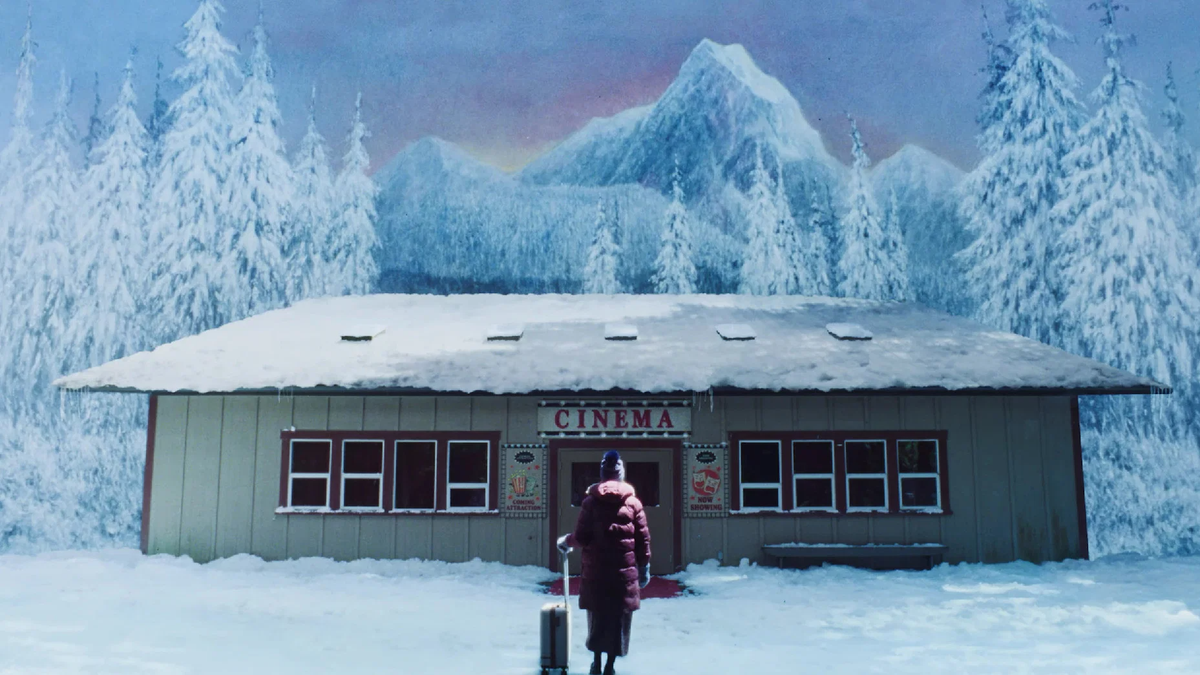
They've always hyper-focused on (and expertly wielded) the imposed boundary of the screen, making it a key part of their stories. But in Teenage Sex and Death at Camp Miasma, they take your face in their hands and point it at the duality of the narrative, of the terror, of the characters. It opens by leading us through an outdoor film set, our view that of a camera being carried, until it's locked onto a tripod, at which point day flips to night as we snap into a wide shot of a young couple being brutally murdered by Little Death (Jack Haven)...a humanoid with an oversized, cubic HVAC vent for a head, causing a geyser of blood twenty feet high to erupt from the deceased's chest, more the color of jam than blood. That loudly artificial visual style persists throughout, indoors and outdoors, day and night, sometimes more subtly than others, but always there, always reminding you that the construction is part of the point. The skill in its deployment ensures it results in stunning, surreal imagery, most memorably the many hazy matte painting-inspired shots of a mountainous landscape draped in snow.
We quickly learn what we already guessed: this is a scene from one of the many, many films in the Camp Miasma franchise, which is loudly modeled on Friday the 13th but pulls in details from all types of slashers, classic and campy alike (as well as a lovely and visceral Videodrome homage). Just the same, it's gone through various reboots and re-imaginings and re-evaluations, from adoration to trashy to problematic fave to full reclamation. Now, the studio has hired Kris (Hannah Einbinder), a twenty-something director with a single indie feature under her belt, to reboot Miasma. Determined not to just make "another dumb sequel in the Camp Miasma franchise", she seeks out the enigmatic star of the first film, Billy Presley (Gillian Anderson), who disappeared from public view after passing on the sequels. Her initial goal of signing the actress quickly falls to the wayside in favor of deeper discussions of sex and horror and Miasma and dipping sauces.
Their back and forth plays as Schoenbrun wrestling with two sides of themself, working through their hangups and insecurities and openly questioning whether anything they think they know about their life makes any sense. Kris is eager and bashful and intellectual, so trapped in her own head that she forgoes sex in order to avoid confronting her complicated relationship to it, tied up in her love of the horror genre as it is. Furthermore, she's so aware of the misogyny of classic horror in general and transphobia in Camp Miasma specifically that she cannot help but go off on a rant about studio pinkwashing when her reboot is brought up. So why is the scene that so entrances her that we see it twice the one where Billy's character is cajoled into uncomfortably losing her virginity to some random guy she doesn't really like, in which she climaxes at the exact moment Little Death runs them both through with his spear? Why is her greatest fantasy to be running through the woods covered in blood, screaming, Little Death in pursuit, wearing just a t-shirt and panties, her bouncing breasts calling attention to her nipples poking through her skimpy clothing?
Whereas Gregg Araki chose to lecture the younger generation about their sexual anxieties, Schoenbrun engages in a dialog that dives into the nuances and very real difficulties of navigating a world that's so scared of the abuse of sex that it's forgotten the power of it. Ideas of the trade off between self-denial and self-indulgence via sex vs. sweets are quietly present throughout, although less elegant and at times jarring, perhaps the only real knock against the film. There's even a few unspoken bits on the eroticism of submission, of willfully giving up control to someone you trust take you higher. Through it all, unlike the latest from the elder statesman of 90s New Queer Cinema, Schoenbrun has no interest in making a clean statement about which outlook is "right". It's barely addressed on a broader scale, and there are no stilted, sweeping statements about "your generation". They have shown a much deeper interest in the personal, so it's fitting that their approach feels like it's simply showing one woman's story, not trying to stand in for an entire age-group.
The meeting point of Schoenbrun's conflicting perspectives is further highlighted in their approach to the franchise. Even as Billy's age and maturity (and Anderson's face melting, awards-worthy performance) cause hers to come across more strongly, it's notable that despite her insistence that Kris is overthinking everything, even the fifteen minutes of Camp Miasma we see is ripe for discussion (meta-point number one: almost every camp counselor is played by a queer or gender nonconforming actor, many of whom are indie filmmakers: Quintessa Swindell, Avalon Fast, Eva Victor, and Jack Haven). Schoenbrun hits it even harder regarding Kris' inability to just let a film wash over her. The only cutaway from their abridged screening is a perfect comedy beat in which Kris excitedly mutters "split diopter", the most obvious of the many instances in which they're playfully needling film nerds (including yours truly). But they employ the exact same shot to end the film to great effect, indicating self-parody while simultaneously demonstrating the reason we're so enamored with cinematographic technique. The ultimate point shines through loud and clear: it's easy to claim you paid no attention to the cultural moment and bigger ideas during production; it's much harder to truly isolate yourself from it, even if it only bleeds through subconsciously.
Although I find it hard to believe Billy doesn't understand at least some of the significance of a transgender slasher villain, especially as we grow to understand the knotty relationship she has with Little Death. But the audience has a better view of the deeper significance. What was likely intended by Camp Miasma's writer(s) to play off the "villainous/vengeful queers" trope, instead serves as a reassertion of power and control and pleasure. True to his name, Little Death's kills are frequently accompanied by an overwhelming eruption, most notably when penetrating his victims with his spear. While most in-world viewers will cheer for each kill's gore, every new entry in the series is another chance to make that connection to a teenager somewhere who needs help to step outside of themself.
Through it all, Schoenbrun never loses the ability to land a killer joke, you just might not notice. So often, they come in the middle of some off-kilter conversation, or are simply about line delivery or quiet juxtaposition or some small, unremarked upon behavior. They're occasionally daring you to laugh, not clearly signifying that a joke exists. Or through repetition shifting the context of repeated statements, such as the refrain "If it gets too real, you can always turn it off". Or even tiny production detail, such as when Kris is on a video call with her producers, as well as a woman whose display name is just "Queer Assistant" (Louise Weard, another transgender writer/director). The quietness (if not subtlety) of the humor ensures that not everyone will dial in to it, and even those who do will notice certain details at different times as they scan the frame or process some odd bit of dialog. The result is the always odd experience of being the only one laughing in a crowded room, but confident that everyone else is simply missing out.
The surreal dreamscape is enhanced by the relentlessly snowy mountain setting of Billy's home, the camp from the first movie. Flakes continually fall outside the windows, and all is accompanied by a perfect score of dreamy, distant, crunchy guitars and synths languorously blanketing the landscape from their long-time collaborator, Alex G. That is, until the weather turns suddenly in a deliberately loud announcement of a shift in the plot, and the score opens up into lighter, airy, more soaring compositions. Less searching, more hopeful, a full embrace of all that the women have been discussing, as the cutaways to the story of Little Death take on a life of their own.
That such a singular, creative filmmaker has become such a widely known and celebrated artist is one of the most refreshing things in movies right now. While certainly not a household name nor a huge box office draw, they're one of the internet's favorite filmmakers, all three of their films have been highly acclaimed, and the segment of the public that turns out grows with each release. These films look like nothing else at the cinema, and they're unabashedly queer (even World's Fair, albeit subtextually), while also speaking deeply to the experiences of coming of age in the modern world, and presenting or musing on a host of other ideas. Schoenbrun is a special talent, their every release is an event worth celebrating, and Teenage Sex and Death at Camp Miasma just further cements that.