The Christophers
"Never underestimate the internet prowess of a man who’s spent decades Googling himself."

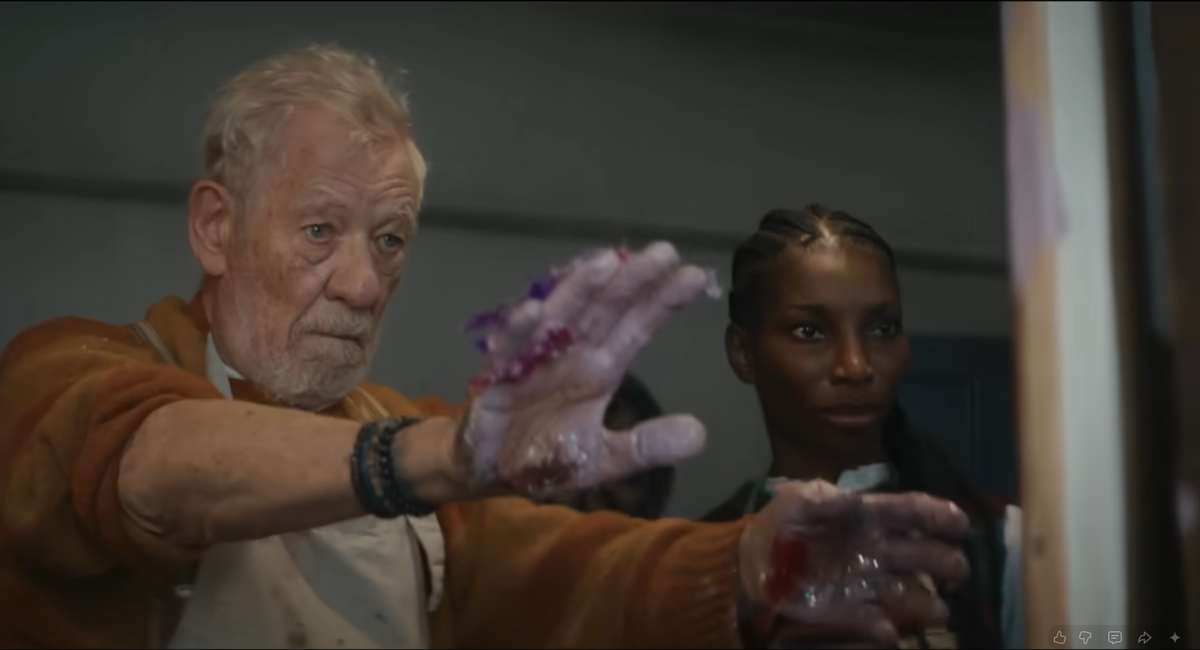
As delighted as I was for my second watch of Steven Soderbergh's latest directorial (and editorial, and cinematographical) effort to be in a nearly sold out (albeit small) theater, I was baffled by the limited laughter coming from the rest of the audience. It's not exactly full of quippy one-liners, nor big set pieces with goofy antics, this is true. But the humor is nonstop nonetheless, imbued in every moment by the caustic, self-important, narcissistic air of reclusive artist Julian Sklar (Ian McKellen), and the quietly intense and amusingly expressive reactions to this pompous ass by his new assistant, art restorer Lori Butler (Michaela Coel). It's in the irony of Sklar's motormouth arrogance, and the disbelief that Butler (and we) feel as Sklar goes on and on, belittling those he feels are beneath him, and whole generations while he's at it. It's in every bumbling, buffoonish word spoken by his money-obsessed children (Jessica Gunning and James Corden), who hire Lori to forge entries in his most famous series (the eponymous "Christophers"), to serve as their inheritance upon his death. And it's in Sklar's deflation when she reads him for filth, delivering truths that his face informs us he's never heard said out loud, but have endlessly rattled about his own head. That is, before the whole situation inspires him once again, gifting him the boundless energy of a child, performed by McKellen with an infectious glee.
This cheekiness never once detracts from the tense drama at the film's core, even as it very successfully distracts you from the true shape of it. What begins as a heist film of a sort, with Lori pretending to catalog his long neglected attic to gain access to the supplies required for a truly convincing forgery (not to mention the unfinished twenty-year-old canvases), slowly morphs into an equally off-beat take on a revenge story. Revenge against his idiot children, trying to pick dry his still animated corpse. Revenge against a world that most values art as a commodity and status symbol, and cast Julian out: why, we never find out, but there are a few implications that his downfall was his own doing. Revenge for being betrayed by those they most loved. And revenge for...well, you get the idea.
Lori's fury towards Sklar is alluded to early, but rather than stew until the end, it comes to a head in the movie's most electric and revealing scene. Her one-time adoration has soured into resentment, her feelings made crystal clear by the magazine piece he comes across when trying to figure out who exactly she is.
This confrontation is the first moment in which Coel elevates her performance from merely excellent to absolutely stunning. Once she recognizes her words coming from his lips, the tone of her voice slightly drops, her bright-eyed and bubbly demeanor melts away, and her speech becomes far more casual, dropping its "proper" affect. It's subtle but deliberate, an unspoken cue that the relationship has shifted, and she no longer feels the need to perform for him. And so it's entirely unsurprising that after coming clean and taking her leave, she returns a beat later to turn the tables on him. She precisely identifies the arc of the "Christophers", mapping it to his relationship with the man they were inspired by, and in doing so psychologizing him to such a degree that even when he limply lobs at her the opinions of critics who loved every last one, all he can do in the face of her forceful parry is to limply concede that she's right.
And so the story moves into a new phase, although far from the movie's last. Each one is shot through with questions of legacy, of course: how can it not when its male lead has illuminated our screens for over fifty years, and the director for nearly forty? But primarily, it's about private redemption. While redemption in the eyes of the public is present, every moment of the film pulses with the desire to be not only noticed, but regarded by a special someone: while ruminating on why he's so stuck on this series thirty years later, Sklar muses, "That's the thing, isn't it? To linger in the minds of others." Be it an ex-lover, a former mentor, or a distant father, each action taken is driven by the innate need to be loved, and the feeling that nothing we do matters if we cannot leave an impact on those we most adore. Late in the film, a single sudden, surprising action puts a deeply moving bow on the idea, heightened by how starkly it contrasts against the soft, slow, subdued nature of all that came before.
The film's biggest magic trick is Coel's brilliant performance, as seemingly effortless as it is powerful. She is the strong anchor through the storm that is this late period of Sklar's life. And yet, she is simultaneously her own character, driven by her own desires, never spoken out loud but communicated to us through various biographical details and the way she gently exerts her influence on Skalr. She's not a manipulator, but she is driven and clever, quickly formulating plans that will claim her small slice of a much greater triumph. The inner life Coel conveys is marvelous, so rich that despite an early assertion she won't be sharing personal details with Sklar, and her only other on-screen conversations involving Tweedledee and Tweedledum, you feel like you understand her whole deal. It's impossible not to be taken in by her spirit.
Ed Solomon's script absolutely sparkles, from the sharp dialog to the layered structure that rewards repeat viewings to the simple but effective way he weaves the exposition into natural conversation, such that it never stands out. There's a little bloat in a particular repeated image that is driven home by grinding everything to a halt for its explanation, despite the rest of the plot demonstrating how it could have been blended in more quietly. But it precedes and paves the way for a moment of emotional catharsis so powerful and unexpected it threatens to knock you off your feet, so it's hard to resent it too much. Especially since the accompanying score, more often used to bridge scenes rather than undergird them, is such a laid back, light, and lovely electronic piano.
Its limited scope, involving just a few impeccably laid out sets, and that nothing all that much happens, nearly ensures this will be regarded as "minor Soderbergh", as the musings of a master on his own legacy. While Soderbergh's skilled camerawork is not as inventive as it was on Presence, and the intricacies of its plot features fewer thrills and less interpersonal intrigue than Black Bag, it's nonetheless a compelling portrait of two people who benefit from each other's influence more than they're willing to admit. Small is not the same thing as slight, and The Christophers represents Soderbergh continuing to operate at a high level, even if it's not quite the top of his game.