The Death of Robin Hood
"Knives cut bread as well as they do flesh. It's a question of balance."

While the world may not have been clamoring for another tale of Robin Hood, so goes it with each of writer/director Michael Sarnoski's features. Maybe people would have been more on board with this particular iteration had it been marketed better, an issue that's continued to follow Sarnoski. His films are inevitably sold as some flavor of traditional(ish) action film, a bait-and-switch that makes for audiences frustrated by unmet expectations. A revenge film without violence. A prequel that explains nothing. And now, a Robin Hood tale that mourns the legend. Sarnoski's primary project is presenting an unmistakably optimistic (if occasionally ugly) view of humanity, blending upsetting intensity with soul-warming compassion and connection in the darkest of circumstances.
The year is 1273, the Merry Men are no more (if they ever were), and Robin (Hugh Jackman) is old and weathered. Little John (Bill Skarsgård) remains by his side, a scrappy puppy dog of a man. A lonely child (Jade Croot) wanders the wind-swept wasteland, finding Robin by the light of his fire. Their ensuing interaction tells us much about who he has been reduced to in his twilight years. He offers the child some advice and food, and after denying her assertion that he is the legendary outlaw, he calls those same tales twisted lies with a heavy sadness in his eyes. As they sleep by the fire, the child anxiously creeps up behind him, blade drawn. For what reason, we do not know. But the way that Robin easily detects her presence and coolly slits her throat while telling her how he knew of her presence makes clear that he's been the target of many who desire retribution, that he is without mercy, and that his remorse has come far too late to do him any good.
The world they inhabit is dreary and violent and nasty, the smell of people who never bathe mixed with animals and rotting flesh and mud wafting off the screen. The duo set out to "rescue" Margaret (Katie Breen), John's "wife", which here means "the woman whose husband he killed". Not only are they to kidnap a woman from her home, but we see every instant of the brutality they must employ to succeed. The vibrant visual of fires raging against the inky black of night is a stunning image, all credit to cinematographer Patrick Scola and the special effects team1. Through this, there is life and there is death: although Margaret dies in the raid, her young daughter (Faith Delaney), whom John creatively dubs "Little Margaret", joins their party.
The exhausting length of this preamble is designed to make you feel the way Robin does. He's full of regret, well aware of the enemies he's acquired along the way, and unconvinced that anything he did was worthwhile. What goes into constructing a legend that lasts a thousand years is laid bare, all the exaggeration and cherry picking and spinning messy exploits into a ripping good yarn. Whether or not any of it was true is left unclear; what we know is that the life of an outlaw slowly erodes a man's soul until there's little left.
As for all this, it's maybe too effective. This portion is a slog, joyless and upsetting and occasionally a little silly (especially given Skarsgård's somewhat twitchy performance), although Scola does a remarkable job at crafting numerous indelible images, foreshadowing the beauty to come. Even Jim Ghedi's score walks this thin line, undeniably gorgeous and atmospheric and perfect for the time period, but relentlessly somber, played by string ensembles with guttural chanting, mixed with dirges and vocals that yearn to see the sun. For all its beauty, this mire keeps the narrative thrust unclear, playing as if you're in for two hours of a gritty, "realistic" approach to realizing the 13th century on screen, with no hint of release.
Finally, release does come, in lighting and theme (if not exactly in atmosphere).
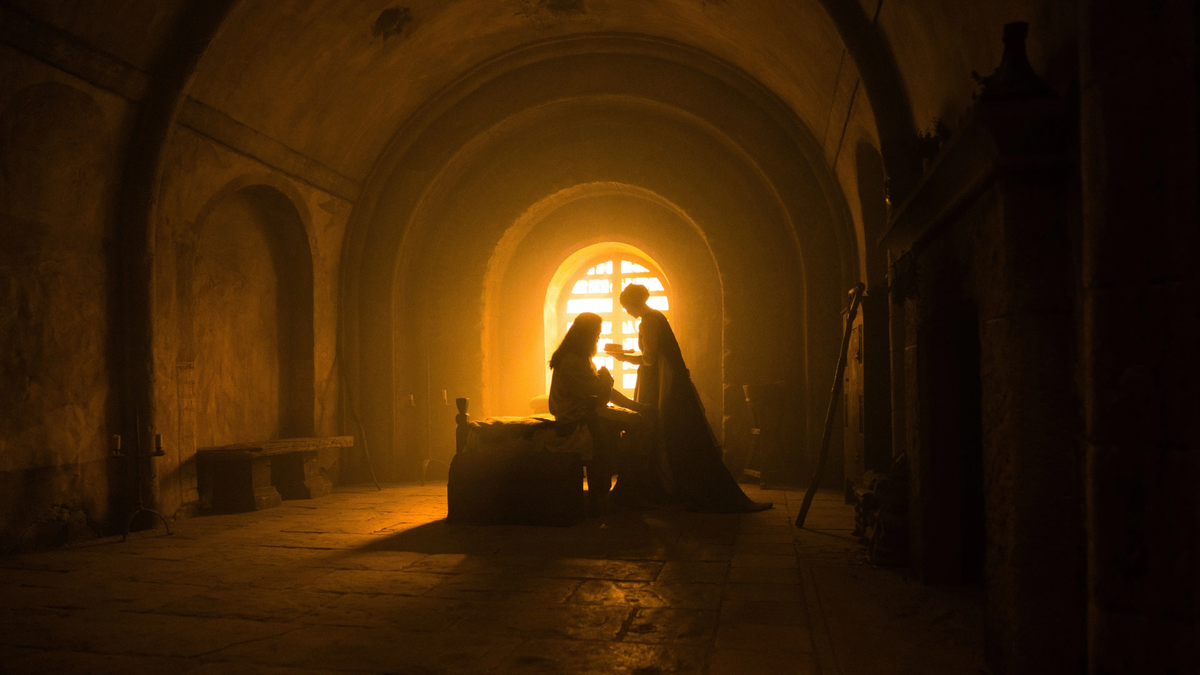
After a knife to the gut has Robin on the edge of consciousness, John drops him at an island convent known for their skill at healing. He awakens in this verdant isle to Sister Brigid (Jodie Comer) apologizing for ignoring his delirious pleas for death, before informing him that his payment is to help in the apple orchard. Thus, the core of the story finally begins to take shape. For in this place, the deeds of Robin Hood are merely the thing of folklore, and he's relieved that his visage is unknown. He introduces himself as Randolph, and can reckon with his past and twisted legacy from a remove through conversations with Brigid and the resident leper (Murray Bartlett), a man of great inner peace despite his body's unstoppable deterioration. Soon thereafter, Little Margaret shows up without her father, and Robin finds himself with something resembling a renewed purpose, even as he continues to search for his "right death".
The importance of story and hope in a time of great suffering is clear, as none of his light protestations are the least bit convincing. Randolph is a man, as fallible as all the rest, albeit guiltier than some; Robin Hood is an idea. His adventures are only spoken of in enough detail to inform us of the light they represent, with the one exception demonstrating his capability for compassion. As a man, he contains much darkness, and he would have you believe that makes him a wretch unworthy of grace, regardless of the perspective of others. Sarnoski puts forth the conviction that the question of redemption is secondary and uninteresting, for who is fit to render such a judgement? But no one is so lost that they cannot do some good in this world with their final breaths, be it raising a child lost in space and spirit, be it saving a would-be avenger (Noah Jupe) from going down the same "righteous" path he did, or be it giving yourself over to someone who deserves the vengeance they seek.
For all my loving words, do not mistake my praise for a coronation. The pacing can be languid, far more so than benefits the plot, and some of the side plots don't amount to all that much. Even once the tone turns, it remains dour throughout, without the cheeky levity present in healthy doses throughout Pig. While Jackman is roundly excellent, embodying the type of old soul you would expect from such a traveled character late in life, the character falls in a fairly narrow lane, so it fails to impress (Comer, on the other hand, is characteristically luminous). The script is searching and poetic, often nailing it but sometimes tipping into overwrought and overwritten. Does it need to be just over two hours long? Maybe not.
But it ensures the experience sticks with you, rattling around in your head in the days afterwards, as you're forced to grapple with the disparate movements of what you witnessed. While a straightforward narrative, its emotional through lines are more nuanced and layered, even as they're only presented indirectly. We only ever think about what legends do for us, what they mean for us. But peel back the layers of wish fulfillment and comfort they give, and you're left with a human being. What of their soul? What of their personal legacy? What does the constant pressure of living in your own shadow do to a person?
Reckoning with their humanity turns them from a god into a man. In doing so, they become aspirational, rather than sacred. Someone you can aspire to be, rather than merely worship. And when darkness encroaches on all sides, there is far greater value in inspiring people to be better than to be saintly.
To my eye, the fire was far too impressive and realistic to have been purely CGI. But with the actors often seemingly surrounded by it, I doubt it was purely real, either. I'd assume there was a blend, some flavor of actually setting the fire, then using VFX to make it even bigger and insert the actors seemlessly into the scene.↩