The End of Oak Street
"Is that a fucking dinosaur?!"

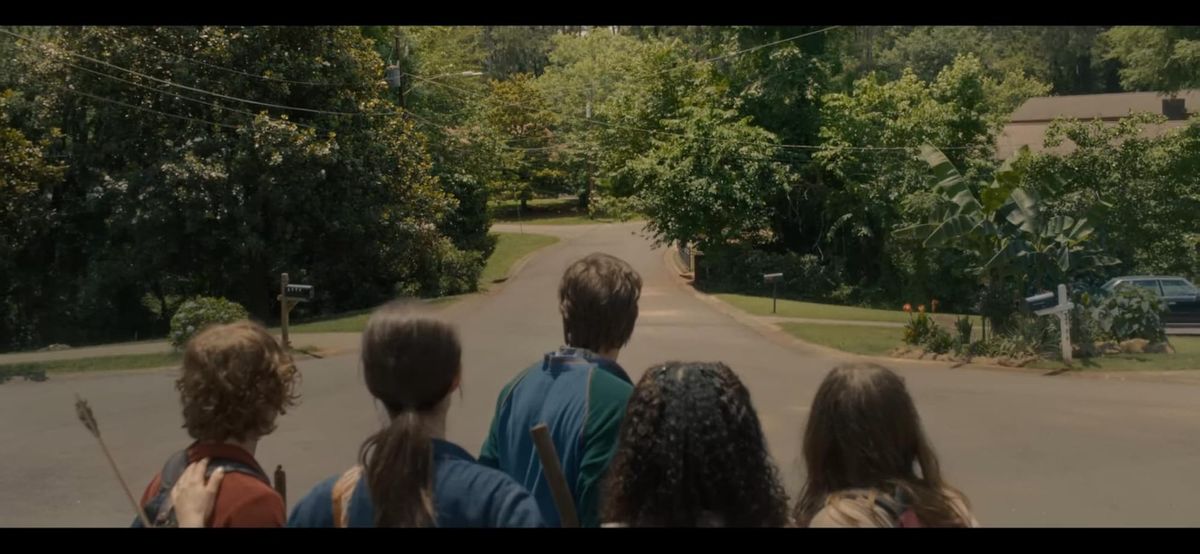
The return of writer/director David Robert Mitchell is reason enough to be excited about this movie. After providing an early entry in the current arthouse horror wave with acclaimed sophomore effort It Follows, he alienated Hollywood with his follow up, Pynchonian thriller Under the Silver Lake, a masterful and nihilistic riff on Mulholland Drive. Middling reviews combined with the ability to pivot to digital distribution appear to have scared A24 off of a larger theatrical release, so its twisty mystery sank into a watery grave, along with any momentum Mitchell may have had. While the years since have seen the work's reappraisal, his career has experienced no such revival.
Until now. What's fascinating is that not only does his re-emergence comes by way of a major studio (and one he hadn't worked with previously), it's with a project that bears little resemblance to his prior work. We already knew about his fascination with the 70s and 80s courtesy of the aesthetic of It Follows, so it's an unsurprising time period for him to set a feature. That film also features his most ambitious VFX and set pieces, although to compare them to an $85 million monster movie is laughable. Mitchell's big coup was to get producer J. J. Abrams on board. Abrams has been proving skilled at spectacle for his entire career, from Mission: Impossible 3 to Cloverfield to Star Trek, so no doubt his presence and assumed influence made the project more palatable to the studio. Never mind that the last time theatrical audiences saw his name as either director or producer, it was attached to a legendary debacle, one whose effects ripple throughout the Star Wars franchise and Hollywood's relationship to fandom to this day. But given the Amblin-coded opening, Abrams' experience writing/directing Super 8 likely came in handy.
Granted, it's not just the opening that reads as an extended Spielberg homage. From the very first shot, the world is softly focused, the pastels emphasized, transporting you back to the days when men would wear bowling shirts comprised of loud, broad stripes of muted colors. George and Denise Platt (Ethan Hawke and Anne Hathaway) are helping out with a block party, while their kids Brian and Audrey (Christian Convery and Maisy Stella) hang out with the neighborhood kids. Brian is avoiding an older kid after accidentally breaking his brother's arm, Denise is appalled that her friends haven't heard of (never mind seen) Carl Sagan's Cosmos, but neither is blind to their parent's squabbles over money and child-rearing and independence. Oak Street is a lovely little suburban cul-de-sac, where the neighbors know and get in each other's business, and their dog Starbuck can roam. Their only troubles are the shifting economic tides and the way it foregrounds their self-identity, with scenes like a joyful pizza dinner full of reminiscing making clear this was once a happy home, and could be so again, if they can just cut through the bullshit.
What do you think - could being forced into survival mode, running from dinosaurs after being transported millions of years into the past, have that effect?
To call this Mitchell's version of Jurassic Park would be as reductive as it is true. This makes four straight looks at suburban malaise giving way to decay, albeit through very different lenses. This one just happens to also involve destruction enacted by creatures who haven't walked the Earth for millennia, involving his obsession with the inexplicable elements of what would otherwise be ordinary life. An overheard radio news report informs us NASA has been tracking bizarre ripples in space, which appear to manifest as shimmering bubbles that are either very small or super huge. And after some failed attempts to flee reveal the land in a whole mile radius has been plopped in the middle of a pre-historic swamp, Audrey puts her love of science (and sci-fi) to good use to posit that maybe it has to do with a wormhole swapping the land. That's all we're going to get about how any of this works; why would a pizza delivery guy, a stay-at-home mom/award-winning hunter longing to be an author, a scared and rambunctious boy, and an aspiring Cornell student be able to puzzle out the mysteries of the universe while evading giant lizards?
But Spielberg he is not, for good and for ill. One of the master's most famously discussed techniques was to keep the camera at the eye-level of the humans, always looking up at the dinosaurs, increasing the wonder and danger it conveyed. Mitchell and longtime collaborator Mike Gioulakis do the same thing here, but effectively adapt it to a setting with a bunch of two-story buildings. Not that this film has the same reverence for dinosaurs: one of the most indelible images will certainly be two brontosaurus looking creatures finding their inner golden retriever, to much amusement from both the audience and the characters. This is amongst the first feature films to incorporate the most annoying pre-internet "Well, actually...", depicting most of its creatures with feathers or fur of some kind. It's well done, but inherently goofy looking, even as their unkempt manginess makes them appear even more alien and unsettling. The film is absolutely scared of the pre-historic monsters, but occasionally so overcranked as to slip into parody. On the one hand, there's a quoting of the Velociraptor kitchen scene, and an assumption the dinosaurs have some of the abilities they acquired in Jurassic Park. But it gets a little ridiculous the fourth time someone looks away just before an enormous snake that easily fills the hallways of their house twice over goes by, somehow none of them hearing this thousand pound monstrosity. The reptiles never stop hunting and never stop feeding, despite the plot covering a few days, and the population of Oak Street being fairly small.
That relentlessness and commitment to its less sanitized terror (contrasting Audrey being chastised for saying "shit") comes at the very noticeable expense of the interpersonal drama. Regardless of the warm and well-realized setup, any attempts to further the story grind the movie to a halt with middling dialog and unspecific, unearned emotional pleas. Whether it's Brian encountering his bully, or the moments of reconnection between Greg and Denise, or aiding the next door neighbor Jeannette (Jordan Alexa Davis) before adding her to the crew, it's all so brief and secondary in light of the extended action sequences. Even the grief following the deaths of people they care about move by fairly quickly and weightlessly. It's all a reflection of Mitchell's inexperience making a movie of this scale. In his previous films, and even the beginning of this one, the plot could afford to take its time, for characters to pause and contemplate, for actors to write their thoughts on their faces rather than clunkily speak them out loud. But the demands of action filmmaking render that a more difficult balance which he does not strike.
As if to prove my point, the final ten minutes or so are an unsuccessful exercise in tying up loose threads, in which at least as many questions and objections are raised as resolved. The movie feels like it's wrapping up despite your brain screaming that it cannot be the end. But instead of moving into a final evolution of the plot, in which we take its implications to a natural conclusion (at least, as natural as possible, given the circumstances), it's resolved in two short scenes that directly precede an awkward, cheery denouement, clashing hard with the tone we just left behind to provide an ending that rhymes with the beginning. Alas.
The result is a fun summer action-adventure flick that fails to be the savior of dinosaurs at the movies, even as its weak competition means it's arguably the best one not directed by Spielberg (I haven't subjected myself to enough to say definitively, but Patrick Willems has). The VFX are good throughout, although it's wild that Jurassic Park remains the high water mark. And while Michael Giacchino's marvelous orchestral score doesn't introduce us to any themes as recognizable as John Williams', it does effectively add to the wonder of each shot of the beasts. There's enough here for anyone to have a good time, but it feels destined to slide into Mitchell's career as the odd Hollywood misfire that aimed to be a crowd-pleaser, before he goes back to making the idiosyncratic yet impactful indie movies that we don't know we want.