The Housemaid
"Juice is a privilege, and we don't drink it out of a dirty glass."

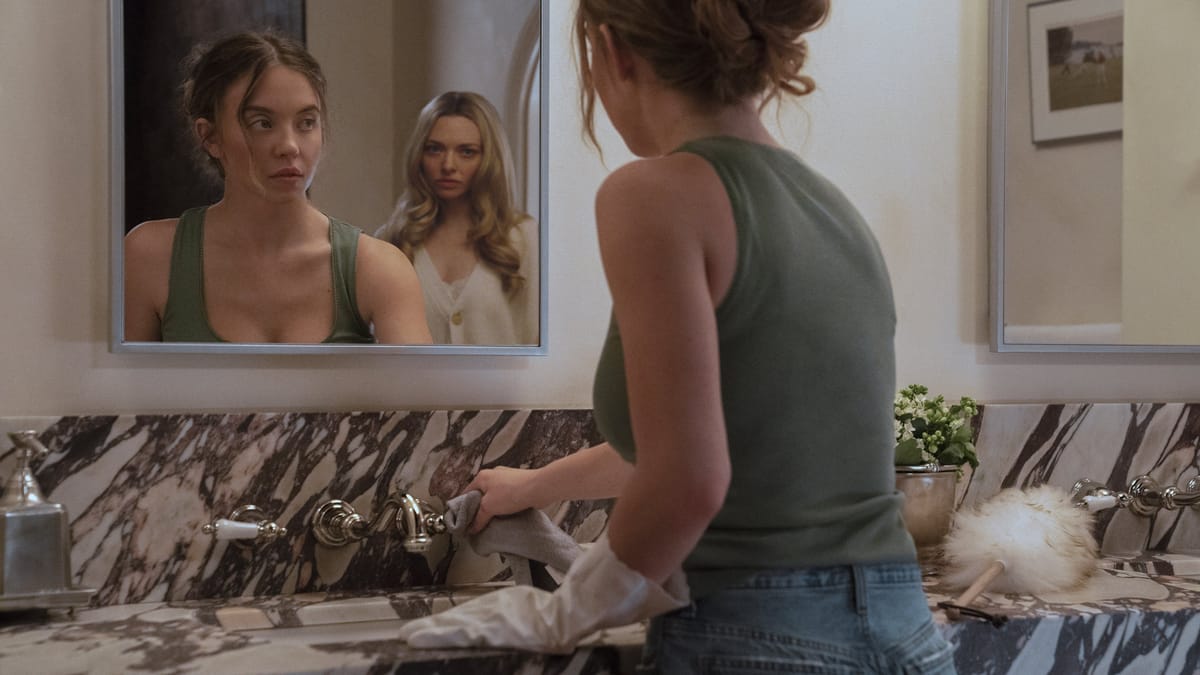
Over the past three years, Sydney Sweeney has quietly been amassing a solid body of work. It's taken time to convince audiences of her talents: people tend to be skeptical that bombshells can also be good at their job, and she began her career by leaning into her physical attributes, be it her breakout role on Euphoria or trashy, sexy thrillers like The Voyeurs. But since refocusing on movies, she's been going to great lengths to demand the public take her seriously. While no one had a prayer of escaping Madame Web unscathed, she turned in remarkable (if vastly different) performances in Reality and Immaculate. This year, she easily shared the screen with Paul Walter Hauser in Americana, held her own against the likes of Jude Law and Vanessa Kirby (and an electric Ana de Armas) in Eden, and was excellent as the titular Christy, despite the screenplay not doing her any favors. Her tastes have been commendable, even if the box office isn't always there, and she's proven to be an adept producer; it was Sweeney who brought Glenn Powell aboard Anyone But You, which helped turn that mediocre romcom into a hit.
Sweeney closes out the year in director Paul Feig's third feature in eighteen months, a level of productivity rarely seen these days outside of Steven Soderbergh. One can only hope he's about to ease off the accelerator, as his latest effort is either the product of putting quantity over quality, or a gas leak in his office.
The conceit is messy, but presents enough intrigue to pull you in. Millie (Sweeney) is a parolee, having recently returned home after a ten year prison sentence. She's intent on keeping that from Nina Winchester (Amanda Seyfried), who's interviewing her for a housemaid position. Millie doesn't have any experience (another secret to be kept), but her record has thus far precluded her from employment elsewhere, despite her efforts. Their chat goes well enough that Nina gives her a tour of the house, during which she makes some odd comments, and creepy details come to light, such as how the guest room door only locks from the outside. But she's ultimately given the job, which is a live-in position, much to the surprise of Nina's husband Andrew (Brandon Sklenar). As soon as she starts, it becomes clear that despite Nina's previous warm and inviting demeanor, she's determined to destroy Millie for some as yet unknown reason, and the stage is set for a swirl of power dynamics and mystery and sex.
The problem is that while it thinks it's Gone Girl, The Housemaid has far more in common with the worst direct-to-Netflix fare or a late-career James L. Brooks movie. Each scene is played deadly serious, complete with the dramatic strike of a single, fading piano chord. Meanwhile, the audience is erupting in gales of laughter at nearly every line of dialog. Awkward phrasings, absurd reactions, and inhuman behavior from every character abound. Their seven-year-old daughter Cecilia (Indiana Elle) is supposed to be blunt and unnerving, but lands as comic relief. All the while, a Lifetime movie is unfolding. The moment Andrew finds Millie watching Family Feud at 2 AM in her PJs that show off a suspicious amount of cleavage, you know what's about to happen; the two have been eye-fucking since they met. But it's still eye-rolling when he comforts her with a gentle hand on her knee, which is shot in close-up, just in case you'd have missed it. At that moment, their eyes meet, and you can just feel their impending future date, shot in soft, overlit slo-mo and accompanied by Lana del Rey (they chose "Old Money").
This is the language of every cheesy forbidden romance made by people with no creativity. It's so vacuous and played out that you could be forgiven for thinking Feig is doing so to deliberately comment on the genre, before pulling the rug out from under you. I'm sure he'd say so; the rug pull does come, in an interminably long, flat, boring monologue that lays bare everybody's secrets to bring us into the third act. But by then, we've been living in this nonsense for nearly ninety minutes, every moment played as earnest as the last, leaving me unwilling to give him the grace required to pull it off.
Worst of all, the third act doesn't make any of the slog that came before worthwhile. Feig and screenwriter Rebecca Sonnenshine don't completely fall on their faces, remembering to include some cathartic moments. But their power is diminished by being drawn out beyond all reason. The quality of the writing remains in the toilet, and the characters remain poor facsimiles of human beings. Sweeney gets one moment to shine, reveling in her only chance to act naturally, which she nails. But the rest of the time, whenever you try to lock on to the characters, you've no choice but to throw up your arms in defeat.
Not all of that is due to horribly miscalculating how to keep your attention; some is born of unfinished or pointless sequences. While it's in line with Nina's antagonism and gaslighting to demand Millie pick up Cecilia from ballet without telling her the name of the studio, why doesn't Millie try calling her back? Or calling Andrew? Not that it matters: as soon as an insert of Millie's phone shows us how many ballet schools are nearby, it cuts to Millie walking into the correct one just as class ends. So what was the point? In isolation, it might be an acceptable mistake; when such issues plague every other scene, it's poor filmmaking. While some such actions technically make sense once the screenplay fully reveals its hand, many of them cannot escape the weight of their stupidity.
This is the kind of film that wears its themes on its sleeve, screaming them at you through otherwise meaningless scenes and some incredibly misplaced and unmotivated voice-over. It's about the class divide, so we see Millie sleeping in her car, getting hassled by cops. It's about trauma, so we learn about the untimely death of Nina's parents. It's about parenting, so Cecilia refuses to warm up to Millie. It's about misogyny, so we learn about Millie's past. When almost every idea is one-to-one with some event in the film, and multiple are conveyed through flashback accompanied by voice-over telling us exactly what we're seeing, it's impossible to take any of them seriously.
Many of the shockingly positive early reviews have been referring to this as a campy great time, but they miss that finding a bad script funny is a different thing entirely. I've no doubt that plenty of audiences will have a blast marveling at the inexplicable dialog and the Winchester's strange, Stepford Wives-esque friends, who function as props to spread gossip and highlight how out of touch rich people are (truly revelatory stuff). But "camp" implies some level of self-awareness, of a heightening and a lightness that is never once sniffed across its severely bloated one-hundred and thirty one minute runtime. Instead, you can feel the source material straining against a filmmaking team that's wholly unsuited to the task.