The Huntsman

Full disclosure: I know a few of the people involved with making this movie.
When adapting a novel of fully realized characters and a twisty plot containing multiple red herrings, directors and screenwriters have a bunch of choices to make. Books don't translate directly to the screen, no matter how angry audiences get about deviations from the source. The success of the adaptation rests on the script's ability to capture the vibe and ideas of the book while molding the details. The recent Dune movies are an excellent example: they reorder events, collapse characters, and completely excise subplots deemed superfluous. This can result in a simplified text, placing a heavier burden on the main actors to convey the inner life of the characters. But when done well, locating a new interpretation of the novel's core opens a dialog with it, and deepens the experience of both.
The debut feature screenplay from Steven Jon Whritner and third (narrative) feature from director Kyle Kauwika Harris demonstrate an alignment with those who believe in direct adaptation, and is a great demonstration of the flaws in that approach. The first act of the story does little more than introduce you to the situation, making heavy use of montage and short, choppy scenes that frustrate making an emotional connection to anyone on screen. The novel is largely experienced through each character's internal monologue slowly revealing their hopes and desires and character details; meanwhile, the movie's stripped down script leaves no room for depth. Only a few stray lines of dialog and out-of-place scenes hint at more, leaving limited exposition (much of which comes very late) to give you just enough info for it to be coherent. None of the explanations for anyone's actions are satisfying, but you can make sense of them if you squint real hard.
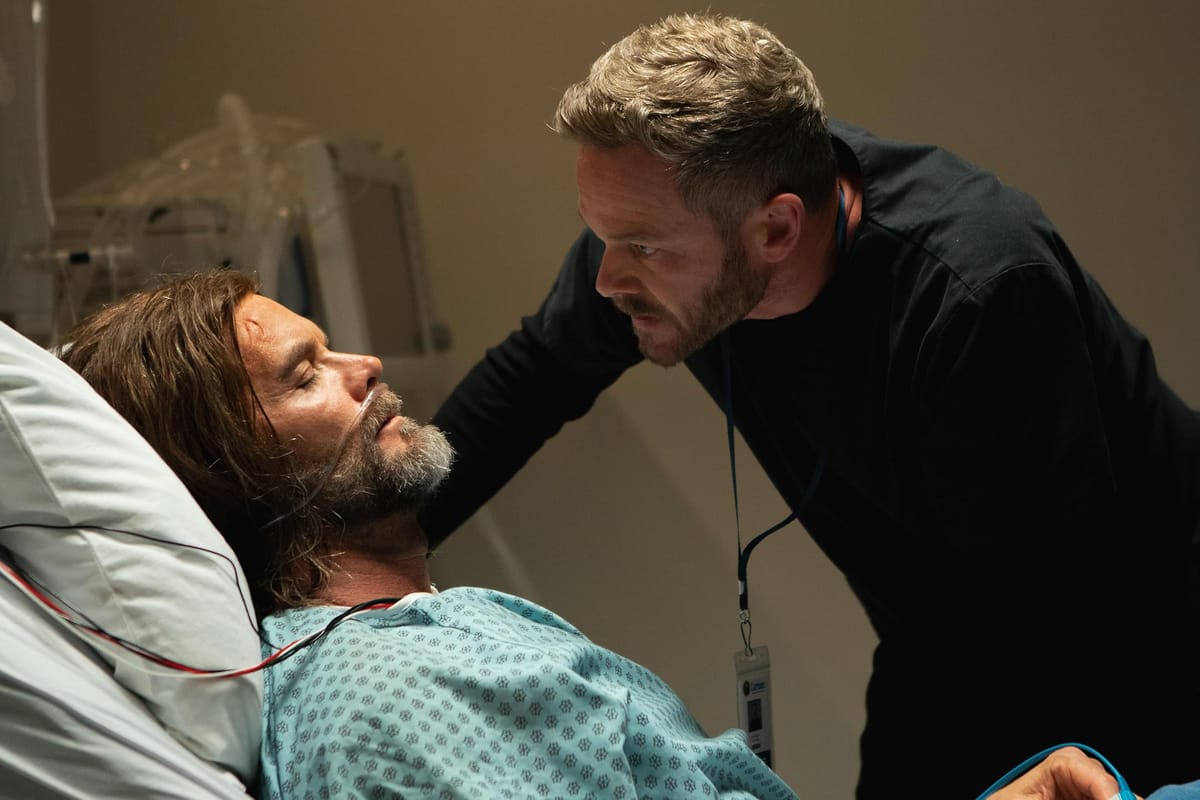
The biggest problem is Max (Shawn Ashmore). He's just transferred hospitals and requested to work with coma patients. He gets assigned to Lincoln Raider (Garret Dillahunt), whose condition came at the end of a gun barrel; he's been accused of being "The Huntsman", an anonymous figure who's murdered six young women in the sleepy New Hampshire town of Antrim. The movie makes clear that Max asked to watch over Lincoln, but leaves his motivation a mystery. In fact, it's not until the final twenty minutes we have any understanding of what he wants. There is one tiny bit in the hospital where Max asks Lincoln what his first kill felt like and if he enjoyed the wonderful sense of power, then puts headphones on the unconscious man with some unheard recording. But the otherwise complete lack of commentary on his plan makes it feel like he has none, even once the action moves to Lincoln's house with his wife Jolene (Elizabeth Mitchell). That he ends up working for the Raiders following Lincoln's discharge almost by accident deepens that impression.
Given its unceasingly dour tone (save for an out of place reference to Something's Gotta Give), it would be tedious to spend that first forty-five minutes hanging out in a hospital with a stiff and his patient, so Max's story is split with his sister, Detective Darby Albright (Jessy Schram). She's investigating the Huntsman's grisly murders, because although Lincoln was a suspect, everyone else is convinced it's Sam Miller (Todd Jenkins), a character we never properly meet. Here, the movie's approach to adaptation hits another snag. Max's heavily internal storyline is reduced such that his screentime roughly matches Darby's. However, their narrative weights remain the same, throwing the careful balance of the plot completely out of whack. Darby's impact is minimal, simply filling in details of the murders (in which the movie is not very interested) for the audience. But as Max learns many of them independently (if he learns them at all), they don't matter all that much. Instead, this co-plot just adds a bunch of flat shouting, as everyone in the police department is constantly angry at one person or another, and unafraid to announce that.
This division of screentime is yet another obstacle in engaging with either thread. The protagonists are not afforded enough time nor space to define themselves, nor to make their concerns feel important, and thus end up one-dimensional. That's before you factor in the half dozen times we arbitrarily cut to an unnamed woman in a nondescript cellar being held prisoner. It's clear her captor is the Huntsman, which is why we never hear their voice or see their face, just a gloved hand. But it does nothing to deepen the story or characterize anyone or give us any additional info. You could lose these scenes entirely with no consequence, but they're included to mirror the novel's chapter endings.
Maybe all of this could have been salvaged by solid performances, but they're nowhere to be found. Every single line delivery is so overwrought or monotone as to be physically painful. No one is reacting to anything being said to them, as if they only got their lines minutes before Harris called "Action!". Dillahunt is especially bad, mutating his naturally distinct manner of speech into something truly baffling. There are many long, hard stares, yet all feel weightless. The only one ever having fun is Elizabeth Mitchell as Lincoln's wife, Jolene, but even then, most of her performance is as bland as everyone else's. Given their inability to convey all but the most explicit emotions, any possibility of nuance is lost. As such, every character is flat as a board, with about as much charisma. Such a broad failure is only possible in concert with poor directing, as it arises from a dramatic miscalculation in how to maintain an even tone.
The warning signs were there from the very beginning. The images are poorly lit and the colors washed out, especially in the outdoor scenes (never mind after dark). Shots are occasionally out of focus in ways that appear to be mistakes, and when it is deliberate, they add and say nothing. The camerawork is unimaginative. Worst of all is the score. Composer Cory Perschbacher crafted a terminally generic, droning carpet of sound that never really changes, always invoking a cool wind. And as is common in indie flicks, it's severely overused. It lurks underneath most scenes, exhausting your ears with its insistence that what's happening is Very Important. Additionally, the same track often bridges scenes, causing them to blend together and stomping on the chance to land a dramatic beat. It rarely adds any emotion to the scene we're watching, and even clumsily clashes with a few.
Underneath it all, the story is pretty solid, but its expression is ruined by miscalculations at so many levels. Even its eventual resolution lands with a resounding thud as it fumbles (or just plain forgets) its explanation, although you can take some educated guesses and land close to the intention of the source material. If an adaptation fails to stand alone, a decent consolation prize is drumming up enough interest in the story that viewers are inspired to pick up the novel. But when the plot is without hooks, when the characters inspire no strong emotion despite their own heightened ones, and when you must strain to find traces of artistic intent in the finished work, audiences are far more likely to forget about it the moment they leave the theater.