The Moment
"I know it's not chic to be the last one at the party, but I think…I just hate going home."

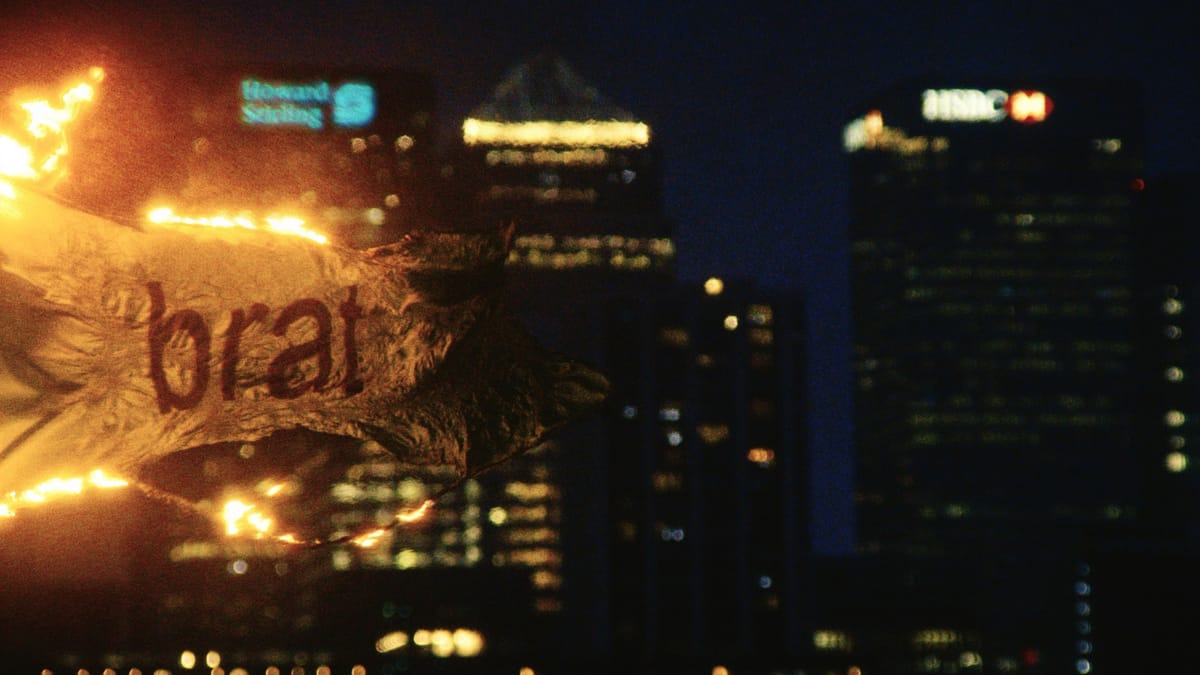
I was never entirely clear what "brat summer" was. I knew it had something to do with Charli XCX's newest album of the same name, but that was about it. I'm aware that makes me irredeemably uncool, but I can't pretend to be someone I'm not. Fortunately, defining The Moment is somewhat more straightforward, even as it holds you at arm's length for long enough to frustrate that understanding.
Technically, it's a mockumentary. However, don't think a brightly colored Christopher Guest comedy, despite Charli programming This is Spinal Tap at Alamo Drafthouse. While there is loads of humor, its narrative approach and tone is more evocative of 2010's I'm Still Here as made by Gaspar Noé in Lux Æterna mode. Charli plays an impressionistic version of herself as the biggest summer of her professional life draws to a close, and her entire team hunts for ways to extend "brat" indefinitely. Presented as a fly-on-the-wall documentary about the difficulties preparing for an arena tour in support of the album, it's instead a chaotic, anxiety-fueled experience that follows from achieving the kind of cultural notoriety few ever do, leading an army of sycophants to emerge under the guise of helping her capture every single opportunity.
From the opening shot, the movie is an aggressive assault on the senses. Intense strobes, blaring bass, and repetitions of "three six five party girl" at chipmunk speed knock you back into your seat, bracing for the rest of the film to continue apace. Fortunately, it does calm down, although the constantly moving handheld work from cinematographer Sean Prince Williams ensures we feel Charli's lack of solid footing at every moment. It's even preserved in each new establishing shot, whose location is labeled with an array of brands and people with similar names, each on screen for a fraction of a second in a flickering red-green-blue so fast that they melt into mud. None persist long enough for you to be certain what you saw, more ephemeral than the cultural force they're in service of.
Further adding to the vibe is A. G. Cook's energetic, scuzzy, electronic score, deployed both to drive up your own anxiety as well as add another layer to the soundscape. Accordingly, it has more in common with compositions from The Substance and Marty Supreme (and to a lesser degree, Challengers) than it does the artist's own dance-pop. While we do hear a few, their predominant absence is a reminder that in contrast to so many recent movies about musicians, The Moment has no interest in hagiography. As such, Cook's oft-contemplative, always glitch-filled work contrasts sharply with the nightclub feeling Charli and her creative director Celeste (Hailey Benton Gates) discuss creating for each and every show.
All of this style is quite effective, but belies the substance. While the story is always clear, the weakness of the plot and the characters within it are the root of its struggles. Yes, it's easy to recognize Johannes (Alexander Skarsgård) as the type of director intent on taking over every element of the production until barely any sign of the artist remains. The tensions that arise between him and Celeste and Charli are plain to understand, as is the meddling of the record company, personified by Tammy (Rosanna Arquette). But Charli's refusal to push back, stammering concerns before acquiescing to every "suggestion", quickly gets tiring. Her waffling is in direct opposition to how much power she holds, suggesting some apprehension about wielding it. But then why does a chance encounter with Kylie Jenner at a resort/spa cause her to about face and dig in her heels hard, even as she expresses her discomfort in private conversations with Celeste? It's manic due to missing information, rather than emerging from a character Going Through It.
It would help if we had any real sense of the (fictionalized) woman at the center of the maelstrom. That the story was her idea (which she asked Bertie Brandes and director Aidan Zamiri to turn into a screenplay) is all the more frustrating, as it feels like she has things to say about ending up a passenger in her own life that fail to come through. The blank look behind her eyes as people argue about her show speaks to a willful disengagement, especially given the movie's minimal attempts to expound upon or display her inner life. She's entirely reactive to external forces, so even when she states what she wants, it's only a matter of time before it gets undermined. None of this is easy to connect to on an emotional level, even as you feel some sympathy for the pressure that comes with the label watching your every move.
The lack of Charli's interiority on screen makes the opening feel even longer than it is. We quickly understand the monstrosity of the cultural firestorm she ignited (even if we hadn't all just lived through it) and how she's reacting to it, so repeatedly hammering it home only serves so much purpose. For example, while both the launch of the brat card and the offer of a free vacation if she posts on Instagram come back around later, neither's resolution has enough of an impact to make the amount of time spent on them feel well-calibrated.
That is, until we get to the finale. In a voicemail, Charli reflects on the previous few weeks, delivering a clear, heartfelt monologue about the beauty of endings, reiterating her desire to move on to the next project, and the relief that this will no doubt be the dagger to the heart of "brat". As it ends, the unmistakable opening strings of The Verve's "Bitter Sweet Symphony" slowly fade in. It's a perfect choice: not only do its lyrics fit the moment, but the band famously lost control of their song due to a legal dispute.
While The Moment is not an entirely successful film, it's easily one of the most exciting musician-driven projects in recent memory. Not because of who Charli XCX is, but because of who she's trying to be with this piece. While a number of musicians have expanded into the cinema as of late, be it through biopics or concert films or even mockumentaries, none have done it quite like this. Its closest comparison was last year's widely (and wrongly) reviled Hurry Up Tomorrow, but that was a self-reflective visualization of one's own demons rather than taking aim at the industry and reacting to how it treats those whose popularity reaches some critical mass. Realizing her ambitions may require working with another director, or maybe it will just take Zamiri getting some more experience under his belt. But whatever it takes, Charli has demonstrated that her narrative voice has value on the big screen.