The Rivals of Amziah King
"I've met a whole lot of smart people not patient enough to wait for something to grow. Yeah, I'd rather be patient than smart."

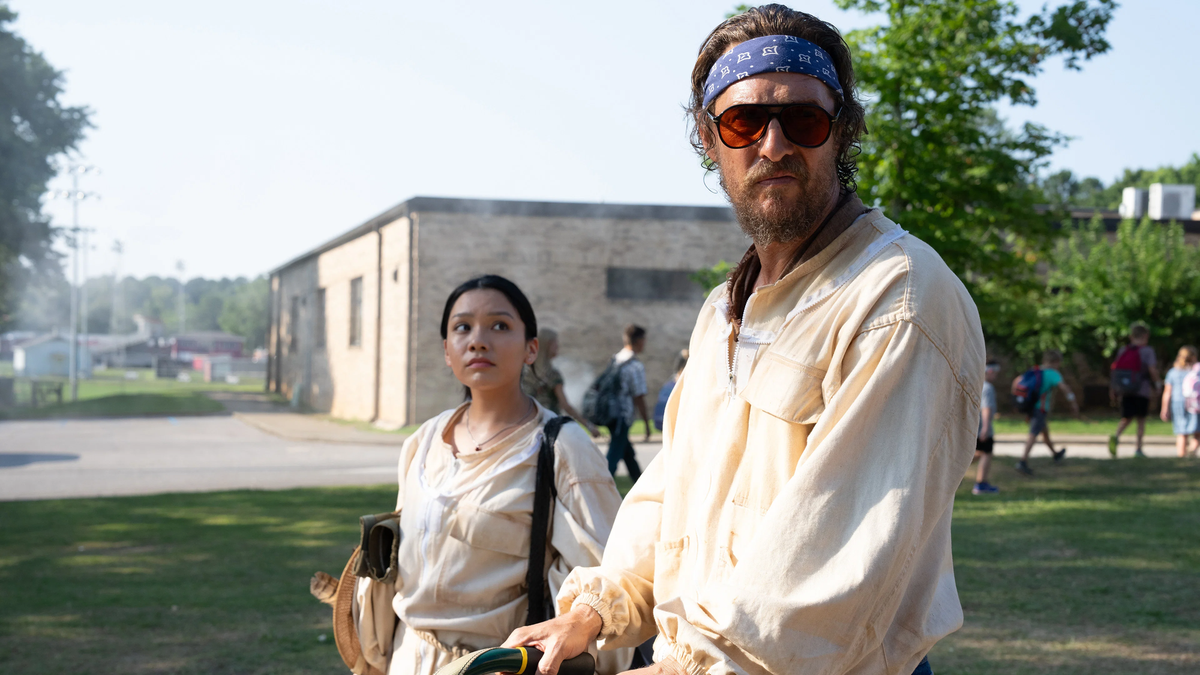
With the notable caveat that I've yet to see the hotly anticipated and roundly acclaimed Teenage Sex and Death at Camp Miasma, the first half of Andrew Patterson's apiary noir is the best film of the year so far. As people mill around a walk-up chicken fried steak joint one evening, we watch as a few gents pull out guitars and banjos and a harmonica, clearly waiting for someone. A flatbed drives up and parks off to the side, and Amziah King (Matthew McConaughey) walks over, banjo in tow. They take a moment to warm up, then start to play, the air filling with the kind of bluegrass/folk that makes it obvious why people so quickly tired of the watered-down version peddled by the likes of Mumford & Sons and The Lumineers. They were good enough, but there's just no comparison between that and the layered, friendly, quick, and joyful music that comes from Amziah's friends (including Owen Teague, Jake Horowitz, and Rob Morgan), nor the work from Erick Alexander & Jared Bulmer that scores much of the movie (diegetically and otherwise), daring you to avoid tapping your toes along with the beat. All of it communicates wonderfully just how important Amziah is to the community, even before the authorities approach to enlist his help identifying some stolen honey they picked up.
Imbuing it with extra energy is the outstanding work of editor Patrick J. Smith. Great editing is often invisible, but Smith makes an argument that the best editing should call attention to itself. During that impeccable intro, even simple close-ups are made fresh, given a flip book quality by employing a few quick cuts across handheld shots taken a few seconds apart, before freezing for a second or two. So rare is this style that your brain is likely to reject it, and immediately begin searching for signs of motion in the stillness. Especially since the subject is not always an important character: the first is the cashier at the steak place (Jenna Harvey), with a warm smile on her face as these old friends come together to just have a wonderful time. Early on, it hammers home the importance of connection and memory, while preparing us for the impressionistic flow to come.
But somewhere around the midpoint, the story's focus shifts from Amziah to Kateri (Angelina LookingGlass), as he's indisposed and she attempts to track down the beloved bee hives that comprise his life's work and livelihood, stolen all at once under the cover of night. The growing warmth and trust between them is part of what powers the previous sections through their meandering vignettes, from removing a swarm of bees inciting panic in an elementary school to an impromptu jam to Amziah teaching her how to see stories in every potluck dish. He imparts upon her life philosophy under the guise of beekeeping, all while the actors are covered in thousands of real bees. Their easy rapport hints at familiarity from the moment Amziah encounters her waitressing at a nearby diner: he and his late wife Glenda fostered her and her brother as children, and she's only recently returned to rural Oklahoma as an adult. Their father-daughter relationship is made even more lovely and palpable once you realize all it says about Amziah's desire for children of his own. As such, the movie is sorely lacking for its absence when the plot turns towards her detective work.
Not that it settles into a new normal. Instead, it moves through a few different micro-plots on the way to its finale, in stark contrast to the way the movie began. It's frequently fighting against itself, from noir to heist to revenge, trying to engineer ways for the main story to hit without the time to make us truly feel its beats. Outside of the central heist, which is fun and well-constructed and contains a couple of creative contraptions, we whip through so much plot so quickly that you could be forgiven for losing the thread a little bit. It doesn't help that other characters flit in and out to help Kateri, namely Chimmy (Scott Shepherd) in an advisory role, and Oat (Cole Sprouse) as an accomplice, as well as Officer Sunderland (Bruce Davis) doing his own investigation (in theory, anyways). We'd spent some time with all previously, so their presence is reasonable, but their use undermines our faith in Kateri's competence. There's an attempt to make the case that "when they're ready, the workers choose a new Queen", but both the words on the page and what we see on screen hold that idea at arm's length.
I don't want to bag too much on a brand new actor, but it's hard to ignore that LookingGlass is part of the problem. McConaughey is absolutely magnificent throughout, turning in one of the best performances of his career (and the year), never once feeling like anyone other than a rural bee farmer who's a bit world-weary but remains dedicated to his hives first and foremost, closely followed by his community. When LookingGlass shares the screen with him, it works, as Kateri more of a shrinking violet to his steadfast oak. When she attempts to harden and confidently assume her new role, her diminutive stature does her no favors, but most damning is the amount of effort you feel pouring out of her in an attempt to land every line, every movement. Even next to Sprouse and Shepherd and Davis, who are plenty good albeit nothing special, you feel the difference.
While those flaws mute the overall experience, there was never a chance they would ruin it. Patterson's sophomore effort is as spellbinding in its construction and confident unorthodoxy as his 2019 debut, low-key sci-fi thriller The Vast of Night. That the path of second half is hard to anticipate flows from its manic nature, but even the more easy-going first half has its shocking moments, starting in just the second scene with an event that indirectly sets the stage for all that's to come. The landing is far from smooth, yes. The journey is wonderful, nonetheless.