The Testament of Ann Lee
"I never / did believe / that I ever / could be saved / without giving / up all / to God."

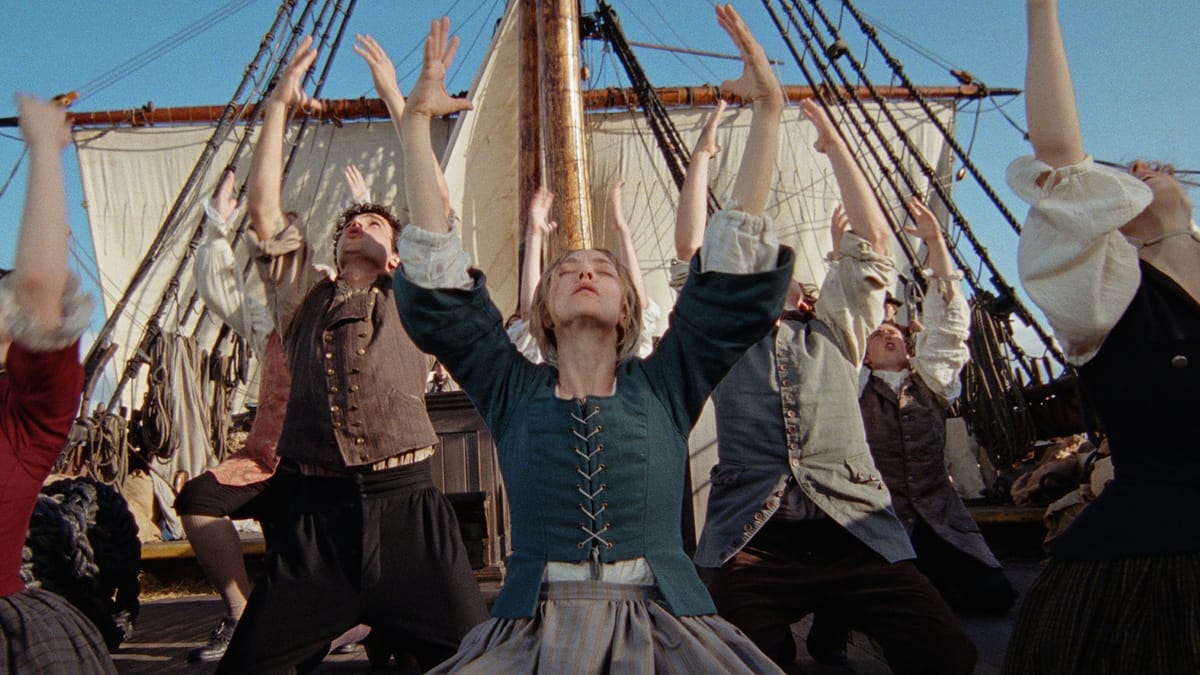
In a movie full of remarkable moments and craft, the most astounding piece is the music. Largely adapted by composer Daniel Blumberg from old Shaker hymns, their arrangements consist of layered strings with an emphasis on bass-heavy instruments (e.g. cellos and upright bases), accentuated by the worshipers drumming on their chests in large, showy motions, and stomping their feet as they give themselves over to the Spirit. The human voice is deployed rhythmically to create both nonsense sounds and complex rounds, all of which harmonize in unexpected ways. Most are in a predominantly minor key, reflecting their struggle against persecution and their battle against the darkness of the world, as well as their belief in giving over their pain and strife to God in exuberant prayer. Such scenes sweep you off your feet, sending powerful shock waves rippling through your very soul. Believer or not, your witnessing a deeply human outpouring of emotion, so no matter the context, you'd be hard pressed to be unaffected.
Given how unique such sequences are, it was smart for director and co-writer Mona Fastvold to introduce them to us so early. It's the first thing we see, many of the women chanting and dancing in an otherworldly worship in the woods, as Mary (Thomasin McKenzie) begins to regale us with the legend of Ann Lee (Amanda Seyfried), mother of the Shaker movement. They began in Britain as an offshoot of the Quakers, known as the "Shaking Quakers" for the raucous outpourings that were so central to their relationship with God. Although Lee didn't form the Shakers, it was through her influence and experiences that they grew to become a notable movement in the early history of the United States after their relocation to avoid religious persecution. Lee experienced visions from the time she was a child, represented marvelously through split second insert shots of disconnected and abstract scenes, at times catching you as off guard as they would the young girl. These led to her hunger for a spiritual practice that suited her needs and beliefs, which she finally found in the splinter group formed by Jane and James Wardley (Stacy Martin and Scott Handy).
What follows is a unique if straightforward accounting of their history through the death of Ann Lee in 1784. Mary's narration guides us through the story, dispensed in sensible dollops that move us forward and cover much of Lee's life while reminding us this is self-mythology, as she was by Lee's side from almost the beginning. As such, the more fantastical bits of this purportedly historical story read as exaggerated (at least), and the stylistic flourishes become easier to swallow as impressionistic, such as the chaotically synchronized choreography accompanying the music. Did Lee's devotion and quest for purity reflect her status as the Second Coming of Jesus Christ while imprisoned for blasphemy, resulting in a lightness of being-induced levitation just after a vision revealed God's demand for uncompromising celibacy and relocating to the New World? Maybe not, but telling her fellow worshipers upon release elevated her to Mother of the Shakers, and ensured they would unquestioningly follow her to the ends of the Earth.
The key ingredient is Seyfried's intoxicating performance, without which the whole thing would collapse. While the stellar supporting cast never lets her or Fastvold down, the nature of the story puts a ton of weight on her shoulders, and she is absolutely game for all of it. You completely forget her diminutive stature when she storms into the Church of England to proclaim them heretics, or stares down soldiers come to arrest her after a marathon worship disrupts the neighbors. Seyfried conjures a palpable fire behind Lee's eyes directed at all who are not completely aligned with her, be it spiritually or moralistically. This is particularly valuable in the many instances her followers are physically attacked or arrested, when she must convincingly stand face to face with those whose wish her harm, and defiant declare they will pray for their abusers "for they know not what they do". You never for a second question her inner strength, and it forms the foundation upon which they persevere. Nor do you question her accent, for regardless of its time or period accuracy, its consistency gives it credibility.
Lee is fascinatingly comparable to another recent Oscar-worthy subject, with the key difference being that her drive is not marked by an inward ambition, but an outward conviction. Her values, although uncompromising, are rooted in a devotion to God and a belief in consent. With the exception of denouncing other preachers as false prophets, and the occasional shouting down of slave auctions ("God loves all his people and wants them to be free"), the Shakers are not interested in forcing the outside world to conform to their way of life. She even emphasizes that her followers are welcome to leave at any time if they no longer wish to follow her teachings: her niece Nancy (Viola Prettejohn) takes such a route rather than swearing off sex after falling in love. In contrast to cults, Lee is emphatic that children brought into the faith by their parents should be free to choose whether to stay once they get old enough to do so.
All of the focus on their journey crowds out the discussion of their beliefs. For the most part, we only get the two key elements they're best known for today (to the extent they're known at all outside of New England): their unique worship, and their celibacy. And even those aren't explored very deeply. While we witness the upsetting sequence of events that are implied to precipitate Lee's proclamation of celibacy, all we get for the style of prayer is that it contrasts to the Quaker's belief of internal worship. Granted, the film is named after a person rather than the religion, so perhaps it's foolish to have expected such an explanation. It leaves them feeling somewhat vague and unspecific, an unfortunate fate for a religion that peaked at just 6000 people, and today stands at a mere three.
But this small corner of history, of a charismatic leader who used her powers largely for good (and was at worst benign), resonates today. At a time when all manner of ideology is wielded to whip people into a frenzy against their neighbor, when authority seems to be the domain of those devoid of ideas who possess ambition and crave raw power, it's refreshing to see a community that simply strove to exist. They sought to preach their gospel and spread the word to attract new followers, not forcibly convert them. Even at their most obnoxious, their outbursts were directed at those who would abuse their power. It's easy to forget the utility of religion when we're surrounded by public figures who strive to exert their selfish will on the broader public by donning the trappings of faith. The tale of Ann Lee is a reminder to all that it doesn't have to be this way.