Undertone
"Don't be scared of the dark. Be scared of the silence."

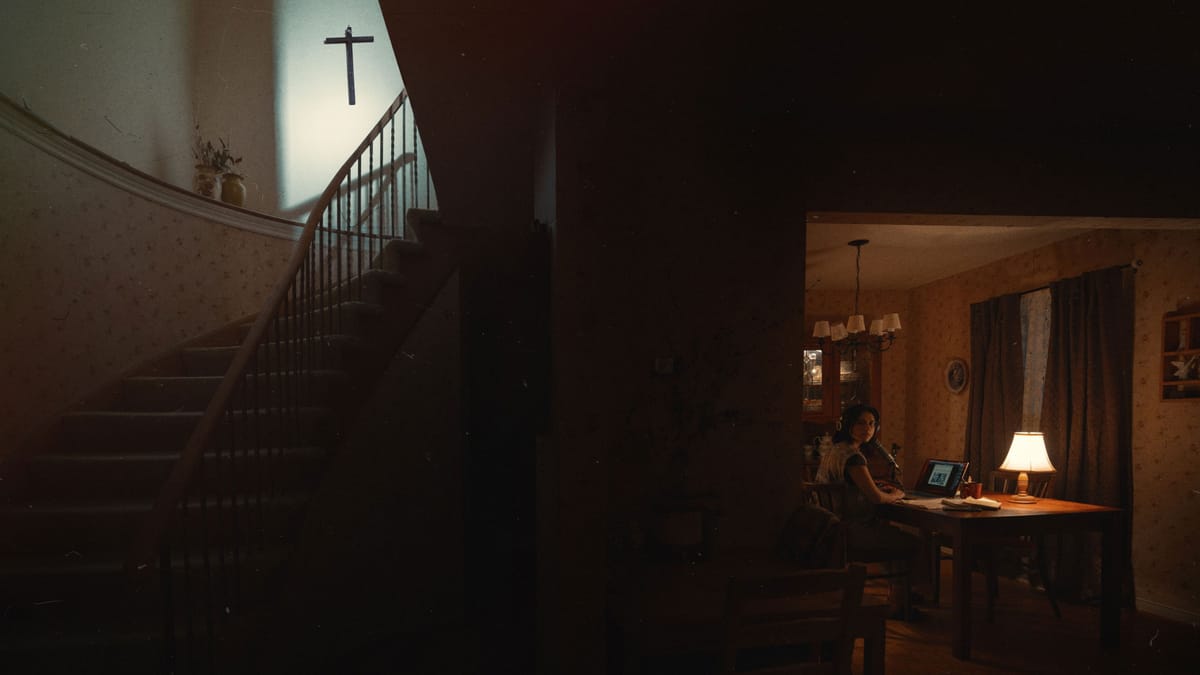
Given the massive popularity of podcasts for well over a decade, it's surprising how few movies there are that incorporate them in any significant way. Sure, President Idris Elba drops the title of A House of Dynamite (sort of) by saying he heard it on a podcast, and there have been numerous documentaries about podcasts and podcasters and true crime and so on. But by far the most significant narrative feature to involve the format is Tusk, which came out twelve years ago, and is more often a punch line for the lows of Kevin Smith's career than a reference point for how to incorporate the medium into film. So it's notable that despite Undertone's uncommon structuring around such a recording, and being a scrappy Canadian film made by a first time director without any notable stars, A24 purchased distribution rights for a tidy sum. It's an attempt to fill an unrealized niche, further emphasized by their positioning of it as a uniquely terrifying auditory experience.
That focus on sound makes it an even more unorthodox experiment. Whereas The Zone of Interest utilized dual narratives, presenting a more "conventional" (if disturbing) period drama backed by the sounds of the camps telling their own sickening story, Undertone is explicitly less interested in its images. It doesn't take long for you to notice the lengths to which director Ian Tuason is going to keep you focused on what you're hearing. Even in the few instances Evy (Nina Kiri) leaves her house, the camera never even looks outside, depriving us of the details of what happens beyond its walls. That choice becomes painfully loud when the camera palpably strains to avoid catching a glimpse of a nurse's home visit to check on Evy's bedridden, nearly comatose mother (Michèle Duquet). The two women are the only people we see in the entire film: everyone else is a simply a disembodied voice.
We're along for the ride as Evy and Justin (Adam DiMarco) record an episode of "The Undertone" over the course of a few nights. And I mean nights: at the start of each record, Evy's clock reads just before 3 AM, an ungodly hour justified by Justin living and working in England. It's a great time for scary stories, such as the supernatural tales he recounts before she confidently shoots them down with some real-world explanation as the show's skeptic. It's business as usual when Justin receives a series of numbered audio files from an anonymous address, which he then plays for them to react to in real-time. The creepy audio could have been lifted straight out of last year's Dream Eater: Mike (Jeff Yung) has recorded his girlfriend Jessa's (Keana Bastidas) increasingly erratic and freaky sleep walking and sleep talking, often backwards and in a voice that's not hers. Despite Evy's cool demeanor, she's freaked out, and starts to imagine weird noises and flickering lights in her house. Or does she...
That comparison is more apt than expected when it first occurred to me. Both films are quite creepy, only sparsely deploying jump scares, preferring to play with your sense of dread and the distant sounds of someone in distress. Both overuse their score, a fine enough if uninspired atmospheric composition that turns cheesy when the volume increases and a deep note is struck to ensure you take note of what just happened. And although Undertone is unquestionably the better film, it also suffers badly from mismanagement of tone and tension. Tuason dutifully ramps up the tension every eight to ten minutes or so, but completely breaks it between hauntings, resetting the danger and entirely dispelling your anxiety in the down time. There's no meaningful heightening of stakes until the all-out finale, which is almost wholly disconnected from all that came before, greatly diminishing its power. That's not to say nothing happens, but much of what does turns out to be red herrings. Even the "discovery" Evy makes midway through the film fails to convey any weight, although it does further cement the feeling of being in stasis, with external factors conspiring to prevent you from living your life.
That Tuason wrote this while taking care of his ailing parents during COVID should come as no surprise. He hasn't spoken at length about his experience, but it's easy to imagine being required to put your life on pause, even to look after those who raised you, would breed some conflicted feelings, especially during a time already defined by isolation. He's translated the experience a fair amount, though, expanding it to include the ways our society traps women in cycles of "damned if you do, damned if you don't", the crushingly oppressive thumb of religion through the years, and the general fear of aging and losing bodily control. His thoughts aren't all that deep, and he's blaring them at you the whole time, but it works well enough until he decides to dig a bit further into the characters' pasts.
Which exemplifies the screenplay issues. It's full of odd contrivances that fail to hide the reason for their existence, taking you out of the story as you wonder "Why?" For example, what doctor is going to personally call to give you test results at 3 AM, even if they're expecting to leave a voice mail? And how fortunate that every call she receives comes through her podcast microphone! Worst of all is when the movie completely forgets how podcasts work in the finale, which sees Evy and Justin open the phone lines so listeners can report on real-world instances that match the recordings, turning it into a radio show. How they know when to call in is hard to fathom, and the first few appear to be real callers, before they transition to...something else.
The poor writing leaves little room for cinematographer Graham Beasley to craft interesting, motivated shots. As such, many of the scenes during the episode tapings see the camera slowly drift until Evy is far to one side, as if some unseen spirit is watching them. Your eye is directed to watch anything but her, lest you miss something important - but it never comes. Occasionally, something small may happen in the background while she's not looking, but it never matters. There are a few legitimately good scares, albeit nothing revolutionary, and that finale I keep mentioning bears much of the film's technological load. But prior to it, there's so much nothing that you're likely to be too far gone before it can arrive.