Wicked: For Good
"It's not lying. It's looking at things another way."

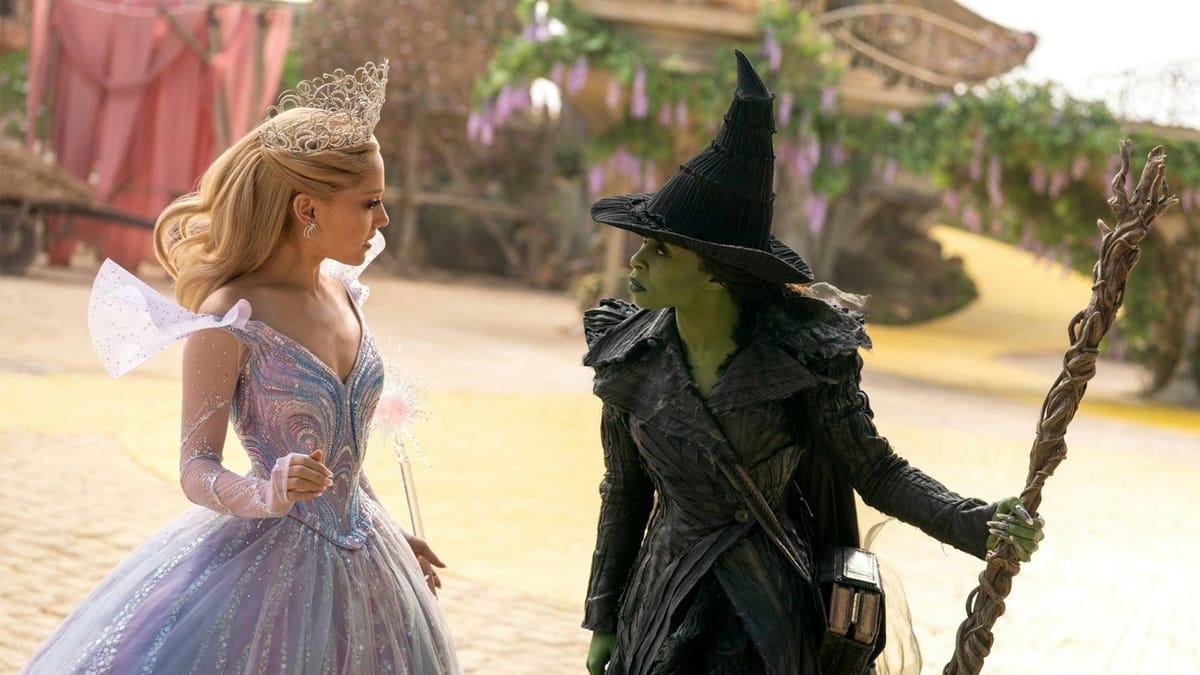
In the wake of the joyous reception of Wicked last year, fans of the Broadway production immediately started warning everyone that the second act is the weaker half of the story. As such a fan, that was news to me. Act One is great and all, but it's setting the stakes and positioning the characters for an Act Two that wonderfully pays it all off as Elphaba attempts to use her powers to oppose the Wizard, improvising when things go wrong and holding on to those that go right. The songs are less memorable, yes: the new ones aren't anything special, and many are reprises or riffs on the more famous tunes from the first act. But "For Good" is the culmination of the emotional core of the story, and "No Good Deed" is a plain old banger in which Elphaba is wonderfully spotlit. The plot darkens but is not without hope, and it involves some of the more clever uses of its integration with the 1939 film.
Despite my excitement for this half of the story, I was a bit apprehensive. Word was it added a few songs, and included a decent amount of material missing from the stage play, yet the runtime was still twenty-five minutes shorter. Add that while I still like the first movie, its hold on me has distinctly weakened on recent rewatches, and I was concerned.
Fortunately, with the very first scene, director Jon Chu set the tone for the next one hundred thirty-seven minutes. Unfortunately, that tone is best summed up by "What in the hell am I watching?"
Lacking confidence in the power of the story, he opens on an invented action scene designed to capture your attention while not doing much to pull you into the plot nor remind you of what transpired in Part One. It also signaled his intention to wholly embrace fan service and lean far more heavily than the musical on references to The Wizard of Oz through his continuing obsession with the origin of the iconic yellow brick road. Instead of focusing on the emotional elements of Elphaba's (Cynthia Erivo) story and actions, the movie resorts to being as explicit as possible at every turn. From dumb details like a Munchkin carrying a bucket of water that reads "MELT HER" to literalizing a bunch of ideas Broadway only alluded to, Chu earnestly believes that more is more, despite all evidence to the contrary that appears on screen.
The aforementioned new material doesn't help one iota. It amplifies the animal oppression plot line begun in Part One, sure to spell out its immigration allegory at the expense of other interpretations. It doesn't help that a key animal scene involves one of the new songs, "No Place Like Home", which is not well written and features Erivo holding back when you want her to just go for it. Worse yet, that subplot is barely developed, leaving it a background detail that nonetheless sidetracks the plot a couple times. It's a strange mismanagement of tone that's repeated throughout...well, the whole film, but most palpably the new scenes.
For example, why do we get Madame Morrible (Michelle Yeoh) implying Glinda lacks any magical ability, only for it to never come up again? Yes, it gives her a specific reason to desperately cling to power, so much so that she's willing to hunt her dear friend Elphaba after the Wizard (Jeff Goldblum) brands her a terrorist. But we're already familiar with her desperation to be liked and respected, and we've seen the residents of Oz lavishing her with praise, so it adds nothing.
Having moved past Shiz, both the Wizard and Madame Morrible play bigger roles in this half, highlighting the failures of their casting. Although I mentioned how poor Goldblum was in my original Wicked review, I neglected to bring up the weakness of Yeoh's performance. And neither of them can sing worth a damn, then or now. Goldblum bumbles through his sing-talk rendition of "Wonderful", and Morrible's parts in "Every Day More Wicked" and "Thank Goodness" are painful. Even our leads seem lackluster, neither able to shine anywhere near as brightly as they did in the first half. Chu has said Grande was sick during the recording of her new song, which definitely shows up in the finished product.
Many of the overblown critiques of the first film's visuals apply in spades this time around. A lot of scenes take place inside buildings or under the cover of night, and given Chu's refusal to embrace impressionism despite the fantastical world of the story, the images come out muted and muddy. Facial details are frequently difficult to discern, and shadows cover everything, giving Glinda's skin a sickly (not wickedly) green tint. The shots look better outside, but are frequently overlit and thus uniformly pale. There's a representative shot of Glinda standing in the middle of a wheat field, her skin nearly matching the surrounding grain. What's worse are the few scenes that are properly lit, because their natural and vibrant palette remind us what this could look like, implying what we're seeing was a deliberate choice.
Not to mention that large swaths of the movie look completely flat. To hide the VFX, the backgrounds are often severely out of focus, eliminating the textured distances between environmental elements, and making it seem as if the characters are standing in front of a curtain of washed out colors. It's as if they had to rush post-production, because much of the CGI in the film looks good enough, if nothing special. Well, save for Elphaba flying, which is still a monstrosity born of their failed attempt at a completely computer generated character, resulting in a rubbery figure shooting through the sky.
Apart from the technical aspects, many of the choices made by the creative team undermine the story's innate power. Splitting up and drawing out the songs weakens their carefully calibrated emotional impact. The script's lack of levity clashes hard with the instances it finally shows up; the scuffle between the two leads is stupid rather than silly, and Glinda's dazzlement at the bubble mechanism paints her as a child. The air of unearned self-seriousness in the middle of a fantastical world even undermines the beauty of "For Good", although the quality of its writing ensures it at least conveys its message successfully.
That Part Two (excuse me, For Good) fails so spectacularly on so many levels is almost impressive. Although always intended to be two separate films, the two parts were shot together, making the lack of uniformity in performance and tone all the more baffling. The technical aspects are more understandable, as post-production was mostly done after Part One was released, also implying fan feedback could have poisoned the process. Whatever the cause, the way it ends wonderfully encapsulates the experience of the film: long and drawn out, splitting songs and scenes to no great effect, its dramatic power completely drained and forgotten by the time the final shot cuts to black.