"Wuthering Heights"
"Blue is always blue, no matter how small."

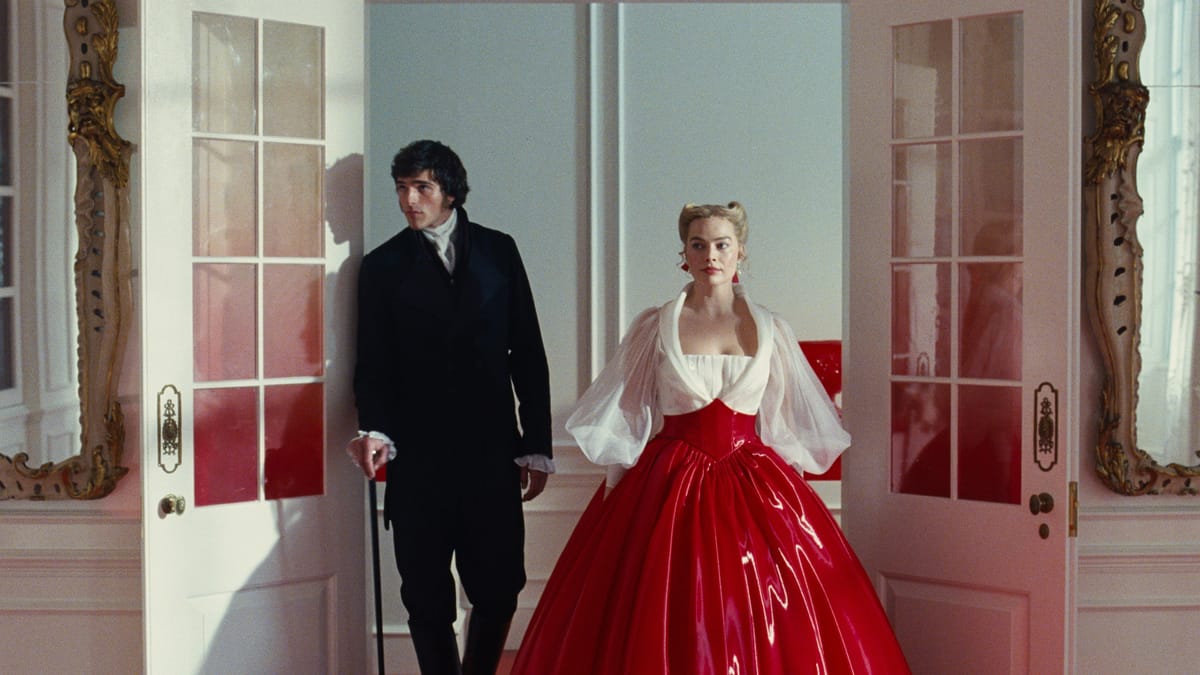
As if anticipating the blowback from her harshest critics (those who conflate directness with meaninglessness), Emerald Fennell has already surrounded the title of her latest film in scare quotes. It's Fennell, not detractors, informing the public that her adaptation of Emily Brontë's classic work of literature plays fast and loose with its source material. Granted, her hand may have been forced by the controversy around casting white boy Jacob Elordi to play dark-skinned Heathcliff. Although it seems like this was always the plan, as she's since elaborated on how her philosophy towards all adaptations is their inability to truly capture their source. In any case, the movie's narrative is much stripped down compared to the novel's plot, laser focused the story as a tale of love just out of reach.
Catherine (Margot Robbie) and Heathcliff (Elordi) grow up together, becoming intensely bonded from a young age. However, he's a foundling who was brought to Wuthering Heights as a servant, and she's the daughter of a wealthy widower (Martin Clunes) on the way to pissing away his status through gambling and booze. So when the Lintons move in to the stately Thrushcross Grange "next door" (I guess five miles away qualified in the late 1700s), Cathy sees marrying Edgar (Shazad Latif) as her only real option, despite her feelings towards Healthcliff. As required by any good melodrama, Heathcliff overhears and misunderstands her intentions, and leaves without a word. He only returns three years later, mysteriously wealthy and just late enough to cause Catherine maximum distress. As such, his insistence on hanging around and his lingering bitterness at Catherine's disparaging of his prior fortunes drives the rest of the whirlwind story.
The plot is pretty straightforward, following all the beats you'd expect from such a tale, but infused with Fennell's sensibilities. Catherine is intrigued when she spies the kinky relations between two of her family's servants, and sex becomes an key element of the story later on, deployed for pleasure, procreation, and rebellion. Fennell continues her excellent usage of contemporary music, aided by original, dreamy songs from Charli XCX, as well as her regular composer Anthony B. Willis. The visuals are quite striking, full of saturated colors and impressive, living compositions. They're not quite as surreal as the marketing implies, but they can be strangely unsettling, such as when Edgar shows off how the squishy walls of her room are designed to look like the skin of her face, complete with her distinctive mole and visible veins. And the costumes are designed to match, similarly bombastic while not feeling fantastic.
What sits strangely, though, is the tone. Fennell's previous two films employ a light, playful air mixed with their occasionally dark subject matter, and this adaptation is no different. Which clashes hard with the stately language, voices, and presentation, constantly threatening to drag her characters into the modern day despite being staunchly creatures of the 18th century. It's most noticeable in Catherine, for while Robbie gives a great performance, her character is so spoiled and childish as to stand apart from all that surrounds her. It's not that comedy has no place in Victorian or Regency dramas, but that the movie's approach only lines up with its time period half of the time, and reaches to our modern impressions the rest of it. Yet, even when discordant, you'll still find yourself frequently laughing out loud.
As for the romance at the center of this romance...I'm not so sure it works. We never understand their connection, even as the movie convincingly tells us it's unbreakable. It's stated as a fact as obvious and right as the color of the sky, and that's that. Sure, they bonded as children, and Catherine quickly proves to be more open and free-spirited, pushing against social expectations to an extent. But what is it that brings them together apart from the recognition of each other's beauty? If we're to believe the strength of their love across years and miles, we need to not only conceptualize their attraction, but feel it. In her works thus far, Fennell has yet to show an emotional streak, and her latest is no exception. Montages, dollhouse order, and cartoonish dilapidation combine to keep us at arm's length, as does each character's lack of inner life.
Which is before you get to how quickly they prove to be terrible for each other, destructive forces in each other's lives despite the joy they bring each other. Frustratingly, the movie blissfully ignores this reality in favor of arguing they truly were soulmates, despite the way their paths diverged in years past. There's even a parallel story in the decay of Catherine's father, brought on by crippling addictions that took over his life even as he acknowledged their destructive power. But that's left as a side plot with little bearing on the central story to foreground the tragedy of their yearning, even as their behavior becomes ever more depraved.
The other major side plot that seemingly goes nowhere is the presence of her trusted maid, Nelly (Hong Chau). Chau is doing excellent work exploring the bizarre tension of being close friends with your employer, especially in an era where such an arrangement put a roof over your head. But even the limited actions she takes that impact the plot could be lifted out with little issue; although a few drive the plot forward, they mostly explain plot points that don't require explanation. Chau plays Nelly as if she harbors forbidden ambitions, but they never come up and they go unaddressed, so there's nothing to grab on to.
That the movie doesn't lose us is a credit to the union of the stylistic with a plot containing enough shiny elements to keep our attention and great efforts from its stars. The moment to moment experience is wonderful, and while it's unlikely to move you deeply, it's far from a slog. A bit overwrought, somewhat overlong, and the romance undercooked, yes, but as a piece of visual-first storytelling, it's quite effective. Everything with Edgar's ward Isabella (Alison Oliver) is perfectly pitched entertainment, and well-wielded as the plot carries on and she moves from off to the side to center stage in the estranged lovers' game of emotional chess. It may not be satisfying to worshippers of the novel, but the totality is a strangely compelling story despite its flaws.