Yield to its Gaze
"Places within the mind echo as landscapes."

Full disclosure: I have a prior connection to the director, and he asked me to review his new short film.
What is a film without movement?
Motion is so fundamental to movies that their name derives from it, so of course the omission of this fundamental attribute has long been an interest of the avant-garde. Most famously used by Chris Marker for his short La Jetée, the "still image film" (also known as a "picture movie") is exactly what it sounds like: a series of stills, usually with some narration, dialog, and/or music. Some projects employ extensive montage to suggest movement across frames, such as Robert Downey Sr.'s Chafed Elbows. Others vary the duration of each image to alter the pace and control its anxious energy. Some simply stick to slow pans and zooms to direct your attention as desired. While many are interesting from an intellectual standpoint, the best retain the emotional impact of a traditional film, despite their radical minimalism.
It would be unfair to judge this six minute film from visual artist/filmmaker Anders Elsrud Hultgreen against a film that's landed on two straight Sight & Sound polls. However, intentionally or not, it borrows language from him, making clear Hultgreen's work is the latest in a long tradition. To it, he brings his own sensibilities, most notably the ethereal atmosphere and sense of crushing dread that has characterized much of his work, from The Pyramidical Silence to Septichexen.
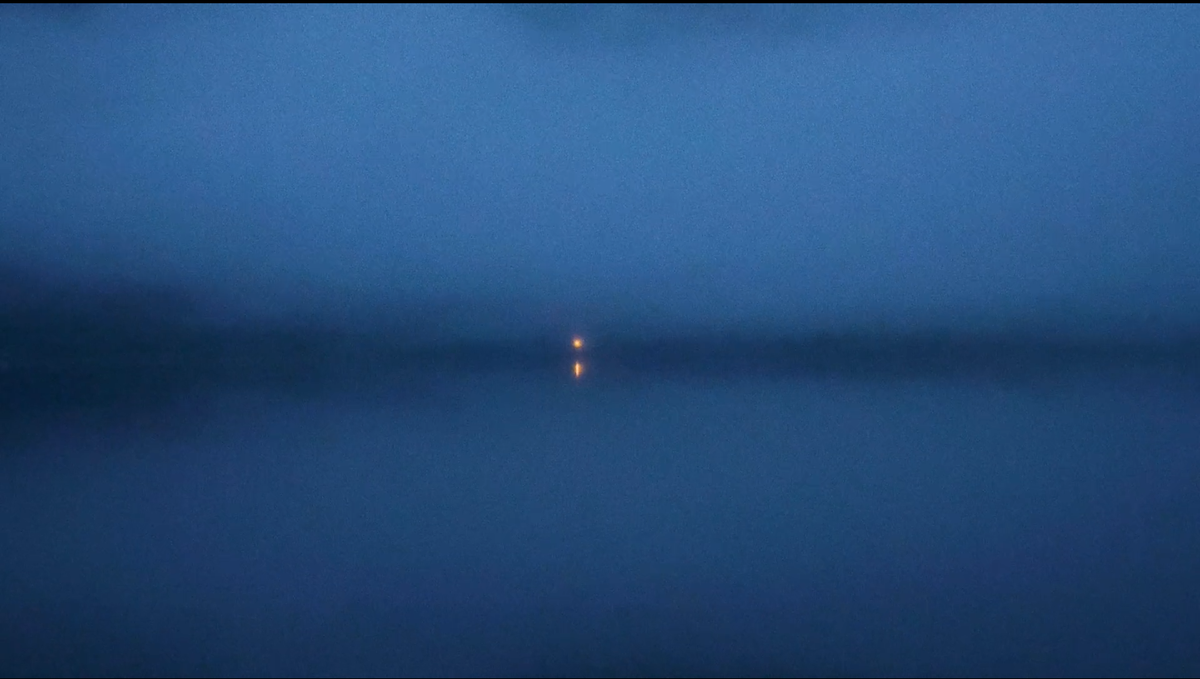
He once again employs an abstract voice-over, delivered in a loud whisper by the filmmaker, that turns a natural occurrence we take for granted into something hauntingly fantastical. Yield to its Gaze eschews any semblance of narrative in favor of a tone poem accompanied by a dozen low-res images of a lake. They contain no movement, although the film grain could fool you into thinking otherwise. However, ever-so-slight zooms draw our focus, and the nigh-imperceptible bobbing of the camera implies it rests on a not-quite-perfectly steady pier. The lake's glassy surface perfectly reflects its surroundings, erasing the boundary between up and down, preparing you to accept a supernatural explanation for what you're to see. His guided meditation further relaxes your mind, preparing you for the Marker-esque pattern break that is to come: "Breathe in slowly. Breathe out gently.", "Look toward the lake,", and "Do not be afraid."
The nearly monochromatic gray-blue color grading of most of his shorts is again present, although even more noticeable with the lack of definition and the mirroring. Being forced to wonder if the look is intentional, your eyes hunting for clear boundaries, frustrates your ability to understand what you're looking at. It forges a strong atmosphere, absolutely, but it makes it hard to call any particular shot "beautiful" or "striking".
However, with the appearance of the "light orbs" of the synopsis, you at least understand why he chose that presentation. Against such a murky image, even a tiny pinprick of light is an overwhelming beacon. The score's jazz-inflected cold wind takes on a new meaning, ensuring these small, faded, yellow spots are somehow menacing, emphasizing why the speaker anthropomorphizes them and assumes the unknown must be unknowable. With some remove, calling them "A hole in the world through which something looks back" might be a little silly and overdramatic. But while watching, the sudden appearance of something so minuscule yet unexpected is eerie enough to send your mind down odd paths. Which is to say nothing of the final image, the context of all that came before rendering it as shocking as it is confounding.
That such a stark impression is crafted through just thirteen images and a hundred or so words is indicative of both the power of the mind to find meaning and emotion everywhere, as well as the filmmaker's care with our time, fleeting though it may be. That said, little of this emerges instantly; it is, after all, just a few static pictures. This is not a film that rewards passive viewing, even as its slow, dialog-lite nature make it perfect, captivating wallpaper. Finding its wavelength requires fully giving yourself over to the experience, allowing it to wash over you until its meditation strikes a chord and pulls you into the screen. If you can manage that, then as with all of Hultgreen's experiments, what was once opaque will begin to unfurl, its poetic nature allowing an ultimate interpretation that is entirely unique.