Fjord
"Am I on trial for my beliefs?"

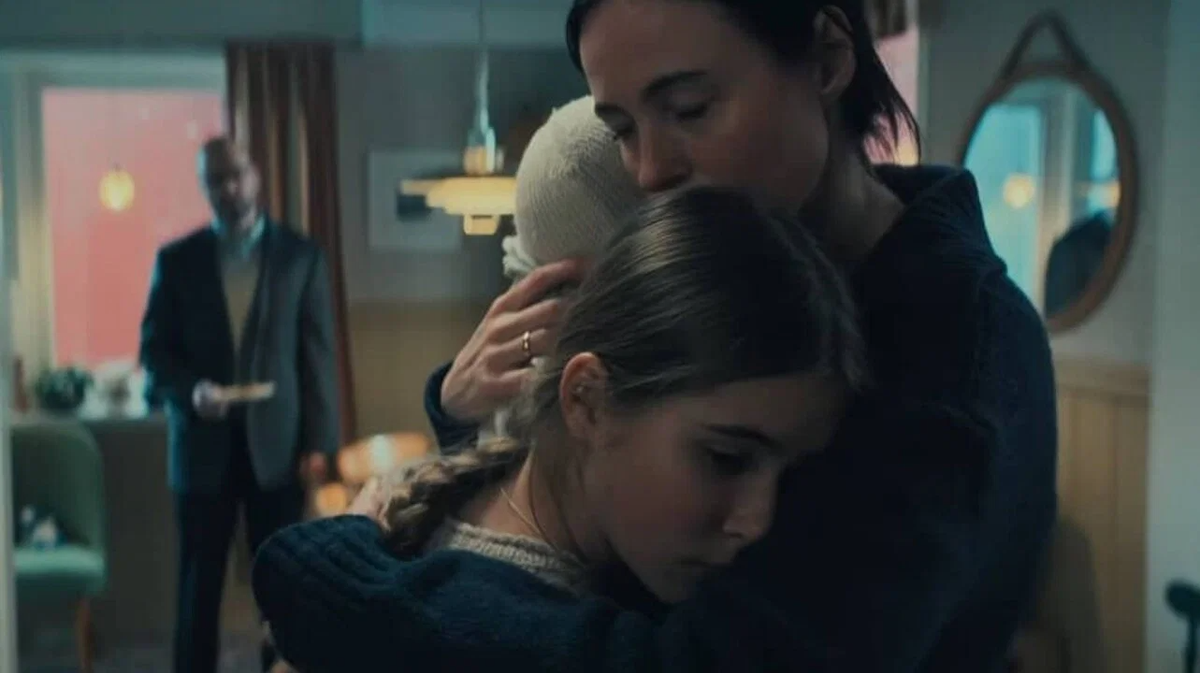
"You need to admit when you’re wrong."
We open on the layered composition of mother (Renate Reinsve) holding daughter (Vanessa Ceban) as she utters that line, father (Sebastian Stan) looming out of focus in the background. We hold on it for a bit, long enough for you to scour the image, hunting for what it could mean, or at least eagerly anticipating its reveal. Romanian writer/director Cristian Mungiu pulled off a similar trick in his masterpiece, 4 Months, 3 Weeks and 2 Days, pulling the camera back in steps to eventually reveal the whole scene. He makes no such move here; we're left entirely without context: the situation is never referred to again, and the frame carries no further hints as to what happened. There's an implication of punishment, but what form that takes is never addressed. Even as such questions become important to jump-starting the plot, the unobscured truth of what really goes on behind closed doors is never shown to us. We can only surmise and infer, while trying to evaluate how much to believe others.
But whereas Nathan Fielder and Lance Oppenheim dedicate nearly three hours to the complicated nature of what the truth even is, Mungiu spends about two and a half pushing a step deeper. Faced with the seizure of their children by Child Services after a teacher notices bruises on Elia's shoulder and back, Mihai and Lisbet Gheorghiu openly admit they have, in the past, spanked their children as a form of discipline. It's not long before questions are raised about the source of the precipitating marks, but by then, bureaucracy is in motion, locked on to the parents' admissions, uninterested in nuance. But it's the way everything unfolds that is of much greater concern to Mungiu.
Some of Child Service's actions land as stilted contrivances despite being based on a real case in Norway a decade ago, casting light on the precise nature of the cold and uncaring machine purporting to have children's best interests at heart. It separates their still-breastfeeding infant from his mother despite no indications or credible allegations of abuse towards him, and splits their five children amongst three separate foster families hours apart. As unproductive and unjustified as such extreme actions are even before taking into account the paucity of evidence, it's the quieter comments left to hang in the air that stir the strongest emotions in the audience.
Much like Thomas Vinterberg's The Hunt, the soul-destroying situation begins as well-meaning adults trying to protect children from the harms of which they may be unequipped to speak openly. But as it progresses, the focus perverts into policies that smack of "guilty until proven innocent", of strong incentives towards assimilation, and of a general distrust of foreigners. Mihai explains that to him, to Romanian culture, spanking is not the same as hitting, and is instead a natural and helpful way to correct children's behavior, a mentality backed up by the members of his small congregation made up of Romaian expats. However, as they and their lawyer/neighbor Mia (Lisa Carlehed) converse with members of Child Services and the teachers who reported them, the suggestion arises that although corporal punishment was the catalyst, the immigrant couple's overall beliefs are a much bigger sticking point.
You can feel Mungiu's thumb on the scale with how bluntly and deliberately this comes to light, but the questions it raises are no less relevant. Wielding Bible quotes at school to denigrate a classmate for declaring themselves a lesbian is certainly inappropriate, but for the teacher to consider calling Child Serves as a result is patently absurd. The agency's case brings up the family's structure around religion, and their refusal to let their children watch YouTube, and their system of points regarding punishment, all completely and totally irrelevant if they're indeed just trying to determine if they beat their children. To drive their irrelevant ferocity home, the lawyer for the state gives his counterpart from Anatomy of a Fall a run for his money in terms of punchable faces and abhorrent, poor faith tactics.
While some of these deepen the drama, many of them stick out like a sore thumb, feeling calculated to make you side with the Gheoghius. Whether based on real situations or not, they don't feel grounded in reality, and thus do more to call the actions of these individuals into question rather than the state more broadly. It doesn't help that another bunch of ideas are introduced or realized down the stretch without fully capitalizing on them, throwing the pacing into disarray and keeping them as shallow sojourns. Mihai's approach to "handling" the situation by going outside the system is ripe for investigation an commentary, but it only really comes up as an additional way the state is holding the family accountable for the actions of others when considering whether their children should be returned.
But the power of the story lies in the subplots threaded throughout the film alongside the main narrative. They are numerous, but concern things like Elia becoming very close with her classmate Noora (Henrikke Lund Olsen), whose strong rebellious streak is beginning to rub off on the children, just as their evangelizing is rubbing off on her, and the isolation and confinement that define the life of her post-stroke grandfather, Åke (Øyvind Venstad Kjeksrud). Their interleaving with each other demonstrates their centrality, mutually reinforcing each other's relevance. Combined, they contrast the Gheogiu family with the Norwegian experience, and while Mungiu stops short of calling their actions correct, he does assert that Norwegian society doesn't have it as figured out as they present. In doing so, he at least questions (if not condemns) the way the West forces its views on the world, preaching the good word while covering up its own chaos.
Both of the leads never miss a chance to impress, with both wonderfully capturing the boiling fury and righteous indignation below the surface of Mihai and Lisbet, suppressed by the knowledge that any outbursts will undoubtedly be held against their case, justified as it is. Renisve returns to form, easily convincing us that the flatness of her Backrooms performance was a byproduct of the demands of so much screentime in her nonnative tongue (not to mention a middling script). But it's Stan who stands out even more, easily switching from gentle and loving to firm and imposing as the scene demands, ensuring we understand both his children's love for him and their unquestioning obedience. This is the first role in which he largely speaks his birth language, and while I cannot comment on how well he's held on to it thirty-five years after leaving the country, his physical performance and emotionality are on point from start to finish.
You can always count on Mungiu to approach challenging issues with grace, their nuance and empathy for people not often afforded it ensuring they carry tremendous power. Fjord is no different, but its screenplay goes in too many directions to squarely land its punch, falling into some clunky constructions to advance the plot without sufficiently hiding its work. Still, watching the way it works in its many shining moments (e.g. the court scene, Åke's journey, Mia as a force of nature, and more) easily makes it worthwhile. The complexity of the relationships and specifics of everyone's opinions and actions make for a rich tapestry to pull apart and discuss at great length, and its central interrogation of the commitment the West has to a pluralistic society asks us to consider what those words truly mean, and if we're interested in or even capable of upholding them, with Mungiu's own answer laid bare by the film's finale.