You Can See Everything
"I know it's weird. She's weird. She's really weird."

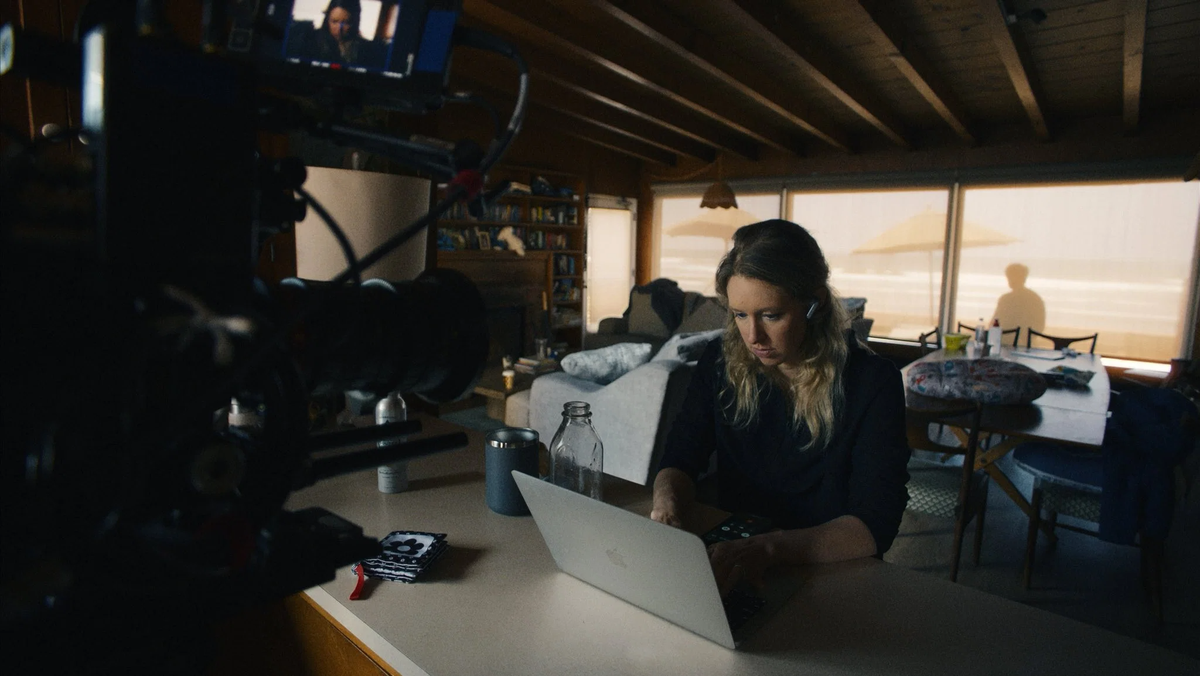
Comedian Nathan Fielder has long been interested in the line between fact and fiction, focusing on what replication can teach us about the world. That's the basis for his brilliant HBO series The Rehearsal, in which he runs highly detailed simulations of events in peoples' (or airline pilots') lives, enabling a deep exploration of the possibilities in a consequence-free environment. The nested layers of artificiality more often than not are intensely revealing, albeit not always in the ways expected: the first season truly hits its stride when he begins to double back and question whether his methods are failing his subject.
Thus, Fielder is a more appropriate choice to document Elizabeth Holmes's final thirty-four days of freedom before reporting to federal prison than he appears at first blush. Her public appearances surround her with an intense reality distortion field, seemingly oblivious (or indifferent) to the truth in favor of her own interpretations and insistence. There's the conviction of defrauding investors for half a billion dollars through her failed health care startup Theranos, sure. But rightfully or wrongfully, she's better known for the construction of her own persona, her own myth, made iconic by the assertions that she deliberately deepens her voice when speaking in public. The cultural hyperfocus on such minutia speaks to all the confusion and conflicting information about her, especially in light of her statements about reacting to trauma by rebuilding herself. Given Fielder's tendency to latch on to small details and pick at them, revealing the meaning behind the seemingly insignificant, he's well suited to worm into what makes her tick.
Despite that, the film isn't really about Holmes. It has little interest in re-litigating Theranos; you will come away with a limited understanding of what happened, and only small allusions are made to the details. Nor does it attempt to craft a biography of her, or excuse her, or excavate her romantic and business relationship with Sunny Balwani. Rather, it begins as a snapshot of an almost surreal period of time, the lead-up to an infamous woman's prison sentence. What it evolves into is far more concerned with our relationship to the truth and documentary's role within that, as well as studying the way the highly manipulative work their discomforting magic, and the danger inherent in the well-meaning but uninformed.
For starters, many questions arise from the bizarre setup and strange relationship between Fielder and Holmes (whom he always calls "Liz") and Evans. Those with preconceived notions of Holmes will certainly take issue with any attempt to sympathize with such a nefarious figure. But it's that goal that makes what transpires so fascinating. We learn the desire to separate her perception from the scandal was what led Holmes to invite Fielder to live with them for a month (which he declined until the final two weeks), mingling the professional and the personal in ways that are, at best, uncomfortable. That "ick" hits a screaming peak on her final day of freedom: Fielder presents her with a few small gifts, offers to give Holmes and Evans "private time", and shares an otherworldly, tense, long stare down before she gets in the car to report to prison. Sure, his entire screen persona is gently awkward and overly polite, complete with a steady gaze in which he never looks entirely comfortable, so it's not wholly out of character. But it smacks of a familiarity that makes us question whether he's truly a neutral party, a question that's raised explicitly by the end. And if he's come to feel protective of her, has the team overcompensated in the edit by making sure to paint her as an impossible alien?
Fielder and co-director Lance Oppenheim want us thinking about all of this from jump. We first see Holmes through the bars of her newborn's crib, and only after a few more shots of her and Evans do we catch a glimpse of Fielder. The image brings to mind the prior work of both directors. He's watching from around a corner, his face half obscured, like one of the many indelible images from Primetime. There's something illicit about it, as if he's ashamed to be there but cannot resist, knowing that his presence will unavoidably impact their behavior, and is thus trying to minimize it, so he can observe their natural state as much as possible. When he begins to talk with them, it's a friendly but probing conversation instead of an incisive prepared interview, and all takes place in a casual register with him on camera, trying to push them to answer personal questions while remaining sensitive to crossing a line. That is, it plays like an episode of The Rehearsal directed by Oppenheim. Indeed, You Can See Everything was noticeably shot by Oppenheim's long-time (and excellent) cinematographer, David Bolen, and wonderfully, discordantly scored by his usual composer, Ari Balouzian.
But even between edits, she continually if wordlessly puts forth the idea she's a tabula rasa, even making the asinine claim that she's never told a lie. From start to finish, her face is frozen with an uncomfortably big smile and eyes forced wide open, the artificiality ensuring nothing she says is taken seriously. Has she really never heard of "Who's On First?", and does she truly not understand the wordplay at its heart? We'll never know, but given her central claim to innocence lies in the definition of the word "can" (how Presidential), your interpretation of that scene will be key to your understanding of her.
At least in the first half. Despite being premised on the lead up to Holmes reporting to prison, we get there remarkably swiftly, a little more than halfway through its nearly three hour runtime. The back half takes a beat to find its new shape, but starts to coalesce around the most arresting element of its opening ninety minutes: Evans.
He was always lurking and talking up his partner of seven years, of course. But his protective instinct is what jumped out. Whether Fielder was talking to Holmes or Holmes' father (a former Enron exec), he disrupted any line of questioning he disliked, even if the subject insisted it was okay. He was always visibly annoyed at Fielder's presence, going so far as to blame the house's unstable wifi on the film crew. As time wore on, he became more standoffish, and took more personal offense to any questions. Ostensibly, it was interfering with his efforts to get the ball rolling on a new company (effectively Theranos 2.0). But it's hard not to see it in light of his later musing that this whole project may have been a huge mistake.
None of that hints at anything worth a deeper dive. He's an asshole, sure, but he's easy to read as earnestly if over-aggressively protecting his partner's mental health. Save for one revelation: contrary to earlier implications, Holmes had no idea who Fielder was until Evans showed her a clip of Nathan For You. While simple, in context, it implies he may exert a surprising amount of influence over her life. Now, a few years into her sentence, that suggestion has blossomed in truly shocking ways.
Or has it? We remain unavoidably trapped in Fielder's compromised perspective, which the film has gone to great pains to highlight. The line between façade and reality blurs even further in the back half, as he utilizes techniques from The Rehearsal to explore interactions that occurred when no cameras were present. How can we trust that what he says happened, did? While believable, the unknowability of what's going on in another person's mind is the whole point. Even if he's being honest, that doesn't mean he's remembering correctly, such as when he corrects his own "transcript" of his prison visitation: she said "something", not "it", which drastically changes the meaning of the sentence in question. To say nothing of the information he and Oppenheim deemed irrelevant that may have impacted our feelings about either Holmes or Evans.
While the idea that documentaries are the unvarnished truth has long been discredited and exploited (for example, see 1973's F for Fake, or 1967's Symbiopsychotaxiplasm: Take One), it's an especially important thing to remember in today's world. The unyielding proliferation of generative AI seems a likely candidate to topple the already precarious information landscape, making it all the more crucial to question who's providing your information, and what their motives may be. But as the title You Can See Everything so ironically demonstrates, that's easier said than done in all but the simplest of situations. And of course, the people who are hardest to pin down are those best positioned to exploit and profit off deceiving you.
Fielder and Oppenheim are not so arrogant as to offer any sort of solution. Instead, they elect to end on a revelation of another sort, much smaller in scale and less damning, but no less dumbfounding, and maybe more suited to color what we just saw. And yet, it still serves as a grand statement, a final parting shot that douses the raging fire of internet discourse with gasoline. If you'd told me before release that a three hour film ostensibly but not really about Elizabeth Holmes which also spins out to call into question what the line is between narrative film and documentary would be this well received by the general public, I'd have called you deluded. That I was proven wrong implies maybe there's still hope for us to pull back from the cultural abyss.