Mother Mary
"This is what you do. You give people the gift of giving a shit about you."

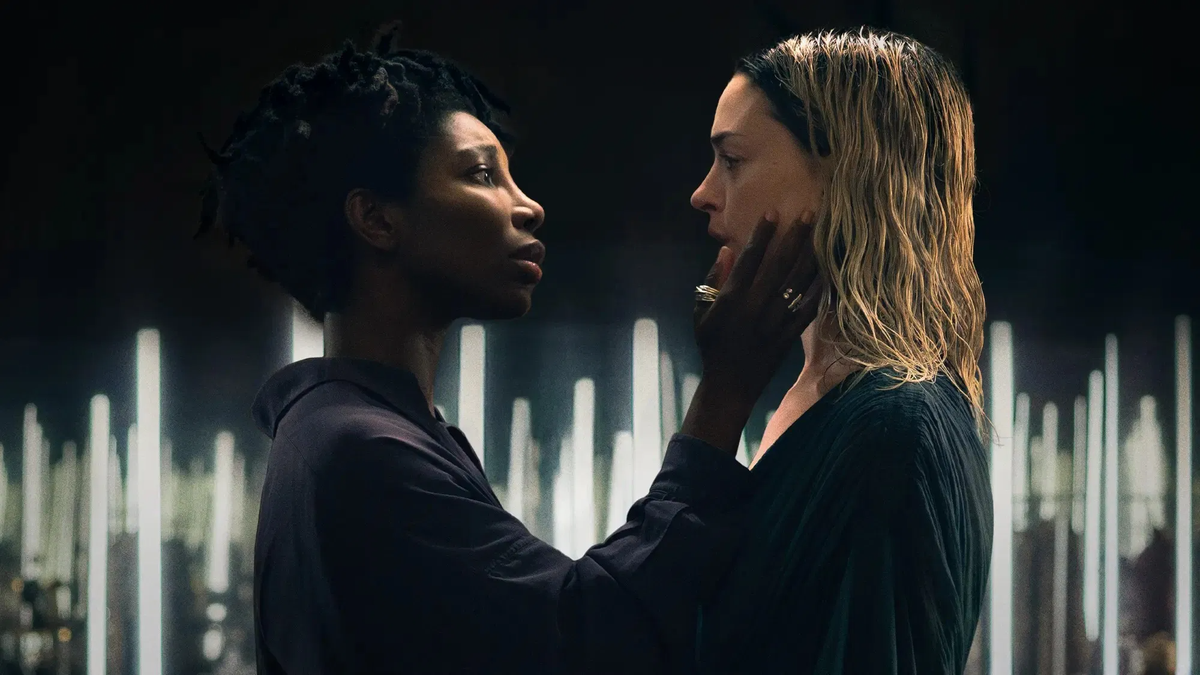
In the opening moments, director David Lowery lays it all on the table. Here is what the film is going to feel like, what it's going to explore. A steady, slowly pulsing, hypnotic, bass-heavy drum machine beat, whose minor key tonality runs counter to the biggest modern pop music while still feeling of a piece with it. The searching, careful, precise, and stunning poetry from costume designer Sam (Michaela Coel), an inner monologue that describes the slow build of emotion as she senses through the æther that her old friend, pop star Mother Mary (Anne Hathaway), will be paying her an unannounced visit. Some brief, hazy, 16mm clips of an elaborate concert from the musician, full of background dancers and religious imagery, and - wait, did she just fall off that platform? Before you can fully register what you saw, it's on to another performance and sweeping through Sam's studio, but the afterimage remains until its significance comes into focus later on.
The two women have been estranged for years, yet it's clear from the moment Mary lands on the doorstep of Sam's England-based studio that there's an unfathomably deep connection between them. The way Sam's eyes narrow as she regards her former friend, the false smiles she gives, and the casualness with which she mentions her streak of not listening to Mother Mary's music make it sound as if whatever came between them curdled into hatred, at least in one direction. But the reality is far more complicated, as it so often is. It's easy to claim a grievous wrong breeds white hot animosity, but the vulnerability and affection required for such harm to occur doesn't just go away. Far more often, the emotions share space, a tumultuous concoction that takes active management to contain, and eventually some sort of purging of your soul to sleep well at night. While Lowery's screenplay rarely comes right out and says it, small bits of dialog and production design communicate the intensity and duration of their previous relationship, making very understandable Sam's inability to close the door on this person who clearly devastated her.
The inversion of power is both fascinating and thematically resonant. Sam is a costume designer, well-known enough that she's in the middle of prepping for a big show, but nothing compared to the world-famous megastar that Mother Mary is. And yet, even apart from looking like a drowned rat after getting caught in a downpour on her way to the studio, Hathaway plays Mother Mary as very small. Her head is hung, her shoulders are hunched, her clothing is modest, especially next to the lovely, vibrant fabrics that surround them in Sam's workspace. Mary is prostrating herself before Sam, in recognition of her past mistakes, and fully submitting herself to Sam's will, agreeing to be dressed however Sam wishes as a condition of the absurdly short time frame (her big comeback show is three days away). It's a reflection of how that complicated relationship played out in the days of their collaboration, in which Mary was draped in Sam's gorgeous artwork, drowning in the other woman's will, losing what remained of herself not only to the unreasonable expectations of the fans and press, but to her closest friend.
All of this slowly comes out as the two women talk, Sam circling Mary like a shark, always ready with words like a knife, their impact increased by their wry humor and pinpoint accuracy. Or maybe more like a cat, as she never goes in for the kill, preferring to take small swipes before returning to playfully flitting around the space, grabbing various fabrics to press against Mary's skin. The unsettled chaos swirling about her contrasts with her frequent delighted demeanor, as if she's doing an impression of David Tenant in Dr. Who, as both characters harbor an unseen darkness that isolates them from the scene, no matter how part of it they appear (also, both wear a long brown trench coat). Her energy is incredible, its precision putting us in Mary's headspace as we learn more about where both of them are and have been. Coel's performance is breathtaking, somehow improving upon the already magnificent work from The Christophers just a few weeks ago, never losing sight of Sam's vibrant soul, keeping that energy up through its entire runtime.
Hathaway ain't no slouch, though. It takes a lot to walk the narrow tightrope required for us to read her as deferential instead of pathetic, as earnestly remorseful and somewhat lost rather than selfishly reconciling just because she's in need of Sam's craft. To say nothing of the power she conveys in the scenes of performance: while the majority of the film stays put in Sam's studio, we see a handful of Mother Mary concert/backstage scenes through either flashbacks or clever, kinetic editing, all wonderfully constructed, including a remarkable montage of the moments before and after she takes the stage to show the way constant touring wears on her. It would be quite easy to mistake Mother Mary for a real pop star putting on real concerts (in part because they put on a couple actual shows to film). The staging is electric, the costumes are immaculate, the audience exuberance is palpable, and the songs are fantastic. Written by Jack Antonoff and Charli XCX (with one contributed by FKA Twigs, who also has a small but memorable scene as a mystic named Imogen), all are performed by Hathaway herself, and each is a legitimate banger of a dark, moody, electropop variety: I cannot help but move to the energy of "My Mouth Is Lonely For You", and the crescendo in "Holy Spirit 2" never fails to make me emotional, although "Burial" was the single released ahead of the film for a reason.
Most tellingly, though, is that the centerpiece of the film is a song we never hear. For her return, Mother Mary wrote "Spooky Action", which she describes as being about someone she doesn't know but to whom she feels a deep connection. However, its tone comes through loud and clear when Sam requests Mary perform the accompanying dance routine sans the music, and it is intense, emphasized by the unmasked sound of her throwing herself around the space. It's a chaotic, violent, impressive bit of choreography that feels more like an exorcism through interpretive dance than a frothy bit of showmanship. All of these sentiments resonate throughout the screenplay in ways predictable and not, especially once their naked vulnerability results in a small revelation that smacks you in the face, and aligns it with Lowery's previously expressed interests. That moment and all that flows from it results in some of the more ethereal, delicate imagery in the piece, before dovetailing with the more aggressive (yet loving) actions taken by the characters, propelling us towards a satisfying, soaring, spectacular resolution.
All the filmmaking is captivating from start to finish, not just the aforementioned spectral beauty. There are a bunch of impressive shots that only quietly announce themselves, but the mingling of memory with experience are the standouts for me. We transition into each when a character pushes open a large door and lands in another time, walking us through a series of events that have played a fundamental role in leading them to this point. Each wraps up with the women as they are now looking onto their past selves, collapsing time and driving home the importance of now to both of their futures. But those are just the most memorable: even the smallest details collectively elevate the experience, from the way the women are positioned in the space to the repeated times Mary is lit from above to gentle fades to black to the use of symmetry.
Mother Mary is the kind of film that sits gently on the surface at first, presenting itself as a simple chamber piece, albeit with some strange edges. You can let it wash over you, and that's an enjoyable enough way to spend two hours. But those bizarre elements are indications of the depths it harbors, should you be willing to lock in to what it has to say. It never spells out its ideas, just puts them on screen for you to engage with however you see fit, such as its portrayal of the Pop Star as religious figurehead (which I've only gestured at here, but the movie very much plays with). The text is rich and layered, not to mentioned beautifully executed across all components, leading to a nearly perfect final sequence and an indelible final shot that will live within me for the rest of the year, no question. All of which is to say that David Lowery has once again demonstrated the exhilarating possibilities of blending populist filmmaking with an arthouse sensibility.