Quick Hits: May 2026
A quieter month, but it included some of the best of the year, which took up all my oxygen.


A handful of factors, from the dawning of blockbuster season to the way dates lined up with new releases to my general productivity, resulted in me seeing fewer new releases in May. Granted, they included some of the best of the year, as well as an indication of where the movies may go in the next few years, given the tremendous success of both Obsession and Backrooms, and colossal failure of The Mandalorian and Grogu.
As such, I've already written about nearly half, with Backrooms to come in the next day or two. Once the big-budget films I care about start coming out, and summer fills up my social calendar at the expense of this hobby, I expect the trend will right itself, and this list will grow once again.
Steal This Story, Please!

My least favorite type of documentary, maybe my least favorite type of movie, is the talking heads hagiography. Mostly straight to camera interviews from acquaintances and friends and colleagues, all telling anecdotes and otherwise endlessly praising the subject, carefully excluding anything that could be construed as negative. The versions that work best dig into the details of what sets their subject apart, rather than just asserting their uniqueness.
Steal This Story, Please! is completely uninterested in "Why?" or "How?", instead praising Amy Goodman and Democracy Now! while smugly denigrating all other journalism. Important professional developments are given short shrift in favor of centering the highest profile news stories she worked on, and claims sole credit for elevating. It's so concerned with portraying her as a hero that it never bothers to convince you. The glazing is ironic: given how much Democracy Now! is built on interrogating journalism, it's notable how much the doc eschews self-reflection.
The result is a boring, eye-rolling doc that caters to people predisposed to agree with her.
Decorado
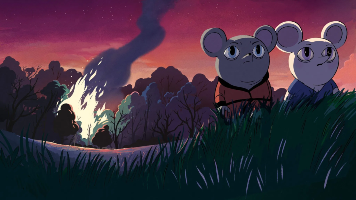
I don't quite know what to make of Alberto Vázquez. He's somewhat of a provocateur, but his adorable, anthropomorphic woodland critters can be quite effective characters in challenging stories. Birdboy: The Forgotten Children imagines what it takes to survive amidst societal collapse, with all its darkness and beauty and the importance of symbols of hope. Unicorn Wars showcases his most edgelord tendencies, accomplishing its anti-war, anti-colonialist message by sending adorable teddy bears into a depraved holy war.
Decorado reins in the shock value in favor of a remake of The Truman Show. At best, it's a pastiche of so, so many stories that ponder the nature of reality: I'm Thinking of Ending Things, The Crying of Lot 49, Dark City, and more. The writing is a slog, clunky and painfully on the nose, robbing it of the ability to be either funny or insightful. And its final destination feels like the midpoint, like it should evolve into some deeper exploration. But the curtain closes, as it opened at the beginning, and the credits roll, leaving the audience wondering what the point was of simply telling us "The world sucks and you can't win."
The Sheep Detectives
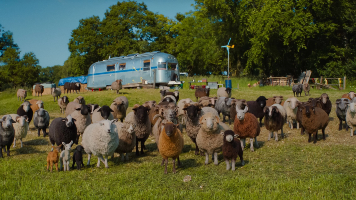
The premise of The Sheep Detectives is incredibly goofy. What if a shepherd (Hugh Jackman) read mysteries to his flock every night, and unbeknownst to him, they could understand him? So when he dies suddenly, they're the first to notice something is wrong, and take it upon themselves to find his killer?
That said, it works. Pretty well, in fact. They commit to the idea, the dialog is fun and clever enough and stays rooted in them being sheep, and it's not afraid to introduce some darkness that pays off in a huge way later, while staying family friendly. It helps that all the human characters are somewhat cartoon-ish, although that also means a number of them are largely wasted, such as Hong Chau. But it's a charming time from start to finish.
The Wizard of the Kremlin
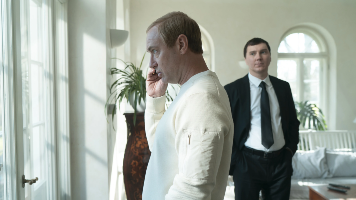
What a strange object. A journalist (Jeffrey Wright) seeks out the fictional Russian (Paul Dano) responsible for guiding Vladamir Putin (Jude Law) into power and advising him once there. So it's a somewhat detached tale of how things could have happened, not how they did. Narratively, Dano's laid back opportunism and ambition to be the man in the shadows of power is compelling enough to watch, but airy enough to leave you soon after leaving the theater.
But if you allow yourself to step back and ignore the names of real people being uttered, it does function as a portrait of accruing and wielding power, and the ways many small decisions can cascade into an unstoppable avalanche. There's a bunch of interesting stuff about Russia in the 90s, a snapshot of time rarely portrayed in films that play in the United States. It resembles the America of the 70s, complete with the looming threat of a sharp rightward turn that would crush individual freedoms under the heel of a fear-mongering nationalist.
Pressure
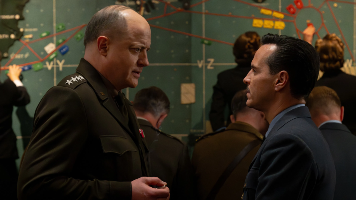
The biggest hurdle Pressure has to overcome is that most Americans know the rough story of D-Day. So when the conflict is set up as a fight over if the weather on June 5 will make for a safe landing, there's only one way the story can play out, even if you don't know the date of the actual invasion. Our protagonist is hyper-uptight meteorologist Captain James Stagg (Andrew Scott), an asshole whose data-based approach points towards a huge, unseasonal storm. His rival, the free-wheeling Irving Krick (Chris Messina), is projecting clear skies based on historical analogs. Either Stagg is right, and the date moves, or Krick is right, and there's no movie.
Given that, it still stays engaging enough, despite the overblown chewing of scenery from all involved, especially Brendan Fraser as General Eisenhower. But all characters and their relationships stay in stasis, so there's little to grab on to, threatening to wash the whole story from your mind as quickly as it enters.