The Invite
"People forget that they deserve more. Somewhere along the way, they start living on crumbs."

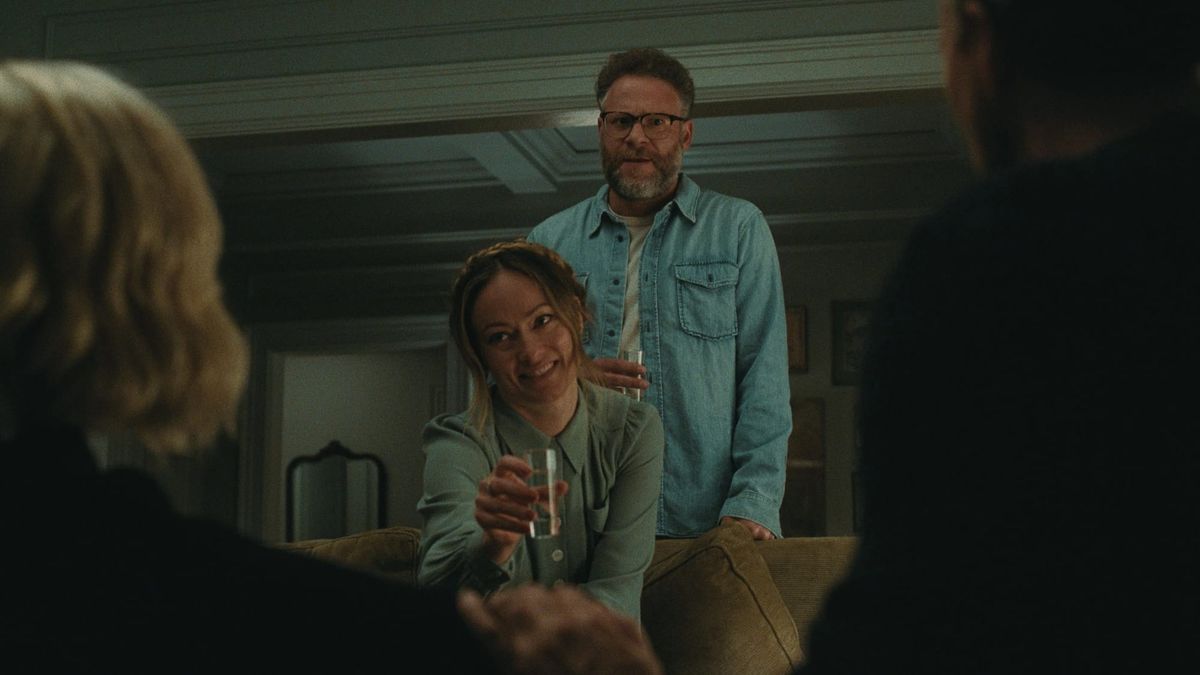
With The Invite, A24 reheated the successful marketing campaign they used for The Drama a few months ago. Both centered on a consequential conversation between four friends where some bombshell is dropped. However, the actual reveal is omitted from the trailer. Instead, the focus is placed on the building emotions leading up to it, and the stunned reactions afterward. The intent is obvious: to stoke your curiosity, create the desire to see it as soon as possible, and provoke follow-up conversations with friends about how you'd handle such a circumstance. And gauging by how many conversations I've had with friends about what The Drama reveals, it worked. So replicating it for Olivia Wilde's new film seems reasonable.
Except the central inquiry for The Invite is not really a secret. Once both couples arrive at the apartment that will serve as the setting for this four-person chamber piece, it's not long before you can infer the proposition to come. Which is fine, because as far as the story goes, it's a bait-and-switch; Wilde and screenwriters Rashida Jones & Will McCormack have more on their mind. That said, it is crucial to driving the events of the evening, starting long before it's ever named, and extending long, long after.
Joe (Seth Rogen) and Angela (Olivia Wilde) are such a boring married couple that despite their lack of coordination with each other, their clothing perfectly matches their impossibly drab walls. They're world-class bickerers, taking shots at each other from the moment Joe returns home from his job teaching music at an elementary school. So ferocious and petty and quick is their fighting that we have no choice but to laugh, emphasized by the short bursts of the cello-drenched score that accompany particular stings, à la Eternal Sunshine of the Spotless Mind. From his complaints about a folding bike to her demand for shoe removal the moment he enters the door to his bizarre fixation on devouring the cheese plate whose existence confounds him, their behavior is as entertaining as it is uncomfortable. Fortunately, Rogen and Wilde are more than up to the task, perfectly pitching their squabbles to communicate the deep pain that underlies it all. Not that they have some dark past or anything. No, nothing so exciting. They're simply a middle-aged couple who's been together long enough that they may as well be entirely different people, something both of them seem to sense. But instead of talking about it, they lash out, to our great amusement.
Into this powder keg comes surprise dinner guests. Well, a surprise to Joe - the jaunty opening credits show their parallel action through cutouts in the screen, Angela rushing around the apartment to prepare, while Joe struggles home on that damn folding bike. Upstairs neighbors Hawk and Piña (Edward Norton and Penélope Cruz) are due to arrive in ten minutes. Of course, Joe and Angela are arguing right until the doorbell brings the title card, and Wilde shows us every single second, ensuring that despite having just met this couple, we feel like we know them. We especially sense Angela's desperation to impress them, which is born out almost the instant they walk in the door. Any compliment bowls her over in hilarious fashion; there are multiple tears shed over the smallest acknowledgement of her work, made even funnier by how flustered and embarrassed she is to be so easily moved. Given how checked out and apathetic Joe seems to be, if she's to receive any of the validation she craves, it must come from elsewhere.
Angela and Joe cannot refrain from comically sniping at each other in front of company, but it's at least toned down enough to allow for conversation, despite their intensely awkward response to any question or request. Even such, Joe's exaggerated honesty to their inquiries seems driven by a desire to needle Angela. Especially his insistence on complaining about the loud noises they've been hearing the last few weeks. Specifically, Piña's Earth-shattering orgasms, accompanied by some other distinctive, animalistic grunts. Angela is mortified he'd bring it up, and tries everything she can to divert the conversation before the oncoming train hurtles right into her new, unspeakably cool (and unspeakably hot) friends. Her delays don't prevent the topic from arising, although it doesn't go the way they expect. One thing leads to another, and they find themselves deep in a discussion about Hawk and Piña's sex parties.
Well, "discussion" isn't quite the right word. They're more like eager children learning about the platypus: they have a bevy of questions, they're constantly laughing in some mixture of disbelief and awe, and they're too excited to wait for the answers. Their hilariously bumbling obsession with the couple's sex life makes clear that theirs is lacking, so the titillation that comes from hearing about the mechanics and emotional connection of group sex becomes their substitute. The film depicts a very American attitude towards sex in order to undermine it, albeit far more elegantly and artfully than Gregg Araki's upcoming attempt (which co-stars Wilde). The mixture of shame and bashfulness that dominates discussing one's own sexuality and desires often falls away when given permission to ask questions of another's, especially if they show no such hang ups, and their exploits are less conventional. It's hard to overstate just how funny the glint in Angela's eye is as she listens with wonder (Wilde's facial expressions throughout the whole film are a masterclass in comedic exaggeration), and begins to copy Piña's confidence.
What's most striking about The Invite, though, is that as close as it comes to escalating into pure farce, it instead harnesses all of that energy to reflect back on Joe and Angela, and on the evolution of relationships more broadly. The vulnerability that comes with frank, honest discussions of sex (and a few other revelations) makes it impossible for them to keep ignoring the rot at the center of their relationship. A simple, petty (humorous) accusation from Joe in a moment of extreme distress ("Your name's not Hawk! Nobody's name is Hawk!") leads to a deeply personal story that sucks the air out of the room, both in their world and ours. The tenor of the movie completely shifts, and the last twenty minutes or so contain fewer laughs and more insights as they begin an earnest conversation about love and relationships and sex and memory. It's in this moment that the very first images and sounds of the film start to make sense: the distant, discordant audio of a couple goofing around on a piano, accompanied by a few short bursts of a distorted home movie containing color and joy, before match cutting to Joe's stoney face.
For all my talk of movies with confident endings, few come close to The Invite. It's even more palpable in the wake of the complete disaster of a finale in Wilde's previous effort, Don't Worry Darling (not that it was a masterpiece otherwise). But to go from dialog that had my theater in stitches unlike any since Nirvanna the Band the Show the Movie, to cutting the score entirely to play out some incredibly real and difficult emotions which we stick with for a while, is quite remarkable. What's even more remarkable is that the final five minutes somehow kicks into another gear, stuffed full of silence and stillness as the impact of the evening reverberates. It's an acknowledgement that as soon as the credits roll, the audience is going to disengage. So instead, Wilde forces you to sit in what you (and Joe and Angela) are feeling before the end of the film, wordlessly confronting you with thoughts of your own relationship simply by nature of raising questions about theirs, bringing everything full circle while refusing to give us an easy resolution.
It's a risky gambit, as it asks a lot of people just before sending them out into the light, that subdued ending the film's indelible afterimage. But that's the magic. It's something few directors have the cojones to try, and even fewer can pull off. But Wilde executes it flawlessly, easily landing this amongst the year's best films, and one that's destined to be remembered (and talked about) for years to come.