The Odyssey
"The song told of all my broken promises, and it said I don't want to return home."

Few filmmakers are interested in tackling the epics of old on film, never mind the clout and technical proficiency to pull it off. The tales with qualifying scale are frequently marred by heavy, overt use of ugly CGI that leaves them feeling more like video game cut scenes than grand stories. There are exceptions, but they're almost always genre films; that's not a slight, although it does make them a different thing. Or they're made to feel much smaller through an uncompromising focus on the characters at its center, such as in 1917, which makes for a nuanced character study but a very different sort of overwhelming tale. It's hard to concoct the right mix of expansive, grand storytelling with appropriately awe-inspiring visuals, while painting its subject as someone whose presence and actions demand they be at the center of the frame, even as they are more unsettled than they let on.
Having one of the most recognizable and well-known epic poems from antiquity as your starting point is a blessing and a curse. Such a sturdy foundation gives the team taking on the adaptation ample room within which to play, visualizing that which the source merely describes, and lots of gaps within which details can be filled in. On the other hand, Homer's Odyssey comes to us from a long oral tradition, so it's structure is less familiar to our modern sensibilities. It's winding and sprawling, meandering down narrative cul-de-sacs and making heavy use of flashbacks and soaring language. Granted, writer/director Christopher Nolan is quite adept at (and fond of) non-linear, interleaving stories: hell, see his previous film, Best Picture winner Oppenheimer.
All of this is to say that he's one of the few, if not only, living filmmakers who could pull off such a bold swing.
But as the story begins, the cracks were unmistakable, and they don't quickly dissipate. We jump between plot lines and flashbacks and visions, some parallel and some out of time, so much so that it becomes disorienting. It's as if Nolan is anxious he'll overlook something in the setup, so he crams it all in, risking the loss of detail in the process, exacerbated by uncharacteristically imprecise work from Oscar winning editor Jennifer Lame. Did we really need a flashback of Odysseus (Matt Damon) picking out his dog Argos as a puppy, so abruptly cut to during Eumaeus' (John Leguizamo) telling of the story as to obscure its beginning and end? The deep connection between them is an important, powerful symbol as we build to the climax to come two hours from now. However, the subsequent flashbacks of their close teamwork on hunts does so just as well. There's nothing wrong with it in isolation, but it adds to the concerning uncertainty of exactly where this version of the story is headed.
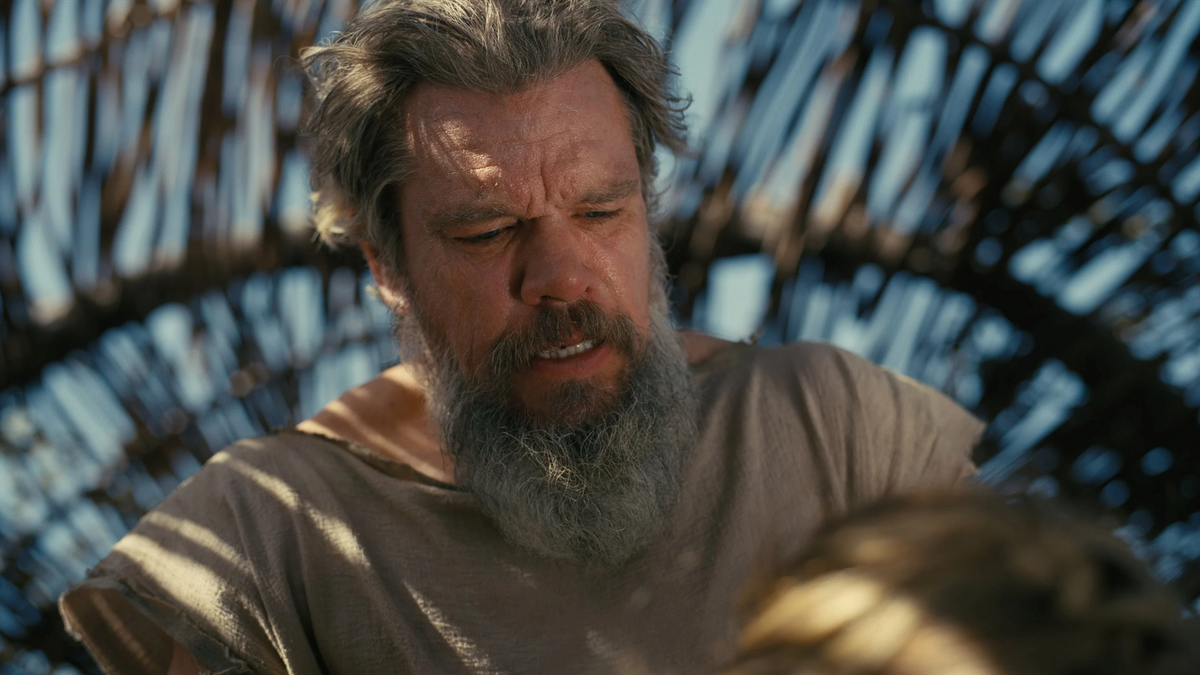
It does eventually settle down, spending long stretches of time following each thread that's born of the opening whirlwind, allowing us to lock in. His son Telemachus (Tom Holland) and wife Penelope (Anne Hathaway) have been fending off would-be suitors for three years, as Odysseus is assumed dead given his failure to return home from a war that ended a decade ago. Led by the snake-like Antinous (Robert Pattinson), they're abusing Zeus' Law, a Greek code of hospitality also known as xenia that is (in short) an extreme form of the Golden Rule, which prevents Odysseus' kin from kicking out these ne'er-do-wells. Meanwhile, through Odysseus' hazy recollections to the nymph Calypso (Charlize Theron) and the dream-like appearances of Athena (Zendaya), we learn of the difficulties he and his men faced on their journey home from the Trojan War, the most famous deception in history depicted in a sequence that is thrilling and beautiful and brutal. We see his repeated, casual hubris and petty acts of honor-blinded vengeance offend the gods and threaten the lives of his men. As their desperation increases and they experience ever greater hardships further frustrating their victorious return, they threaten to cast their lot behind Eurylochus (Himesh Patel) in an act of mutiny. Through it all, we feel Odysseus' heart begin to soften and sadden at the destruction he's wrought, etched into Damon's face, and deepened by his reckoning with decisions long since passed.
For it should come as no surprise that Nolan is once again tackling the story of a complicated man, celebrated as a hero by many but who was troubled by what he'd done, and went to great lengths to pay a self-imposed penance. While certainly textual in Homer's epic, Nolan emphasizes it throughout in ways as exaggerated as it is effective. It leads to the best scene of the entire film, a confrontation with the dead in his wake and his failures as a leader, in which he's accosted with perfectly performed poison by Elliot Page as Sinon. This is the power of films unafraid to put off audiences with an extravagant runtime: the characters are given ample space to gradually and palpably grow and shift, each alteration in their worldview feeling like it emerges naturally from their experiences rather than simply because the screenplay dictated it.
That said, the scale and the action and the scattered story make emotional connection hard. Although frequently accused of being a cold filmmaker, Nolan has always excelled at telling personal stories through the juxtaposition of varying perspectives on it, so to instead juggle disparate through lines doesn't pay off as well for him. Especially since the demands of such a scope means the action will inherently be impersonal. To counter, he opts to highlight the danger with many shaky close-ups during battle, trying to give the impression that Oscar winning cinematographer Hoyte van Hoytema is wielding a handheld camera, not one that costs half a million dollars. Instead of claustrophobic, it makes much of the action unclear and difficult to follow, especially during the many night scenes only lit by firelight. It makes for a cool aesthetic, but lessens the impact of the violence. That is, until the final chunk of the film, as Odysseus reflects on the meaning of the Trojan War; then, it makes the terror unleashed absolutely unmistakable.
That's a great microcosm of the entire experience. Don't get me wrong, the first two hours or so of the film are quite good, the atmosphere set wonderfully by yet another excellent Ludwig Göransson score, more ominous and oppressive and atonal than usual, and thus more interesting (although less memorable for its less obviously repeated melodic themes). When Nolan and van Hoytema are wielding the IMAX cameras to craft overwhelming compositions, no one can match their skill. And Nolan's screenplay keeps you on the edge of your seat, despite the ending and broad beats being clear from the beginning, even if you're too far from high school to recall them precisely. However, until the final stretch, the parallel tracks of the story struggle to cross-pollinate. We can see exactly how they'll intersect through repeated lines and imagery, but the delay in doing so gets more distracting as the plot wears on.
But when they do crash into each other, it's absolutely marvelous. The coldness that permeated much of the preceding movie melts away, through reunion and quiet recognition and white-hot anger. Conversations give us further glimpses into the nuances of their relationships, and peer into the corners of Odysseus' psyche, including one particular image whose brevity makes its flooring impact that much more powerful, a literalization of a mantra repeated throughout the film.
At which point, the answer to "Why now?" comes into sharp relief. Nolan shares a belief with fellow cinematic titan Stephen Spielberg, that human beings thrive on connection and compassion and community. But unlike the former's unbridled optimism, Nolan expresses a wistfulness, a self-awareness that while there are pockets of untainted good, the world is horribly broken, possibly beyond repair. While some are undeniably more responsible than others for our state, few are completely clean, even if only by virtue of neglecting to stand-up. He wants to believe there's a path for humanity to redeem itself, but that doesn't mean he knows what it is. It's hard not to see his outlook aligning him with Odysseus, a man yearning for all that is lost, but whose despair is far greater than his power. As such, all he can do is leave the younger generation in power, take his family, and sail into the unknown West.