Gail Daughtry and the Celebrity Sex Pass

The best way I can spin the fundamental flaw in Gail Daughtry and the Celebrity Sex Pass is to talk about a sweater. The titular Gail (Zoey Deutch) travels to LA with close friend and fellow hairdresser Otto (Miles Gutierrez-Riley), whose cardigan is emblazoned with the pattern from the Overlook Hotel. Why? No idea. It's never remarked upon, he's not a horror fan or a notable scaredy-cat, and neither the plot nor the locations have anything to do with The Shining or Stanley Kubrick or fraying masculinity. But it's such a loud pattern, out of step with the fashion of the rest of the town (even as it suits Otto quite well!), that it immediately catches your attention even if you can't place it. This inexplicable reference to another movie off the bat is a signpost inviting the "Leo pointing" reaction, but serves no other purpose. It's a great example of how distracting inelegant Easter eggs can be.
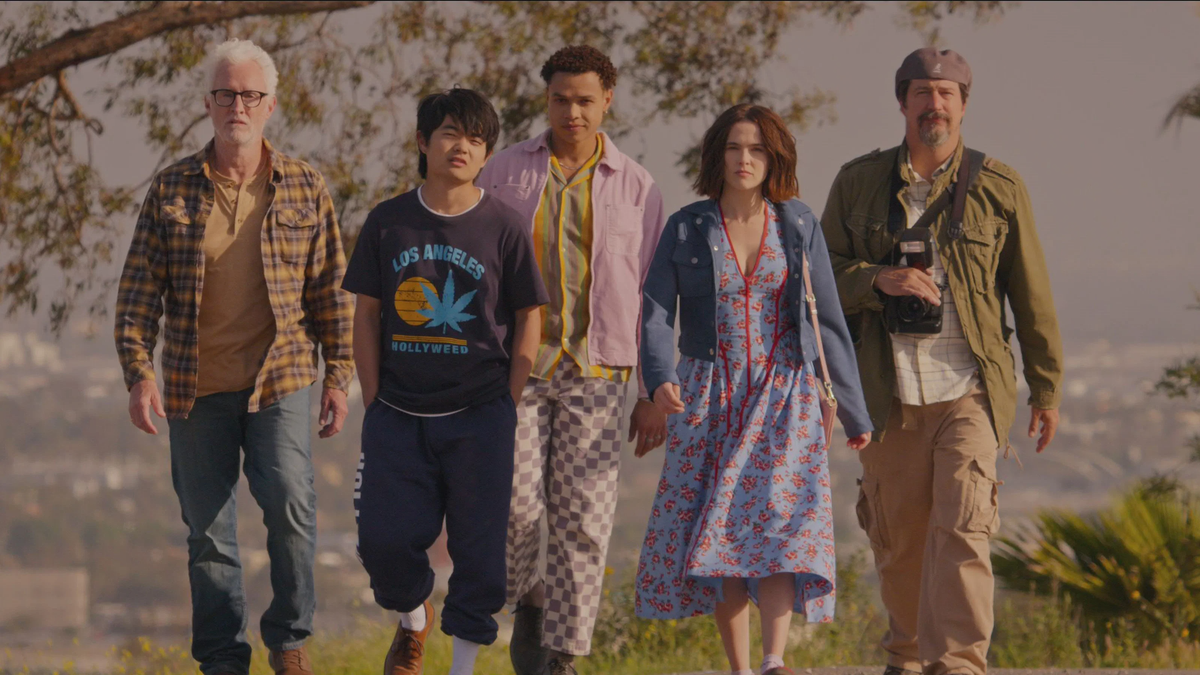
Which brings us to the plot, a poorly formed pastiche of naïve, "find yourself" romcoms. Almost immediately after learning of the concept of a celebrity sex pass (i.e. the one celebrity they're allowed to have sex with guilt-free), Gail finds her fiancé Tom (Michael Cassidy) deep in conference with Jennifer Anniston in the back of a book signing. Of course, Gail thought it was just a fun thought exercise, so Tom taking it to heart causes a rift in their relationship, less than two weeks from their wedding day. Fortunately, this frees her to join Otto, in an attempt to exercise her pick, Jon Hamm. As she tries to locate his house, she accrues a band of misfits, a couple of whom have business with Hamm: John Slattery (as himself) feels cast aside post-Mad Men, Vincent's (Ken Marino) career as a paparazzo was ruined when he couldn't get a photo of the man twenty years ago, and Caleb (Ben Wang)...worked for his talent agency before being fired for trying to get his address?
Which is also emblematic of how this movie fails to deliver on it's inherently amusing premise. While its framework of "assemble the team to go find The Guy" invites comparisons to The Wizard of Oz, the latter film never lets our focus drift from their main objective with unrelated side plots. They believe their pre-existing personal failings can be resolved in the same manner as the protagonist's, so the diversions feel on message, and their motivation is clear. But director/co-writer David Wain lands his characters in a strange middle ground, where it seems they decide to help Gail because the screenplay demands it. None of their motivation is at all convincing, especially when it's as convoluted and outdated as "taking a picture of Jon Hamm is my White Whale".
It doesn't help that most of those digressions aren't fun or interesting. The biggest exception is when they think they've found Hamm's mansion, only to instead come across a silent Penn Jillette and a furious, shotgun wielding Weird Al, neither of whom are moved by her plight and chase them off the property. But even its success is an example of its desperation; just a few months after Jillette wonderfully played a quietly scary farmer in Marty Supreme, why would you hire him to just sit on a golf cart? He's far from the only sweaty cameo, either. Richard Kind, Elizabeth Banks, Paul Rudd, and Fred Melamed as her mailman and the narrator of a bizarre framing device played as if he's having a mental breakdown. The only one that didn't elicit an eye-roll was their sighting of Henry Winkler at LAX, for although it was a sign of what was to come, at least it was the first. But it leads to a suitcase mix-up, which brings them into the crosshairs of Ludovica (Sabrina Impacciatore), a crime boss who wants to bring down global finance.
Yes, within this already overstuffed farce, we frequently cut to henchmen (Joe Lo Truglio and Mather Zickel) incompetently chasing Gail et al. around town, and I'm so tired. Why do we need yet another diversion? Even if its purpose is to poke fun at films that do so earnestly, the limp, lifeless execution of it lands as this movie's problem, not a reflection of others'. It does provide the excuse for a couple solid moments; I'll never think of minestrone soup the same way again. But you get the sense that Wain's strategy was to distract audiences from the screenplay's lack of characters or commentary or cohesion, placing hats on hats on hats. If he throws a bunch of stuff at the wall, some of it has to stick, right? His kitchen sink approach to satire works in Wet Hot American Summer because it's a largely formless collection of vignettes intercut with scenes from half-a-dozen very simple, character-driven stories. In contrast, Gail Daughtry has a single plotline under which everything else must fall, so any deviation from it must naturally follow from the characters. Failing that, you end up with a series of scenes unsatisfyingly strung together by "And then..."
It would have helped if the film went bigger with the comedy, but it feels like Wain's worried about alienating the audience if he does, so instead he just goes with head-scratchers. Most of them are so limp as to leave no lasting impression. The primary exception is Hamm's bouncer (Tobie Windham, in his feature film debut) asserting that if they don't back off, "I'm gonna make you sick", which he repeats so many times to increasingly humorous effect that it becomes a defining mantra, and comprises maybe half of his total dialog. Otherwise, the jokes that do go big shift into that gear out of nowhere, and so result in a cocked eyebrow rather than a chuckle, which is death for this kind of "zany" comedy.
I've greatly enjoyed Zoey Deutch's rise over the past year (see The Threesome for an underrated summer comedy with lots of heart), so I'm not entirely sure what happened here. Her performance is consistent, implying the fault lies more with Wain than with her choices. Her demeanor from start to finish is straight out of 1950s Americana. She's endlessly chipper, hopelessly naïve, and exhaustingly optimistic; you almost expect her to burst out into song at any moment. Its hard clash with the conceit is the point, but the result is her emotional separation from the world around her, and she experiences zero character growth, making the events of the story feel even more meaningless. The rest of the cast does a perfectly fine job, with Slattery being the slight standout, but no one is doing their best work.
The end is as apt as any, causing a weary "Sure, I guess" more than anything else, even as it finally lands a solid blow aimed at the grand presentation of the biggest romcoms. Granted, I'm not entirely sure why we should be rooting for that in the first place: the theatrical romcom is functionally dead, with the occasional exceptions only driving the point home harder. They don't exactly need to be taken down a peg. Although overblown satire does seem the be the primary form that theatrical comedies have taken in the past few years. And maybe has something to do with why they rarely make any noise, at the box office or culturally. A Seth Rogen movie went wide the very same day and surpassed Gail Daughtry's weekend take, despite taking place in a single location, featuring a smaller total cast than Gail Daughtry has main characters, and is infinitely funnier and more clever despite technically being a drama. Nothing could more clearly state that the issue with theatrical comedy is the audience's demand for quality, not their appetite.