Godzilla Minus Zero
After Godzilla set Japan back in their war recovery effort, another monster attack returns them to where they were?

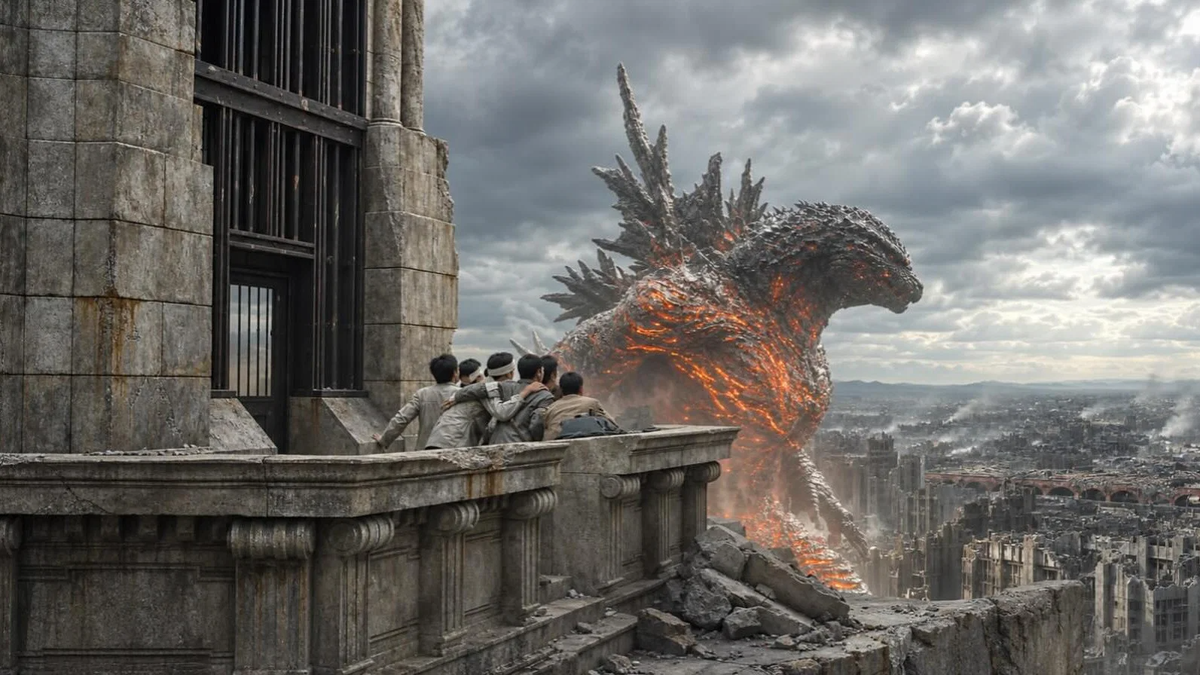
Three years ago, when I saw Godzilla Minus One1, I noted my lack of expertise on kaiju in general. That hasn't changed in the intervening years, and as writer/director Takashi Yamazaki's sequel to his own film begins, I began to wonder if that was a mistake.
Whereas the opening to that earlier film was a tense, dark, anxious build to the reveal of the titular monster, this one dumps you into the middle of chaos and destruction in progress. This time, though, it's Ghidorah, a huge, menacing, dragon-like creature, accompanied by a nerve-shredding motif of wailing violins, wrecking the kind of havoc that formed the fulcrum of Minus One. It's intense and powerful and impressive, and immediately implies only one place for the plot to go. It understandably takes a bit to get there, as only two years have passed since Godzilla terrorized their country, so no one is eager to figure out how they could "sic 'em" on Ghidorah without risking a repeat of the devastation. However, after an American-provided weapon (intentionally?) fails to have any effect, and a plan hatched by meteorologist Makoto Aoyama (Masami Nagasawa) gives him additional powers and a taste for lightning in a plot ripped from Shin Godzilla, they're left with one option.
While the looming threat is what drives the plot (and audience attendance), the human characters at the center of Minus One return, mostly for more archetypal, uninspired storytelling. Kōichi Shikishima (Ryunosuke Kamiki) is pressed back into service by a sense of duty and the insistence of others that only he can pull off the flying needed to evade Ghidorah, à la Maverick. Kenji Noda (Hidetaka Yoshioka) leads the defense against Ghidorah as the head of the Large-Scale Disaster Response Bureau, and lends his confidence to Aoyama, as she, too, has an incident in her past where backing down from her convictions led to the deaths of many. There are some other characters that pop up from the first one, but their roles are small and largely inconsequential.
The one potentially interesting zag is Noriko (Minami Hamabe). While everyone else who survived Godzilla's attack made a full recovery before scaly, spiny mutations appeared on their wound site and killed them, she's the only one whose body seems to have found harmony with the foreign cells. While the "special girl/boy" subplot is well-trodden, in context, there are a number of interesting directions this could push the story. The natural expectation is an exploration (or at least suggestion) of what makes her unique, which will then become important later. You could further embrace the fantastical nature of the story and witness how it changes her in ways good and bad. You could use it for some gnarly body horror. All of these ideas will flash through your mind during the aforementioned exposition dump, but none of them will bear out. While her new biology will become important to the finale, and even their weak approach has promise, the narrative effect would have been the same if she wasn't involved.
That's emblematic of all the story-telling in Minus Zero. While there aren't that many characters, the screenplay still fails to adequately juggle their journeys, defaulting to simplistic tropes paid off with little nuance, hoping to tap into your emotions without building to them. The few interesting beats it introduces are almost exclusively resolved in a few (non-consecutive) scenes, with limited consequences in between. Most frustratingly, it depicts in arresting, alarming, visceral fashion scientist Kanji Murakami's (Min Tanaka) desire for revenge against the Americans for Hiroshima, easily the most upsetting and effective scene of the film...only to drop the ball on developing it. Likewise, America's involvement in combating Ghidorah is superficial at best, and their goals differ from the Japanese, but it never really matters. While the point that America cannot be trusted is clear, given their abstenstion from the events of Minus One, we already knew that.
It doesn't help that eighty percent of the dialog is delivered in an exaggerated, spittle spraying shout, everyone's emotions at an eleven from start to finish, with no room for humor or charisma or a facial expressions without a furrowed brow. Tensions are apt to run high, of course, but when people are screaming at each other over things as dumb as Kōichi's initial intent to train new pilots instead of flying himself, it lands as poorly conceived melodrama. This miscalculated performance afflicts everyone who appears on screen, named and unnamed characters alike, indicating a directorial choice that plainly doesn't work, rather than a failure of the actors. This is what Yamazaki wanted, but instead of highlighting the tension, or contrasting effectively with the ten percent of the time dialog is uttered quietly with an intense and grave focus, it constantly undermines it.
Despite the confusing amount of focus the movie heaps on the plot, what we really care about are the monsters, and they're all well-realized. Every scene with Ghidorah is visceral and cool, with nary a sign of weakness until the inevitable happens. The power he gains as King Ghidorah amplifies that tenfold, while providing some cool and terrifying visuals to go along with it. Godzilla doesn't show up until the halfway point, and while their previous "defeat" of him implies they could do it again if needed, he's no less scary and imposing from the moment he appears.
As with Godzilla Minus One, the VFX are impressive for such a tiny team, and far better than recent South Korean monster movie Hope, or even my beloved Shin Godzilla. The monsters look pretty good most of the time, and you often feel like they're right there amongst the landscape. But effort doesn't equal quality. Most glaring is the frequently shoddy compositing of the human characters and practical sets into this digital landscape, laying bare how few of the backdrops are at all real. The switch to digital doubles when someone is hurled or eaten are unmistakable due to their rubbery movements. Godzilla's energy beam and Ghidorah's tractor beam do look awesome, and pop off the screen, especially in the epic final fight. But that's only because the rest of the image is so dominated by various shades of gray: buildings reduced to rubble, an overcast sky through many of the events, the two monsters themselves, even the clothing of all the people. It threatened to steal the title of "2026's Grayest Movie" from Evil Dead Burn. So sure, the lighting strikes that cause Ghidorah to evolve into the more traditional, hydra-esque King Ghidorah jump out, but it would have been more surprising if they didn't.
The primary element deserving of unreserved praise is the score from Naoki Sato (who also scored the first one). It's not without flaw: the incredibly conspicuous Close Encounters of the Third Kind homage came out of nowhere, and doesn't connect to the rest of what the movie is doing. But apart from that, and having already gotten over my reticence at Minus One using the classic Godzilla theme, the orchestral power and soft drama brought to bare through sweeping compositions are worthy of the most indelible, classic blockbusters.
That's the sandbox in which it wishes to play, but it's at war with itself. As a spectacle, the film's ambition is as towering and excessive as the King of the Monsters himself. It even sparked the kind of annoying online conversations usually reserved for Christopher Nolan movies; for the record, no, it's not "too loud" (whatever that means), but it is a suitably overwhelming sonic experience in IMAX. But all is dragged down and dragged out by weightless and unnecessary interpersonal drama, whose every resolution is telegraphed by its very existence. If Yamazaki had focused on the cinematic thrill ride, this could have been an enjoyable time at the movies. Instead, we get a collection of bland story beats keeping us from moments of awesome.
I'm deliberately omitting the review link as my writing style has changed a lot in the years since. That whole first year of "reviews" I now find to center me far too much, at the expense of the films and the context surrounding them. ↩